|
Gimpel Fils: Sista Pratesi | Jankel Adler - 19 Jan 2012 to 2 Mar 2012 Current Exhibition |
||||
|
Sista Pratesi - The Living End
19 January - 2 March 2012 Gimpel Fils |
|||
|
||||
|
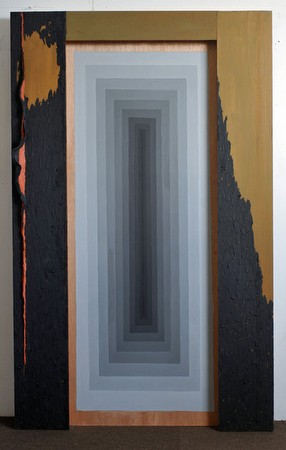
Sista Pratesi The Living End 19 January - 2 March 2012 Private View: Thursday 19 January, 6-8 pm We enter into a space with islands of carpet, clusters of objects, and paintings hanging on the wall. Elements can be picked out, traces of carving, lengths of flowing hair, and figures merging into, or coming out of, abstract spaces. It is not apparent whether this site is an archaeological find of a once powerful empire, or the beginnings of a new world. We are looking at the expression of a state of mind, in which the emotional has become physical. Offered a world of ambiguity and superstitions, somehow out of time, it is unclear whether these are ghosts of the past, or totems for the unknown future. In her new body of work Pratesi builds upon the themes of psychological transformation and transition found in her earlier paintings. Here totemic sculptures are recognized as having symbolic power, but their relationship with the world and their use, remains unknown. Objects are improvised and provisional, held in place by drawing pins, responsive to emotional intuition, connections with the subconscious, and mapping changed states of mind. Their making is not hidden, thereby creating a sense of possibility and growth. In The Living End pasts and futures are offered simultaneously while knowledge and truth remain elusive. This is Sista Pratesi’s third solo show at Gimpel Fils. She graduated from the Slade School of Art in 1994 and was awarded the Abbey Rome Fellowship in 2002. In 2007 she was included in the group show Mirror Mirror, at the Jerwood Space, London and was selected for the John Moores 25 Contemporary Painting Prize, held at the Walker Art Gallery, Liverpool, in 2009. She lives and works in London. Jankel Adler 19 January - 2 March 2012 Private View: Thursday 19 January, 6-8 pm To express anxiety, physical and spiritual anguish in the most solid and stable construction; to bring life into abstraction – an abstraction infused with eloquence, with the convincing strength of tangible reality, of things seen; to give a plastic conclusion and generously, mainly pictural, to the seekings of a generation torn between new objectivity and the most intense and voluntary subjectivity: herein lies the main success of Jankel Adler, herein his claim to our respect and gratitude. Paul Fierens, 1948 Jankel Adler (1895-1949) was one of the most respected Jewish artists of his generation. Born in Poland, he studied and painted for many years in Dusseldorf, where he also taught at the Modern Academy. In 1918 he was one of the founders of the Ing Idisz (Young Yiddish) group, an association of painters and writers in £ódŸ dedicated to the expression of their Jewish identity. The influence of Jewish calligraphy can be found in many of his early works, which also incorporate formal, stylistic and technical elements derived from avant-garde practices, including German Expressionism, Picasso and Cubism, and Constructivism. Despite, or perhaps more accurately, because of his success, Adler was forced to leave Germany in 1933. His paintings were removed from German museums and he appeared on the lists of ‘degenerate art’. At the outbreak of war he volunteered for the Polish Army, and with them arrived in Scotland after the collapse of France. He was demobbed in 1941 and was free to return to painting. Much of his work from the 1940s makes explicit reference to the war, such as The Mutilated, 1942, now in the Tate Collection. He settled in London in 1943, taking an active role in the circle of European refugee artists in the city. Adler had his first exhibition at Gimpel Fils in March 1947, displaying works inspired by the writings of Franz Kafka. Gimpel Fils had opened in November the previous year and Adler’s display was the third exhibition in the gallery’s history. A second solo show followed in 1948, which included a selection of oil paintings, gouaches and drawings. The extract by Paul Fierens, then curator of the Museum of Modern Art Bruxelles, reproduced here, was included in Adler’s 1948 exhibition catalogue. Throughout his career, Adler explored the tension between abstraction and naturalism. The works in this exhibition demonstrate the breadth of his investigations; figurative ink drawings from 1940 and 1941 display emotions, subtly caught in sketchy lines, while paintings from 1947 depict ambiguous, abstract symbols. What was consistent in Adler’s practice however, was a dedication to capturing the dignity of the human spirit. |
||||
|
||||
re-title.com
International contemporary art
SIGN UP FOR NEWSLETTERS

 SIGN UP for ARTIST MEMBERSHIP
SIGN UP for GALLERY MEMBERSHIP
SIGN UP for ARTIST MEMBERSHIP
SIGN UP for GALLERY MEMBERSHIP
Click on the map to search the directory