|
Georg Kargl Fine Arts: CLEGG & GUTTMANN | Harald KLINGELH�LLER - 13 Nov 2009 to 9 Jan 2010 Current Exhibition |
||||
|
CLEGG & GUTTMANN
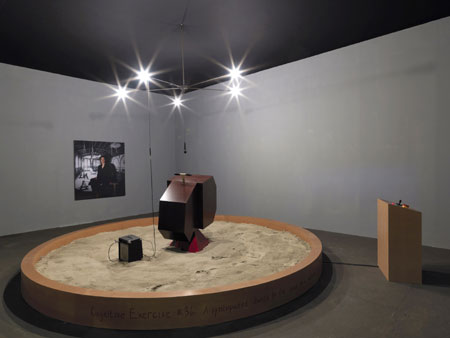
Cognitive Exercise Nr. 1 / Mechanical Bull, 2009 mixed media, dimensions variable, Courtesy Georg Kargl Fine Arts, Vienna |
|||
|
||||
|
||||
|
CLEGG & GUTTMANN Georg Kargl Fine Arts HARALD KLINGELH�LLER Georg Kargl BOX Exhibition dates: November 13, 2009 � January 9, 2010 CLEGG & GUTTMANN Georg Kargl Fine Arts Exhibition dates: November 13, 2009 � January 9, 2010 Variants of Aesthetic Collect ivism (i) In the aesthetic domain, individualism and collectivism stand for competing theories of artistic reception. The former view emphasizes the primacy of the experience of the single viewers, confronted with a work of art, whereas the latter, the manner in which they are constituted by it as parts of an aesthetic collective. For the aesthetic collectivist, you always experience art together with others; for the individualist, the art viewer is essentially alone. Individualism is, of course, the more common sense view; all experience resides, after all, in the heads of single human beings. Collectivism points to the fact that an important aspect of the issue is ignored - that the sense of togetherness generated by common aesthetic experience is not an incidental phenomenon but part and parcel of the aims of all art, whether one experiences it in a concert hall, a cinema or a museum. Genuine art, as Kant reminded us, is not concerned with mere subjective gratification; art must always appeal to the viewer�s sensus communis and the development of sensus communis requires the experience of art. (ii) The present exhibition of Clegg & Guttmann is conceived of as an essay on various concrete forms of aesthetic collectivism found in their recent works of art. i. In �What can be expressed and what is always left out from the description� the issue of aesthetic collectivism appears in a most transparent way. When the individual viewers contribute intellectual labor, drawing the different parts of the tree as it appears to them at various points of time, they are thereby engaged in a communal aesthetic project. ii. �Constraint drawing� is also clearly centered on the topic of multi participant action albeit in a somewhat different way. One could even say that the artwork is, essentially, a devise for collective creativity. Because the movements of the �model� and the three �draftsmen� who are included in the piece are mutually constrained and the drawings that result represent the sum total of the actions of a genuine aesthetic collective. iii. �Our production/ the production of others� is relevant to the present concerns because it is the terminal point of a sequence of events involving the photographers (Clegg & Guttmann) and their subjects (Melos Quartet). Clegg & Guttmann were asked to photograph the musicians. The photograph was used for a record cover of the late Beethoven string quartets. Finally Clegg & Guttmann �re-appropriated� the record cover image, re-photographing it and presenting it as their own work. iv. �Cardinal Red� was made as a collaboration of Clegg & Guttmann and Franz Erhardt Walther � a work of art authored by, both, the photographers and their subjects. In so far as we see Franz Erhardt Walther demonstrating how to use the different parts of one of his works for a performance of sorts, the photograph is inherently concerned with his ideas. On the other hand, the work is also a portrait that employs various art historical conventions; in that regard, it is thoroughly consistent with the concerns of Clegg & Guttmann�s works. v. �Rus in Urbis� is an installation, which explicitly requires a collective aesthetic reception; the viewers are requested to syncopate with their dance movements to the beat generated by a mechanical bull. vi. Finally, �The open Tool-Shelter of Toronto� shows how the work of art can expands its influence beyond aesthetic concerns. Being a mechanism for recycling and sharing various work tools, the work aims to generate in its social surrounding an enhanced sense of a community. To sum up, none of the works included in the show realizes an idea, which appeared, first, in the mind of a single creator. Most required a collaboration of a number of distinct individuals. All are open works, which must be completed by the viewers. Each in its own manner articulates a way in which the work of art casts the single viewer as a part of an aesthetically-generated collective which it helps create and sustain. HARALD KLINGELH�LLER Georg Kargl BOX Ausstellungsdauer: 13. November 2009 � 9. Januar 2010 Seit Mitte der 80er Jahre stellt Harald Klingelh�ller (1954) die Verbindung von Skulptur und Sprache in den Mittelpunkt seines Werks. Die oftmals metaphorisch �poetaster sprachlichen Konstruktionen, die seiner bildhauerischen Arbeit vorausgehen, sind mehr als nur Titel der jeweiligen Werke und verschr�nken sich mit formal sehr verschiedenartig gestalteten Skulpturen. Der grunds�tzlichen Offenheit linguistischer Systeme entsprechend, begreift Klingelh�ller seine Skulpturen nicht als endg�ltige Setzungen, sondern als jeweils gleichrangige Versionen der Zusammenf�hrung von sprachlichem Ausdruck und skulpturaler Form. Den Skulpturen gehen keine vorbereitenden Zeichnungen oder Entw�rfe voran, die Formen werden Schritt f�r Schritt am Objekt entwickelt. Ziel des K�nstlers ist es, ein UNS, einen prinzipiell unabgeschlossenen Resonanzraum zwischen Skulptur, umgebenden architektonischen Rahmen und Betrachter zu schaffen, in dem sich die Bedeutungen seiner Werke best�ndig ver�ndern und neu verhandelt werden. Nach einer Gruppenausstellung im Jahr 2003 in Georg Kargl Fine Arts mit Franz Ackermann, Meuser und Andreas Slominski werden in der Georg Kargl BOX die neuen Arbeiten von Harald Klingelh�ller pr�sentiert. Seit 2005 entstehen die so genannten Schrankversionen, bei denen die Determinierung der formalen Gestalt durch die zugeordnete Sprachform erstmals vollkommen nachvollziehbar wird. Die Abmessungen und Anordnung der einzelnen Schubladen der Schr�nke beziehen sich auf die L�nge der einzelnen Worte, die der Arbeit ihren Titel geben. Das Verh�ltnis zwischen Wort und Visualisierung ist exakt und doch komplett abstrakt. Wenngleich Klingelh�llers Texte einen Bezugsrahmen f�r die Interpretation seiner Skulpturen vorzugeben scheinen, befindet sich Sprache und Objekt nie in einem Kongruenzverh�ltnis. Vielmehr reflektiert Klingelh�ller in seinen Arbeiten �ber das br�chige und unvorhersehbare Verh�ltnis von geschrieben und gesprochenen Wort und seiner Beziehung zu einer parallel existierenden Objektwelt. In der Kombination er�ffnet sich ein assoziativer und interpretativer Handlungsspielraum, der auf die Autonomie eines Werkes verweist, ohne sich zugleich dem Diskurs um seine m�gliche Bedeutung zu verschlie�en zu m�ssen. |
||||
re-title.com
International contemporary art
SIGN UP FOR NEWSLETTERS

 SIGN UP for ARTIST MEMBERSHIP
SIGN UP for GALLERY MEMBERSHIP
SIGN UP for ARTIST MEMBERSHIP
SIGN UP for GALLERY MEMBERSHIP
Click on the map to search the directory