|
Georg Kargl Fine Arts: Max Peintner - Caspar und ich | Bj�rn K�mmerer - 16 Sept 2009 to 7 Nov 2009 Current Exhibition |
||||
|
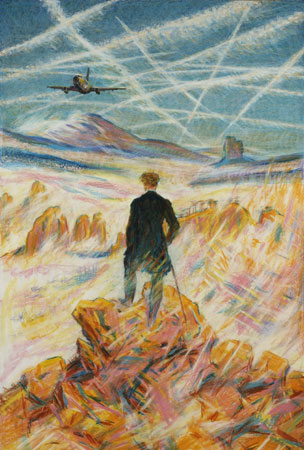
Max PEINTNER, Eine kleine Ewigkeit, 2003
oil stick on paper, 125,2 x 87 cm Photo: Lisa Rastl. Courtesy Georg Kargl Fine Arts, Vienna |
|||
|
||||
|
||||
|
Peintner @ Georg Kargl Fine Arts | K�mmerer @ Georg Kargl BOX Max Peintner - Caspar und ich 16/09/2009-07/11/2009 Bj�rn K�mmerer 16/09/2009-07/11/2009 MAX PEINTNER Georg Kargl Fine Arts Exhibition dates: September 16 � November 7, 2009 Caspar und ich, das sind viele Trained architect Max Peintner (1937) became well known in the early 1970s with his sarcastic drawings critical of modern life. In their bitter acerbic wit, his visions of technology, ski lifts, or highways are still today considered icons of the Austrian environmentalist movement. In the mid-1970s, an eye illness drove the artist to engage with the process of vision itself. Peintner drew things that everyone is familiar with, but usually does not find worthy of mention, for example, afterimages that remain after we accidentally look into a bright light. �For him, drawn self-perception is an appropriate means of expression for representing the perceived environment as it emerges in our minds. His work is about trying to show analytically the feeling and sensations of the ego in the form of a depictive function of that ego� (Peter Weibel). Max Peintner showed his first perception images in 1977 at Documenta 6, and represented Austria at the Venice Biennale in 1986. In 2000, Neue Galerie Graz dedicated a comprehensive retrospective to his work, and this was also the artist�s last solo exhibition. In eight years of untiring research, Peintner has explored the perspective, subjects, and fissures in the work of Caspar David Friedrich and created a presentation for the space of Georg Kargl Fine Arts that sketches the path taken by the artist from initial sketches to final drawings in oil stick. Peintner�s interest in Friedrich developed from his experiments with perception. �I noticed that the flicker in twilight reflects the gradation of neurons firing at the center of vision, and thus allow a concrete scaffolding to become visible which makes it possible to capture the space. In Friedrich�s art, in a sense hidden by the use of air perspective, there is often such an inner structure of space, his geometry is sometimes reduced to mere horizon, the vanishing point, if there is one, is marked by fanned out sunbeams as if by an exclamation point.� According to the Tyrolean artist, landscapes are to be interpreted as dream-like visions and allow us to deduce something of the essence of the dreamer, and in these terms explains his fascination with one of the most important landscape painters of romanticism. Peintner takes on Friedrich�s depictions of nature, often animated by a metaphysical transcendent character: he occupies himself intensely with their subject-matter and materiality, and in so doing provokes in his combination of various allusions to art history. With a challenging �Porno is out, religion is in,� the artist refers to the religious components in Friedrich�s works, without sacrificing a subtle irony. According to Friedrich�s point of view, the experience of nature is a very personal mystical-religious event, for him faith is a steadfast, massive rock, the spiritual foundation of man. The beholder finds people in Friedrich�s images usually resting in themselves, impressed by the natural spectacle and dressed in formal clothing standing before a rock. In Caspar David Friedrich, rear portraits are central, often of the artist himself. Since the 1980s, Max Peintner has repeatedly returned to the self-portrait as one of his key motifs, and always combines it with phenomena of perception and making perception visible. Max Peintner finds himself instrumentalizing the figure of this passive beholder for his own ends. The wanderer becomes a means for transporting his own experiences and naturally points to the destruction of nature and the environment by way of the consequences of technological progress such as aeroplanes and their condensation trails. Peintner shows us the world dependent and centered around the beholder. He emphasizes that self-observation is only a reflection of beholding. In his absurd natural compositions with perceptive images, he demonstrates how we really see reality, that is, with the eye of a beholder that has subjective defects and is an internal observer of the world. BJ�RN K�MMERER Georg Kargl BOX Exhibition dates: September 16 � November 7, 2009 A dark wall of boards fills the gallery space of Georg Kargl BOX. The object, which looks like a cabin, is placed on metal tracks and rotates on its own axis driven by an electric motor. The cumbersome sculpture fills the space, and makes it impossible to enter the white cube, creating a space within the space, but only allowing a view from the outside through the gallery window. Vision has to compensate for what is lacking in terms of physical-haptic experience in the viewing space. In so doing, the gallery space changes into a stage situation and the street in front of the gallery changes into a spectator space. This spatial separation from the object and the beholder alludes to the screening situation in the cinema, which assigns the viewing gaze a fixed location. Besides its materiality (construction wood), an antithesis to the white cube and the aesthetic of the fa�ade of the gallery designed by Richard Artschwager, the object fascinates in its play of gaze constellations. The rotating wooden body generates a visuality that is produced by the apparatus, and is a visual prosthesis like those nineteenth century optical devices, such as the mutoscope or the kinetoscope, that experiment with the laxness of vision. The young media artist Bj�rn K�mmerer, whose oeuvre already encompasses a range of noteable found-footage works and video installations, designed this spatial installation. It engages with the relationship between architectural and cinematographic space as most of his more recent film works and video installations. The wood object at Georg Kargl BOX played the main role in K�mmerer�s current film gyre (2009), a 35 mm sequence, that shot the rotating object in various camera and light settings. On the film set and in the gallery redesigned as a theatrical space, the different dimensions of the wooden walls play with the visual format of the moving images. For example, the second largest wall is built in dimensions of 1:1.66, and can be seen as an ironic commentary on the relations in the wide-screen format. The exhibition space in a certain sense ennobles the craft of film, showing insights into the visual practices of the cinema. They present in a single image both the mechanics of the apparatus (projector) as well as the level of filmic representation (projection). Walls and window openings create different framings and generate a permanently changing film in film. The apparently unimposing wooden construction thus represents nothing less than a way of thinking about the cinema. It could be understood as a kind of built reflection on the filmic representation of the moving image. In so doing, architectural and filmic space serve as two media equal in terms of visual experience. The only fixed indications are quotations and references like the built commentaries on projection sizes. Borrowing from Gordon Matta-Clark, the wood construction includes cut-outs, here window openings in a relation of 4:3 that cut the spatial texture and open up the inside of the structure. The window is a familiar metaphor for the cinema itself and offers in the context of this exhibition the possibility of a further decoding, that is, as a shop window in urban space. Since its early days, the cinema has been closely linked to the commercial staging of commodities and to other entertainment forms like the circus, the variety show, or the fair. In Bj�rn K�mmerer�s spatial installation, this metaphor of the window, that is, the viewing of an image in a frame converges with the exhibition of a desired object, and thus plays with pleasurable and illusory projection in cinema experience (for example, cinema as a virtual space). What we can see is a door that cannot be opened towards the outside. This frustrates the expectation of the beholder. The �missing� entry on the outside of the cabin clarifies the break with everyday perception. This results in this case not in a homogenous visual space. Associated with the film genre of the uncanny, which since the early narrative cinema has operated with the limit between the outside and the inside, the impression emerges of a paranoid film space that with constant reference to the continuous practice of visual spatial construction refuses an overall view (and visual control). An especially striking aspect of the works of Bj�rn K�mmerer is the way they allow film and architecture to enter into dialog with one another. The exhibited installation and the film gyre intersect with one another for they open up new possibilities for thinking about media space in the realm of architecture, cinema, and film. Prof. Dr. Ram�n Reichert Institute Theatre, Film and Media Studies University of Vienna |
||||
re-title.com
International contemporary art
SIGN UP FOR NEWSLETTERS

 SIGN UP for ARTIST MEMBERSHIP
SIGN UP for GALLERY MEMBERSHIP
SIGN UP for ARTIST MEMBERSHIP
SIGN UP for GALLERY MEMBERSHIP
Click on the map to search the directory