|
Georg Kargl Fine Arts: FEEDBACKSTAGE | MARIJKE VAN WARMERDAM - 16 Jan 2009 to 7 Mar 2009 Current Exhibition |
||||
|
Photo: Albert Mayr
|
|||
|
||||
|
|
||||
|
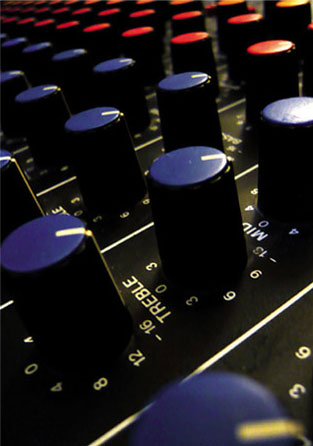
Georg Kargl Fine Arts FEEDBACKSTAGE 16/01/2009-07/03/2009 Georg Kargl Box MARIJKE VAN WARMERDAM 16/01/2009-07/03/2009 FEEDBACKSTAGE Cory Arcangel, Janet Cardiff/George Bures Miller, William Engelen, Michael Gumhold, Jon Kessler, Idris Khan, Bernhard Leitner, Christian Marclay, Albert Mayr, Stephen Prina, Gerwald Rockenschaub, Erwin Thorn, Peter Weibel Curated by Fiona Liewehr Georg Kargl Fine Arts January 16�March 7, 2009 �Everything is music.� �John Cage The exhibition FEEDBACKSTAGE represents an attempt to explore the abolition of the border between the closed and the incomplete. It seeks to be a refusal of the total determination of a real work, defined by temporal and spatial lines, and its sensually limited reception, and represents the desire to develop a discourse without precise limits. In various media such as installation, photography, video, and drawing, the artists shown here engage with music and its various �instruments,� like the measurement of time, improvisation and interpretation, performance or notation of history and memory. Curating an exhibition on the subject of music and fine art represents a challenge in several ways. Against the backdrop of the avant-garde currents of the early twentieth century, with its discourse in manifestos and theoretical writings on the dissolution of the genre boundaries between music, theater, film, and the fine arts, there is the danger of becoming formalistic or dogmatic, of succumbing to a renewed establishment of hierarchic relations between the discursive and the visual. During the latter half of the twentieth century, John Cage became the key mediating figure between the fine arts and music, after shattering the term �music� and opened it to neighboring disciplines. His principle of �calculated chance� and the call to �do it yourself� pursued in the Fluxus movement led to an expansion and almost insoluble mixing of realms. Bernhard Leitner, originally from the realm of architecture, understands sounds as a construction material, exploring in his experiments the impact of sound architecture on the body of the spectator. He draws new borders in our structure of perception, by organizing the space into zones where certain tones are heard and felt and in zones that are found beyond what is heard. Performative and actionistic structures of the Fluxus and Happening movement, which extended to the destruction of music instruments with enormous physical exertion on the part of the artists, were omnipresent, both on the rock stage and in the exhibition space. But how far can the �anything goes� strategies directed at the destruction and deconstruction of the representational culture and the establishment of classical music lead before they become arbitrary? The works of artist and experimental musician Christian Marclay are forceful studies on various kinds of sound. In the works on view in this exhibition, the artist focuses his attention not on its audible qualities, but on the way in which sound is visualized and translated to other forms. In his installation, compiled of computer hardware components and electronic junk, young artist Albert Mayr plays on the performative staging of music as known from punk and rock concerts. The setting is reminiscent of a stage that has just been left, on which the still resonant sounds awaken the energetic affects that are remembered after a concert. The works of the American artists Janet Cardiff/George Bures Miller and Cory Arcangel play with the scandalous performance of �The Star Spangled Banner� at the legendary Woodstock festival in 1969. Jimi Hendrix played the American national anthem with the distorted and howling sounds on the electric guitar. It was said that he was imitating the sounds of falling and exploding bombs to protest the Vietnam War. In Janet Cardiff and George Bures Miller�s work, the exhibition visitor can become a virtual guitarist. We unexpectedly hear the protest song at full volume as soon as a visitor steps on the pedal of the amplifier. Quite in contrast, Cory Arcangel removes the element of protest by applying the autotune function of the Apple music program GarageBand to the song, and, as it were, leveling the sounds. The visual �found footage� material, in contrast, remains unchanged. The visual memory distracts us from the acoustical changes. By linking visual and acoustic performance, the memory of the legendary performance remains unaltered. The artists gathered in this exhibition all come from a generation that grew up with the self evidence of an expanded art concept and the accompanying softening of the borders between existing genres due to the avant-garde currents of the past century. These strategies, leading to the limits of the dissolution and destruction, have also provided a chance for the freedom to explore new dimensions and to accept the playing rules and imitations of genres to use them to open various perspectives. �The relationship between the work that has to do with the eyes and the work that has to do with the ears is naturally not the same because the eye isn�t an ear. And the eye for instance, is used to looking at the world and so sees the horizon and is concerned largely with horizontals. Whereas the ear is interested in time and the succession of events, and so is interested in the vertical� (John Cage). Text: Fiona Liewehr Translation: Brian Currid, www.zweisprachkunst.de Press Contact: Hours Katharina Ebner Tues.-Fri. 11am�7pm [email protected] Thurs. 11am�8pm T +43 1 585 41 99 Sat. 11am�3pm MARIJKE VAN WARMERDAM THE FLOWER SHOW Georg Kargl BOX Exhibition dates: 16.01.- 07.03.2009 Marijke van Warmerdam is internationally renowned for her short films. In the early nineties she made her first non-narrative film loops, which led Daniel Birnbaum to call her the Loop Guru of the eternally flowing present. Together with her photographs and sculptures these form a consistent body of work. With a typically light touch, the work combines a deceptively na�ve approach to the act of seeing with straightforward strategies such as dramatic shifts of scale and rhythm, doubling and reflection to urge us to look with our eyes wide open in order to stress that not everything is what it seems. Nowadays she has developed this retinal openness to themes which deal more explicitly with perception. Marijke van Warmerdam�s exhibition �The Flower Show� includes a film loop called �Trembling�, 2008, which is surrounded by a number of painted film stills. �Trembling� shows nothing but a trembling bunch of white petunias, with a road surface rushing by in the background. The film stills are printed on linen and have white flowers painted on them by the artist in a vigorous and rapid manner. By means of fast Tai-Chi-like movements she has obtained a striking separation between foreground and background. Her apt painterly gesture brings about a doubling that occurs in all sorts of ways in her work. What is special is that in both the �Trembling� film loop and in the paintings, called �Flower� and �Flowers�, white flowers hover in the foreground, while a quieter background image produces a counter-movement. A disturbance of the rhythm or the movement effects a splendid contrast of �here� and �there� in the work. Van Warmerdam uses the themes of repetition and movement above all as a means of evoking a feeling of lightness and an uninhibited future. These are always in the service of an infectious optimism. At the same time her feel-good art broaches the difference between pure �looking� and the more cerebral �seeing�, inviting the viewer to think about what and how he perceives. Born in Holland in 1959, she has lived and worked in New York and Berlin, and is now based in Amsterdam. Her work has featured in numerous important international exhibitions, including the Sydney, Berlin, Kwangju and Venice Biennials, and Documenta X. She has had retrospective exhibitions at the Van Abbemuseum in Eindhoven, Migros Museum in Zurich, ICA in Boston, Muhka in Antwerp, MAC in Marseille, The Fruitmarket in Edinburgh and IKON in Birmingham. |
||||
re-title.com
International contemporary art
SIGN UP FOR NEWSLETTERS

 SIGN UP for ARTIST MEMBERSHIP
SIGN UP for GALLERY MEMBERSHIP
SIGN UP for ARTIST MEMBERSHIP
SIGN UP for GALLERY MEMBERSHIP
Click on the map to search the directory