|
Georg Kargl Fine Arts: Martin Dammann: Blind Spot - 29 June 2012 to 8 Sept 2012 Current Exhibition |
||||
|
|
|||
|
||||
|
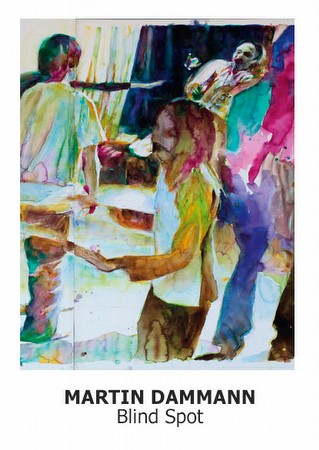
Martin Dammann Blind Spot 29/06/2012 - 08/09/2012 In psychology, the term blind spot is used to refer to those realms of memory that are repressed so that we are no longer aware of them. By way of this mechanism, actions and experiences are eliminated from our consciousness for various reasons. The works in this exhibition by Martin Dammann also deal with the past and our memory. Familiar from earlier presentations of the artist’s work, watercolors based on archival photographs of wartime situations are now opposed to paintings based on personal photographs from his private life. Exploring public and private memory, Martin Dammann stages a dramaturgy of archival and current photographs, his painterly execution of these photographs in watercolors, and a video work. This combination enables a direct comparison of what was then and what is now through analogies between what is depicted and the composition. Martin Dammann’s fascination with the past is expressed in the exploration of how the irrevocable events of the two world wars continue to have an impact on current value systems in our society. By translating these old photographs to painting, he creates a link between the past and today. By adding private, current photographic material, the artist contrasts our images of the past with those that we create of ourselves. This seems entirely convincing, especially considering that an exploration of the impact of the two world wars on today’s society leads to a study of the influence of the family structure on the individual. By transforming his motifs to large format paintings, Martin Dammann focuses on emotions that he discovers in a photograph and applies them with intense hues in his watercolors. In general, the objects in the images are alienated by the choice of the watercolor technique, and only certain components of the image become recognizable. The blurred character of the watercolors can allow for less clarity, both in the process of painting and in their interpretation. Sometimes he leaves out faces or entire bodies that either remain white or are transformed into unicolor surfaces. It seems almost as if his paintings emblematize the human, fragmented form of memory. Elements of what we experience do not even reach our memory, while others can only be summoned as blurry images, and some things remain very precise and clear. In its entirety, it is as incidental as the process that takes place when painting with watercolors on paper. Frequent subjects in Dammann’s work consist of a manifold constellation of group structures. The focus of the current exhibition at Georg Kargl Fine Arts lies on a very intimate structure: the family. By way of the video work in the last room of the exhibition, which is very private in character, an engagement with a global, collective past begins to mix with an interest in a very personal past. We see the artist’s father, who responds to a question about the family’s past with a mere laugh, unable to call anything specific to mind: a blind spot in memory. Text: Marie Duhnkrack Translation: Brian Currid, zweisprachkunst.de BOX: Raymond Pettibon Some early works 29/06/2012 - 08/09/2012 Since the later 1970s, the American artist Raymond Pettibon has been making drawings that achieve a bilingualism of text and image. The relationship between text and image is not clarified in these works, but dissolved. This exhibition at Georg Kargl BOX presents a selection of drawings created between 1980 and 1990. Born in Tucson in 1957, Pettibon grew up in the Los Angeles area and got a degree in economics at UCLA. During his student years he drew political cartoons for the college newspaper. At the beginning of his artistic career, he designed flyers, record covers, and posters, some of which were collected in fanzines. His medium has always been the drawing. This placed him initially on the margins of the art world, for drawing was then still conceived as an auxiliary medium to painting rather than a medium of its own accord. The works now on view at Georg Kargl BOX are from an early period of the artist’s career, when he still worked primarily in black ink; with their contrasts of light and dark, these works reflect the strong influence of the world of film noir. For the texts in his works, he draws on a non-linear repertoire of fiction and scholarly work. “These particles of meaning from a larger context thus get caught in the orbit of his thought, and surface, more or less varied, in the ribbons of that surround his drawings.”[1] In his motifs, Pettibon ranges between high and low culture, between the trivial and the sublime, religion and commerce, comics and politics. In their visual appearance, his works are strongly reminiscent of comics, both in their execution and in their combination of image and text. The basis for his drawings include photographs of the most varied origins, newspaper cuttings, film and video stills. In the constitutive gap between the image and the text, which have no meaningful relationship to one another, new spaces of imagination and thought open for the beholder. He compares his methods of sampling to those of musicians who insert part of a recording in a new context. His proximity to this genre comes from his brother, who as the lead singer of the band Black Flag secured the young Pettibon jobs for designing record covers. In his visual language, Pettibon is always quite clear, because he compacts social relations in the simplest motifs. The artist grasps many of the general structures of behavior of American society from a subcultural perspective, staging them with great accuracy in his work. “But Raymond Pettibon is not interested in standing out as a critic of the American way of life and its rebellious counter universes. He takes a position of complete disengagement. Pettibon registers, caricatures, disturbs, but never takes a position.”[2] [1] Whatever It Is You’re Looking for You Won’t Find It Here: Raymond Pettibon, Kunsthalle Wien (Nuremberg: Verlag für Moderne Kunst, 2006), 7 [2] Ibid., 185 |
||||
|
||||
re-title.com
International contemporary art
SIGN UP FOR NEWSLETTERS

 SIGN UP for ARTIST MEMBERSHIP
SIGN UP for GALLERY MEMBERSHIP
SIGN UP for ARTIST MEMBERSHIP
SIGN UP for GALLERY MEMBERSHIP
Click on the map to search the directory