|
Georg Kargl Fine Arts: Muntean / Rosenblum Georg Kargl Box: - 11 May 2012 to 20 June 2012 Current Exhibition |
||||
|
Muntean / Rosenblum
|
|||
|
||||
|
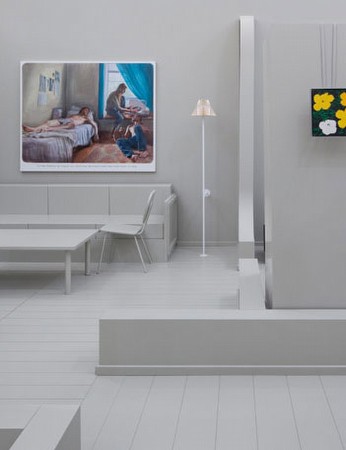
GEORG KARGL FINE ARTS Muntean/Rosenblum GEORG KARGL BOX Costa Vece Muntean / Rosenblum Nemesims 11/05/2012 - 20/06/2012 Galerienfrühstück in der Schleifmühlgasse Samstag, 12. Mai 2012 von 10.00 - 19.00. Künstlergespräch Muntean/Rosenblum 15.00 In Will Wright’s famous computer game “The Sims”, which has become one of the world’s best selling titles, the player is presented with a bird’s eye view into a standard American detached family house and the simulated people living therein. This synoptic perspective turns the player into an omnipotent god with the power to watch his beings and interfere with their simulated lives from above. Many facets of the game resemble those of a training simulator for contemporary consumer culture, since its goal, namely to keep the Sims happy, can only be reached by organising them in such a way that they earn increasing amounts of money which, in turn, has to be spent on consumable goods, from furniture and decoration to clothes, electric household appliances to books and even fine art. The consequential relation between happiness and the never-ending stream of novel items, services and goods, that has become a backbone of contemporary capitalist society, could not be expressed more bluntly. Furthermore, contrary to the Baudrillardian view of the suspension of ideology in the age of simulation, it could be argued that game simulations are hyper-ideological phenomena since all possible actions are literally embedded into the world. In other words, the player has no choice but to base actions on one belief system or another since his or her actions as well as their consequences are already entirely prescribed by the code. Muntean/Rosenblum have chosen “The Sims” as a model for their installation in the entire space of Georg Kargl Fine Arts. Design elements – such as the particular rounded shape of interior walls that emerge from the specific point of view in the game, plants from the exterior front lawn as well as parts of the digital furniture – are turned into sculptural elements which form a coherent whole. By actualising the virtual game space and positioning it as a display for contemporary art Muntean/Rosenblum are returning to a decisive practice within their artistic career. During the 1990s they realised a series of environments, ranging from a desert setting, via a stage for video productions to a sculpture resembling the viewing apparatus of a submarine, which worked as exhibition spaces for the artworks they had curated specifically for the respective settings. This approach allows them to reflect the historical implications of exhibition spaces and enables a highly complex and finely tuned control over the web of relations set in motion by their thematic and architectural choices. In combination with the title Nemesims, which relates to the Greek godess of revenge responsible for the punishment of human hubris, this environment, takes a very precise critical stance. What makes the Sims game so compelling is that its narrative delivers instant omnipotence in a universe defined by (illusory) consumer choices and the never-ending update of surface elements. The adaptation of this cultural signifier not only enables Muntean/Rosenblum to position the precise commentary one has come to expect from their paintings and film pieces, it also extends to a recontextualisation of the function of the exhibition space, thereby affecting all the other artworks displayed within Costa Vece 11/05/2012 - 16/06/2012 Galerienfrühstück in der Schleifmühlgasse Samstag, 12. Mai 2012 von 10.00 - 19.00. Künstlergespräch Costa Vece 15.00 Since the 1990s, Costa Vece has been using social critique and the political to create art. His work is shaped by experiences growing up as a child of Greek-Italian parents in Switzerland and the issues of cultural identity and belonging that result. For some self-evident, but for others something unattainable: Costa Vece has made the issue of citizenship of an industrialized Western country a focus of his work in using flags. In 2006 at Georg Kargl BOX, he presented a tent made of the flags of those non-EU countries whose citizens were living in Austria at the time. As material, he used old clothing that he assembled in the patterns of the flags with safety pins. At the latest with his participation at the Venice Biennale in 1999, Costa Vece has become something of a fixture among critical Swiss artists, such as Thomas Hirschhorn, Christoph Büchl, and Gianni Motti, whose “art is motivated by social politics and—because nourished by a personal background—is absolutely credible,” according to art critic Claudia Spinelli. All the same, he is still today not a Swiss citizen. Based on his sense of belonging to a country where he remains a foreigner, the tension between self and other forms the foundation for the artist’s latest exhibition at Georg Kargl BOX. The central element, the mask, finds its way into his sculpture, collage, and silhouettes in the most various forms. The mask as an emblem of identity or “non-identity,” that is, camouflage or masking, is used across cultures in ritual and religious contexts as part of dress or costume. Costa Vece weaves them in his works into impressive overall structures that make it almost impossible to separate African masks from Swiss carnival masks. He arranges dolls, folkloric figures, and masks like trophies along a tribalesque wooden stick to branches, so that they appear like the leaves of a tree. In so doing, he combines two symbolic objects, the masks and the tree, standing for diversity and universal life. The material of the “trophy trees” is taken not only from countries such as Indonesia, Africa, South America, or Lötschen Valley in Switzerland, but also from the Internet. Finally, he paints “mask trees” consisting of tourist souvenirs and archetypical original material, with black paint, thus leveling diversity and differences in terms of quality. By way of this universe of incommensurable cultural regions, condensed in a single sculpture, Costa Vece sums up the contradictions of our globalized society. While the “tree sculpture” evokes associations of cultic rites, the neon-colored collages on the walls seem like components of our Western culture, although Costa Vece here pursues a similar approach. He collages motifs from ethnographic volumes and magazines with neon-colored PVC foils, thus creating constructs of identity that surpass all barriers of space and culture. In so doing, he uses the collected and the found. Since the beginning of his artistic practice, Costa Vece has worked consistently with found material. He himself says that the material forms the starting point for the idea, concept, and form taken by his work. By way of the found objects of our time and our world, Costa Vece’s work possesses a link to reality that is palpable to all. Text: Marie Duhnkrack Translation: Brian Currid Georg Kargl Fine Arts & Georg Kargl BOX Schleifmühlgasse 5 1040 Vienna, Austria T +43 1 585 41 99 www.georgkargl.com Georg Kargl Permanent Schleifmühlgasse 17 1040 Vienna, Austria |
||||
|
||||
re-title.com
International contemporary art
SIGN UP FOR NEWSLETTERS

 SIGN UP for ARTIST MEMBERSHIP
SIGN UP for GALLERY MEMBERSHIP
SIGN UP for ARTIST MEMBERSHIP
SIGN UP for GALLERY MEMBERSHIP
Click on the map to search the directory