|
Georg Kargl Fine Arts: BERNARD LEITNER - EARSPACEBODYSOUND BOX: Liddy Scheffknecht - 16 Mar 2011 to 4 May 2011 Current Exhibition |
||||
|
BERNARD LEITNER - EARSPACEBODYSOUND
|
|||
|
||||
|
||||
|
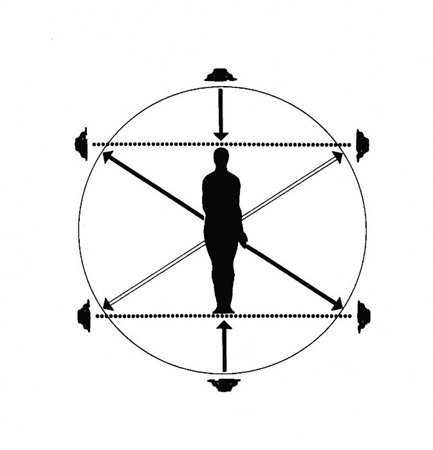
Bernhard Leitner EARSPACEBODYSOUND 16/03/2011 - 04/05/2011 �I can hear with my knee better than with my calves.� This statement made by Bernhard Leitner, which initially seems absurd, can be explained in light of an interest that he still pursues today with unbroken passion and meticulousness: the study of the relationship between sound, space, and body. Since the late 1960s, Bernhard Leitner has been working in the realm between architecture, sculpture, and music, conceiving of sounds as constructive material, as architectural elements that allow a space to emerge. Sounds move with various speeds through a space, they rise and fall, resonate back and forth, and bridge dynamic, constantly changing spatial bodies within the static limits of the architectural framework. Idiosyncratic spaces emerge that cannot be fixed visually and are impossible to survey from the outside, audible spaces that can be felt with the entire body. Leitner speaks of �corporeal� hearing, whereby acoustic perception not only takes place by way of the ears, but through the entire body, and each part of the body can hear differently. Bernhard Leitner is considered a pioneer of the art form generally referred to as �sound installation.� He introduced sound to the installation space, allowing the installation space to emerge through the sound. Leitner, who actually studied architecture, has been a visionary ever since the very start of his artistic career. His sculptures�which he refers to as �sound-space objects��and installations are the result of long, complex processes of development. In precise sketches and workbooks, he first approaches the sculptural, architectural qualities of sound in theory. He undertakes, as it were, foundational scientific research by studying frequencies, volumes, movements and combinations of sounds and their impact on the body, sketching possible spatial figures, such as cubes, corridors, fields, pipes, and exploring the impact of bodily posture on acoustic perception. In 1968 Leitner moved to New York, where he concretely began working on sound-space studies in his studio. He developed multi-channel compositions using sound recordings that were not musically conceived, from which he extracted specific sound material and combined it in work-specific series of sounds. He then notated these series using visual codes that he himself developed consisting of letter combinations on rolls of paper, and transferred them to perforated tape. This resulted in temporary installations of wooden slats on which loudspeakers could be arranged in various geometric arrangements. These were operated individually by way of a control device developed together with a technician, for this was not possible with devices found on the market with the then current state of technology. In this way, Leitner was able for the first time to place sounds and series of sounds in various, exactly performed movements that create �spatial models in an invisible (new) geometry.�1 As Boris Groys has argued, the visual formulation of Leitner�s installations can be read in the tradition of the aesthetics of New York minimalism in the 1970s. There are echoes of Richard Serra, Carl Andre, or Donald Judd, even if the reduced and strict formal language of Bernhard Leitner enters into a new functional context that �serves to shift attention from the visual to the acoustic level of the installation.�2 In the moment when the visitor is no longer unnecessarily distracted by visual stimuli, acoustic attentiveness automatically increases. Bernhard Leitner�s exhibition EARSPACEBODYSOUND at Georg Kargl Fine Arts represents in several aspects something quite special and also a challenge. His first extensive show in Austria in almost ten years, this exhibition is also his first gallery show worldwide. Independently and uninfluenced by the art market, Leitner developed his own �universe,� his own space of thought, which found widespread international recognition on an institutional level. He participated in Documenta 7 in 1982 and the Venice Biennale in 1986, and has also been able to realize numerous sound installations over the last forty years in public space, for example the Agoraphon in front of Hamburg�s Deichtorhallen in 1994, or Cylindre Sonore from 1987 at Paris� Parc de la Villette (still extant today) or the Str�mungen (Streaming) at the orthopedic division, Otto Wagner Hospital, Baumgartner H�he, Vienna (Felix Pavilion), in 2000. The current exhibition focuses primarily on the complex process of development behind the Leitnerian sound/space/body web of relations, pursued with such amazing meticulousness. It attempts to provide both a historical retrospective and to sketch out current positions. Alongside historical documentation material such as work and notation and sketch books, the exhibition includes early sound sculptures like the Tonanzug (Sound Suit, 1975), the Tonliege (Sound Chair, 1974/1983) or Tragraum (Portable Space, 1976) that are committed to the �modern principle of the emanative body�3 to the extent that sound palpably influences the entire vegetative nervous system through loudspeakers directly worn on the body, allowing it to become a whole body experience. Leitner thus stands in the tradition of the international avant-garde movements of Fluxus and Happening, which expanded the concept of art by including the human body in the artistic context. The passive viewer becomes an individual agent in the artistic process, an element that is inseparable from the artwork in that his or her role as the beholding subject shifts to that of the object beheld. While the Sound Suit or the Portable Space allow for the user�s individual movements, that is, the user carries the sound around, and depending on the position or distance from the surrounding space also actively shapes the individual spatial experience by way of reflection or feedback, installations such as Pulsierende Stille (Pulsating Silence, 2004), Vertikaler Raum (Vertical Space, 1975) or Klangspiegelgang (Sound Mirror Path, 2011, created especially for the current exhibition) assign a clear place to the visitor. The experience of most of Leitnerian sound space sculptures is a subjective, lonely matter. Group dynamic collective experiences are shifted in favor of meditative interior examination, in that the visitor becomes aware of his own body belonging to the unified space of the sound installation. In so doing the transitions from �space-feeling (in architecture)� to the �feeling space (of music)�4 begin to blur. The extent to which Leitner�s installations are not only able to decelerate or subdue the movement of the visitor, that is, his or her form of reception, but also to dynamize it, is impressively shown in the 48-channel composition Serpentinata located in the gallery�s skylight space. Through two plastic tubes, which are tangled with one another, hanging organically free in the space, with 24 loudspeakers placed on each of them at regular intervals, the sound seems to drizzle down, making a crunching noise, sounds that seem to shoot through the space, hissing, transforming the entire sculpture into an �acoustic-resonating organism� (B. Leitner) that almost seems to breathe. In comparison to the reduced, formally ascetic installations in which the sound series seem to span geometrically meticulous spatial bodies, Serpentinata seems like a lofty, sanguine spatial inscription that the visitors try to follow in almost dance-like movements. In recent years, Bernhard Leitner�s sound/space/body installations, that have always developed at the intersection of sound, sculpture, and architecture, refusing any clear location, have begun to attract the interest of artists from the performing arts. Dancers and performers develop their own choreographies along Leitner�s sound/space/bodies and allow new corporeal and movement spaces to emerge in temporal-spatial performances. They allow themselves to be drawn into a universe in which visual, acoustic, temporal, and physical worlds of experience �coincide,� and �being in sound� becomes a �being in the world.�5 Text: Fiona Liewehr Translation: Brian Currid Notes 1. Catrin Pichler, �Zu den Ton-Raum-Objekten von Bernhard Leitner,� Geometrie der T�ne (Ostfildern: Hatje Cantz, 1997). 2. Boris Groys, �Die Klanginstallationen von Bernhard Leitner,� .P.U.L.S.E. ZKM Buch (Ostfildern: Hatje Cantz, 2008). 3. Elisabeth von Samsonov, PANAUDITION: All-Frequenz und Ganzk�rperohr (Innsbruck: Tiroler Landesmuseum Ferdinadeum, 2008) 4. �Der H�rbare Raum, Gespr�ch von Ulrich Conrads und Bernhard Leitner,� Daidalos 17 (1985). 5. Catrin Pichler, �Zu den Ton-Raum-Objekten von Bernhard Leitner.� BOX Liddy Scheffknecht a moving standstill Liddy Scheffknecht�s Media Hybrids 16/03/2011 - 04/05/2011 When it comes to photography, movement and standstill are two characteristics that are usually treated as a contradiction. As a cut through space and time, the photographic medium not only arrests a moment, it also stages that moment in an image, statically and enduringly. Photography �embalms time�: with this�still today one of the most famous descriptions of the phenomenon�Andr� Bazin sought to understand its distinction from a different medium: film. Film goes beyond photography, for it adds the very element that defines the limits of photography: the definition of a temporal sequence by way of movement. On first glance, Liddy Scheffknecht�s work 7 Minutes 13 Seconds clearly corresponds to the characteristics of photography: static, immobile, and staged in an enduring fashion, a photographer operates before the outside wall of a building on the shutter release button of a stereo camera placed on a tripod. The photograph was not taken by the artist herself, but is a visual product made by an anonymous photographer that Scheffknecht appropriated, enlarged, and recontextualized. The discursive strategy of media appropriation serves to visualize the aforementioned differences between photography and film. This is made concretely visible in an elementary motif: the video of a shadow is precisely projected onto the photograph, and the referent of this shadow seems to be the photographer depicted. In so doing, the shadow reveals an important characteristic that goes beyond the photographic medium: movement. It slowly moves across the image and by way of its changing shape not only visualizes a temporal sequence, but also mixes photography and film. In this superimposition of two visual levels, Scheffknecht generates a media hybrid, whereby the limits separating the two media are both violated and visualized as transparent. Accordingly, the semantics of the image need to be sought in the difference between the two media. This complex relationship is explored in a similar way in Scheffknecht�s 6 Minutes 38 Seconds. This series of photographs shows a bicyclist whose dynamic motion is suggested by the blurry audience in the background, while the cyclist himself seems focused, like a statue at the center of the picture. The temporally punctual shot of the cyclist, torn from a movement in a fragment of a second and fixed, is repeated in all the photographs of the series. The series of pictures�which itself is a well-known stylistic device to suggest temporal change and thus (filmic) movement across a series of images�thus seems ambivalent. It is not the bicyclist that changes position, but the apparently secondary visual motif of the shadow. In contrast to the depiction [BC1] of the sportsman, the cyclist can be found in each of the images in a different form, thus evoking continuous movement. The contrast between statics and the changed form of a shadow highlights a �break� and/or a �difference� between the two visual layers, which in turn generates a media hybrid of photography and film. Beyond the aspect of media theory, the shadow can also be defined as an elementary stylistic device, which is also illustrated by 7 Minutes 13 Seconds. The dialectic between static and movement is underscored in the video projection onto the photograph by divorcing the shadow from its referent and/or the photographer. On first glance, its continuously changing shape seems not to be an �imprint� or the result of the photographer, but rather suggests an invisible light source. On closer examination, this proves to be an illusion: the shape of the shadow can thus not be explained as a logical visual transformation, but due to its autonomous form the shadow separates itself from the causality of its reference, and thus emerges as an independent �double�. As the only mobile element, it dominates the statistic elements and divorces itself from the narrative context. The photograph�s proximity to reality as well as the course of the shadow, which initially appears to be logical, yet ultimately cannot be traced back to the photographer, makes Scheffknecht�s work slip into the uncanny-surreal. By way of conclusion, if a silhouette appears in Scheffknecht�s picture that no longer possesses any referent in the photograph itself, it includes an additional authority addressed by the camera of the photographer: the viewer. As a perceiving authority, he or she is thus inscribed as the midpoint between model and depiction, reproduction and construction, just as between photographic �reality� and its restaging in film. Text: Walter Moser Translation: Brian Currid |
||||
re-title.com
International contemporary art
SIGN UP FOR NEWSLETTERS

 SIGN UP for ARTIST MEMBERSHIP
SIGN UP for GALLERY MEMBERSHIP
SIGN UP for ARTIST MEMBERSHIP
SIGN UP for GALLERY MEMBERSHIP
Click on the map to search the directory