|
Galerija Skuc : DIGITAL TRANSPOSITIONS - 18 May 2010 to 28 May 2010 Current Exhibition |
||||
|
|
|||
|
||||
|
|
||||
|
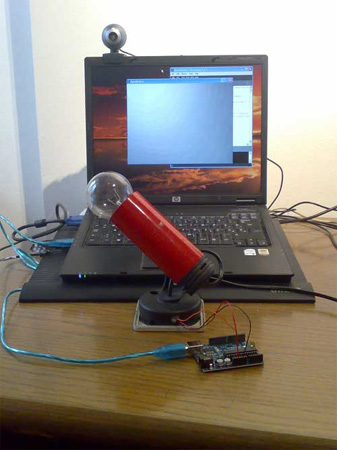
DIGITAL TRANSPOSITIONS 18 May� 28 May 2010 Artists - Coding : Mirjana Batinic - Klemen Istenic, Matej �akelj, Artur Felicijan & Andra� Sedmak - Andrej �trajhar, Nejc Trnjanin, Miha Zorec, Alen Floricic - Uro� Ku�ar, Sa�o Modic, Ana Grobler - Matija Novak, Matija Ja�arov - Miha Boh, Marko Jurincic, Dominik Mahnic - Klemen Nagode; Ana Schaub - Darja Er�en, Iztok �u�ek, Dorian �panzel - Rok Burgar, Matev� Pogacar, Sonja Vuk - Tadeja Kadunc, An�e Rehar, Joanna Zajac-Slapnicar - Marko Dreven�ek Tutors: prof. mag. Sre�o Dragan (ALUO), asist. dr. Borut Batagelj (FRI) Years of collaboration between the Department of Video and New Media at the Academy of Fine Arts and Design (AFAD, University of Ljubljana) and the Computer Vision Laboratory of the Faculty of Computer and Information Science (FRI, University of Ljubljana) have given rise to a Laboratory Institute for Media Art of the University of Ljubljana (LIMAUL), which will be located in a planned art academy campus in Ljubljana. As an experimental research platform, the laboratory enables students to produce and present art projects that � through the creative use of the contemporary media and technologies, the introduction of technological and scientific procedures, and the utilisation of engineering and programming know-how � express the need for an interdisciplinary approach as a mode of contemporary artistic practice. As part of a project-based post-graduate course at the Department of Video and New Media at AFAD, galleries and festivals in Slovenia and abroad annually host some of the original projects that are transposed from the laboratory setting to various public venues. In �kuc Gallery, Prof. Sre�o Dragan presents his selection of this year�s post-graduate course production. Ten projects � some are debuts presenting possible further elaborations, and others are upgrades of previous versions � each through their authors� individual sensibility, explore the individual�s role in contemporary, technology- and science-driven society. The interplay of interactive and responsive installations and web based projects executed in the logic of contemporary media artworks that imply interactivity, participation, performativity, processuality, etc. disclose a spectrum of topics that relate directly to our simultaneous presence in the different spaces (physical, virtual, augmented, cell-space, etc.) of technological reality. Through immersion in the imagery of the digital meta-archive which corresponds to the word, phrase, clause, number, symbol or sign that a user enters into a web browser, Dominik Mahni� in his project Images of a Word on the one hand draws a parallel between the functioning of computer software and associative processes in a human, while on the other presenting data-space as an extension of the physical habitat. Other artists exploring augmented and virtual spaces as research paradigms in contemporary media art include Mirjana Batini�, Joanna Zajac-Slapni�ar and Alen Flori�i�. In her interactive installation Toying with Words until they Lose their Meaning, Batini� addresses viewers through a live online stream of world news which each viewer fragments to the point where they make no more sense by entering and moving about the text field. By abstracting the visual and sonic landscape, Batini� metaphorises the omnipresence of information which invades both public and private spaces through a constant layering of static and dynamic images and text messages. In her installation Let�s Look!, Joanna Zajac-Slapni�ar focuses on the function of the gaze and methods of observation, and highlights the possibilities of tracking and controlling augmented space. Alen Flori�i� explores the merging of the real and virtual worlds, transposing the visitor who enters a designated area into a virtual environment where the visitor experiences an avatar which generates sound and moves as it reacts to the visitor�s presence. The project Soundswitch by Matija Ja�arov revolves around increasingly present intelligent architecture and smart objects that react to users� needs and habits, and awareness of the ecological aspect of living. Ana Grobler�s Pleasure Treasure, an interactive play in the making, acknowledges the possibility of a love affair in a digital environment. A criticism of the pornographic industry, which mainly targets the heterosexual male, the interactive game offers the user a wide variety of avatars (including non-anthropomorphic), original locations and accessories. Ana Schaub explores the identification of individuals with fictional characters in Superheroes 2, an online portal where registered users can post text, pictures and videos to express their experience of, and exchange opinion about, the superheroes of our time. In an installation entitled Which Game Do you Play?, Sonja Vuk explores youth violence as a result of excessive immersion in the world of action films and computer games, and the lack of communication skills required to resolve conflicts. The projects New Church and Altarium Verum invite us to reconsider the role of religion, its symbols and rituals in contemporary society, by adapting the service and transforming a sacred object intended for the modern user entangled in the network of digital accessories and extensions. By automating the act of confession through a visual application, Artur Felicijan and Andra� Sedmak, in their project The New Church usurp the intermediary role of the Christian Church and provide for an objective interpretation of the Bible in relation to set parameters and the content of the user�s confession. Similarly to his previous project Verwandlung, in which he transformed the use of the cross as a religious symbol, Dorian �panzel has this time designed an inflatable mobile altar, the Altarium Verum, which enables the user to activate one of the three available scenarios that, through additional sonic and visual effects, represent heaven, hell and purgatory. Rather than focusing on finished artefacts � that they are not � the exhibition highlights the processual nature of the works on show and the sensibility of younger-generation artists regarding contemporary issues, while demonstrating that the initiative promoting collaboration between students of AFAD and FRI is of paramount importance. - Sandra Sajovic Guiding tour of the exhibition will take place on Tuesday, 25 May, at 6pm. Project is supported by: Ministry of Culture of the Republic of Slovenia and Municipality of Ljubljana - Cultural Department Thanks: prof. dr. Franc Solina (dekan FRI UL), Delavski dom Trbovlje, Ljudmila Link: http://black2.fri.uni-lj.si/ |
||||
re-title.com
International contemporary art
SIGN UP FOR NEWSLETTERS

 SIGN UP for ARTIST MEMBERSHIP
SIGN UP for GALLERY MEMBERSHIP
SIGN UP for ARTIST MEMBERSHIP
SIGN UP for GALLERY MEMBERSHIP
Click on the map to search the directory