|
Galerija Skuc : Uro� Acman - Museums - 30 June 2009 to 15 July 2009 Current Exhibition |
||||
|
|
|||
|
||||
|
||||
|
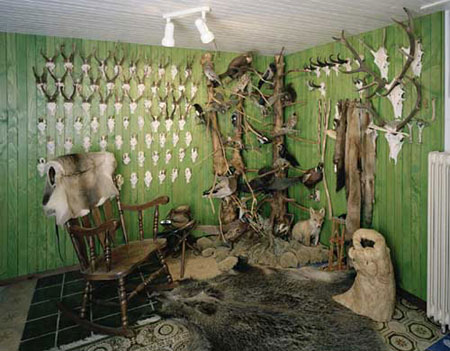
Uro� Acman Museums June 30 - July 15, 2009 You are kindly invited to attend the opening of the exhibition on Tuesday, 30 June at 8 pm at �kuc Gallery. In a series of photographs entitled Museums Uro� Acman documents so-called hunting trophy rooms. Monumental and distant photographs reveal an objective and cold picture, while the bizarre motif functions as an ironic subtext, which gives them an alienating effect. The artist began recording these unusual places quite coincidentally. He says that when seeing one of these 'private museums' for the first time, he felt an odd fascination with the people who spend all their free time arranging collections of stuffed animals. He came to the conclusion that these rooms are almost sacred places for them, which show their specific relationship to nature, which they bring home in bits and pieces. With regard to form, the artist is interested in examining still-life, which offers new meanings, something symbolic, only if the gaze is directed to it. Therefore, photographs make us think of the metaphorical meaning of the spaces portrayed, and their cultural, social and ideological functions. The large-format colour photographs, in the tradition of the 'post-D�sseldorf' school, pay much attention to details, composition and light. The cold images of interiors filled with hunting trophies, which the artist portrays with restrained minimalism, act as a formal counterpoint to the homey decor overload in the motif. Due to this contrast, the viewer perceives them as distant and threatening. One could say that the polished and shiny 'after-images' create a vacuum of a cold, floating simulacrum, and symbolise our erroneous encounter with the real. Through shiny flatness and seriality (a common form of artistic articulation in post-modern photography) Acman's practice sees this traumatic situation as an obsessive fixation on the object. This extends the concept of paradox not only to the images (with their effect and absence), but also to the viewers, who can neither identify with the images (a prevailing characteristic of modernistic aesthetic), nor distance themselves from them. Some contemporary photography is marked by the so-called allegoric split of the image, which increasingly approaches cultural-political intervention. Consequently, the status of the photographer/artist also changes, becoming that of photographer/ethnographer. In this context, the central focus of artistic examination is still the bourgeois capitalist art system, with its excluding definitions of art, artist, identity and community. This second, embedded, meaning brings Acman close to institutional criticism, as it questions the institution of the museum in the modern age. One of the more general definitions of the museum is a place of memory, where everything relevant, precious and significant is collected. Museums are also graveyards of objects. What is kept in a museum ceases to have any function in life, and is therefore dead. Heaven for objects is not much different from a vampire sepulchre, and this is in tune with the general dynamics of the modern age, as already established by Boris Groys. Acman's images of rooms where 'preserved' animal bodies are kept can be understood as an allegory for the contemporary museum, where the commodified art work loses its emancipatory potential and functions only as a dead relic of (art) history. Acman's Museums examine the ambiguous status of art work, which in the post-modern age spans between discourse and documentarism, nature and culture, and the avant-garde and kitsch. Curator: Iztok Hotko Uro� Acman was born in 1982 Slovenj Gradec. In 2003 he graduated in photography from the FAMU in Prague. In 2008, he completed post-graduate studies in visual communications and photography at �cole cantonale d'art de Lausanne/ ECAL in Lausanne. He is currently a student at Koper Faculty of Humanities. He has exhibited at many solo and group exhibitions in Slovenia and abroad. For further information contact curator Iztok Hotko on iztok.hotko@ gmail.com. �kuc Gallery program is funded by Ministry of Culture of the Republic of Slovenia and Cultural Department of the City of Ljubljana. |
||||
re-title.com
International contemporary art
SIGN UP FOR NEWSLETTERS

 SIGN UP for ARTIST MEMBERSHIP
SIGN UP for GALLERY MEMBERSHIP
SIGN UP for ARTIST MEMBERSHIP
SIGN UP for GALLERY MEMBERSHIP
Click on the map to search the directory