|
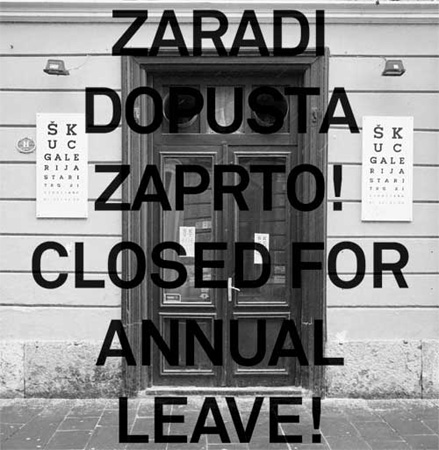
Galerija Skuc : CLOSED FOR ANNUAL LEAVE! - 22 Jan 2009 to 8 Feb 2009 Current Exhibition |
||||
|
|
|||
|
||||
|
||||
|
CLOSED FOR ANNUAL LEAVE! 22. 1. � 8. 2. 2009 Participating artists: Damijan Kracina, Tanja La�etic, Polonca Lov�in, Irena Pivka, Tadej Pogacar, Sa�o Sedlacek, son:DA, Tina Smrekar, Miha �trukelj, Toma� Toma�in, Matej Andra� Vogrincic. Curator: Alenka Gregoric Co-curator: Tev� Logar A variety of reasons influences the rationale of an exhibition. An exhibition often reflects the affinity of the author of the concept, be it an artist or curator. It is often the result of a current situation, even of a wish to swim with the current art flow, which constantly changes course and, consequently, the exhibition programs of institutions. An exhibition can also act as a trigger, or is the consequence of a reflection, of most of the society and environment we live in. This exhibition was instigated by the participation of �kuc Gallery in a two-year project, Land of Human Rights, whose concept stems from the Universal Declaration of Human Rights, which it addresses through the prism of art. The show also logically continues and completes the story begun by �kuc Gallery within the scope of the Land of Human Rights project with the Article 23 exhibition last year. To avoid representational approaches and the usual selection of works of art, the exhibition Closed for Annual Leave is 'tediously' declarative in form. It focuses on the specifics of the local art scene and seeks to avoid presenting artistic projects on the issue, which usually flirt with activism. Thus, it does not enable direct contemplation about to works of art, but invites visitors to think. The idea or concept of the exhibition is rather simple. Collaborating artists received a symbolic amount to enable them a day of paid leave, while the gallery staff took the right to rest and have free time. The doors of the gallery will remain closed throughout the duration of the exhibition, as the concept is precisely what is indicated by the title: Closed for annual leave. The gallery will be closed for three weeks, and not only to the public � the gallery staff will do only what is absolutely necessary and go on holiday, or at least stay at home most of the time. The guiding principle of the exhibition is �Everyone has the right to rest and leisure, including a reasonable limitation on working hours and periodic holidays with pay.' The statement is not a figment of the imagination, or a derogatory remark aimed at an individual or a social group, but a sentence from Article 24 of the Universal Declaration of Human Rights of 1948. Today, this can only evoke a bitter grin, as it is absurd in its having entirely positive intentions, but seems comic or tragic-comic when applied to real life, because in the case of 'self-employed cultural workers', it is far from reality (all participating artists have the status of self-employed cultural workers). The exhibition project is not an appeal to the authorities to change things, a lament over our destiny, or an attempt to present ideas for resolving the situation; we have simply taken time off to rest. And, naturally, we do not fool ourselves that this can change reality. Closed for annual leave is a statement we were used to when we lived in socialism, but is unimaginable in the era of capitalism. A gallery is no exception. As we depend on public funds, which we have to apply for every year, we cultural workers in the non-government sector are forced to produce too much. Every year we can easily fall into a trap, as (too) few applications usually mean less money, and therefore the scope of production exceeds the number of staff of the institution who can carry out the program well and independently. In this respect, Closed for annual leave will serve as an 'excuse' for the leisure time or holidays of the gallery staff � because we cannot afford paid leave on the burden of the government, because we could not justify this expense to our backers, which has not been earmarked for self-employed workers in culture, students and the unemployed. But we can enable a day off to artists. We wanted to enable a day of paid leave for each of them, and the transferred amount was paid as royalty for participation in an exhibition which is acceptable according to the legislation of our backers. It is up to the artists as to how they take advantage of that day, they can do what they like, as we will not ask for any reports, which is usually something that cultural workers, recipients of public funds, waste heaps of time on. After all, �kuc Gallery is closed for annual leave. |
||||
re-title.com
International contemporary art
SIGN UP FOR NEWSLETTERS

 SIGN UP for ARTIST MEMBERSHIP
SIGN UP for GALLERY MEMBERSHIP
SIGN UP for ARTIST MEMBERSHIP
SIGN UP for GALLERY MEMBERSHIP
Click on the map to search the directory