|
Galerija Skuc : REAL TIME SETTINGS FOR NER[D/VE]S - 3 Apr 2012 to 19 Apr 2012 Current Exhibition |
||||
|
REAL TIME SETTINGS FOR NER[D/VE]S
3.4. � 19.4.2012 |
|||
|
||||
|
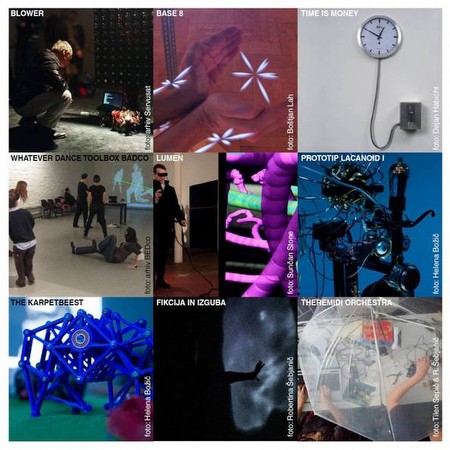
REAL TIME SETTINGS FOR NER[D/VE]S 3.4. – 19.4.2012 Base 8: Chris Sugrue, 2011 (USA) BLOWER: Markus Decker, Karl Heinz Jeron in Us(c)hi Reiter, 2011 (IT/AT/DE) Time is Money: Domestic Research Society, 2010 (SI) Fiction and Loss: Mirjana Batinic and Zoran Obradovic, 2010/11 (HR/SI) LUMEN - Drawing in augmented reality: Dominik Mahnic and Matic Potocnik, 2011/12 (SI) ∆ Lacanoid: �iga Kranjec, Igor Kri�anovskij and Urban Belina, 2011 (SI) Karpetbeest: Luka Frelih, 2011/12 (SI) Whatever Dance Toolbox: BADco. and Daniel Turing, 2011 (HR/DE) You are most cordially invited to attend the opening of the exhibition on Tuesday, April 3rd, at 8 p.m. at Škuc Gallery. The exhibition Real Time Settings for Ner[d/ve]s is not the result of a curatorial selection that reveals a theme, but presents a genre of programme based media art linked to responsive technologies. It is bringing together contents that emerged at Ljudmila’s laboratory for science and art and its network of international collaborators, similar institutions and artist-in-residence programme. Ljudmila connects research in the field of technology, science, art and civil society, and develops and promotes the use and knowledge of open culture, free licencing and software. Their work is closely associated with art, because artists, developers, hackers, programmers and computer engineers are fairly immune to developing end products. They are interested in developing prototype ideas which deal more with researching the poetics of technological tools, anthropological issues and futurist fiction than applicable technological solutions. The exhibition is not intended merely for consumption, but for interaction, which can only be established if we are prepared to invest our own bodies in an installation. Responsive installations simulate the direct and animated work of independent devices, addressing the fundamental issues of perception, cognition, physical and mental states. The works presuppose some level of enthusiasm for technologies, which can also be seen as fetishisation of technology (sensory devices, computer data, software) to promote the play between the individual, the environment and computer interfaces. Response installations reveal different levels of reality, or the passage of time that is established between the interface and human perception. From the aspect of perception, real time is unattainable, therefore perception works in two ways: in terms of the binary logic of software simulating intelligence and in terms of the variable represented by the visitor. Some prototypes are witty and innovative, although the novelty of the medium is not always their most attractive element. They are interested also in reviving obsolete technologies and already known artistic statements to avoid the incessant quest for the new and improved in order to rethink the value of technology tailored to people. There is no clear distinction between virtual and real space, which would tell the human brain the difference between physical and deceptive worlds. We believe what we see. The absurdity of the obvious is portrayed by interactive object Time is Money by Domestic Research Society, presenting a case of the economy of time. Perception is constantly followed by distortions and interruption, depending on the adaptability of the eye, a fact which is examined by Chris Sugrue, and Dominik Mahnic and Matic Potocnik. Sugrue programmed a visualised system exploring the negative space between the fingers following the movement of hands and fingers, and drawing playful minimalist patterns between them, which seem like living organisms. Mahnic and Potocnik equip the visitors with a set of optical glasses and completely immerse them in the virtual interface, which enables drawing in augmented reality. Each new experience with response systems triggers a series of associations, memories and learned systems of classification that is provoked by Fiction and Loss, BLOWER , and Whatever Dance Toolbox. Batinic and Obradovic use a system for monitoring movement in space which has been used in art since the emergence of sensor systems. The artist and programmer push us into an unpleasant disorienting space, which creates tension between the desire to discover the new and the fear of the unknown. The unknown dimension is also uncovered by Decker, Jeron and Reiter, who materialise statistics of the most frequently used terms in web browsers in the form of wind, blowing at us at the gallery entrance. Further on, BAD co. and Daniel Turing entangle the visitor in a playful action, which shatters the established understanding of choreography, dictating unpredictable coordination in space, which frees the body from learned movements. The self-regulative movements by mobile units is explored also by Luka Frelih in his instalment of the animalistic Karpetbeest fabricated by a RepRap 3D printer. The emancipation of the technological mind is one of the most complex riddles of computer and software science. The idea of independent autopoetic entities and fascination with the intelligence of technology is tackled by �iga Kranjec, Igor Kri�anovskij and Urban Belina in the work Δ Lacanoid, which simulates a human-like presence. There is a question hovering in the air about how much the constructions are aware of themselves, what they prompt in the minds of the visitors and what kind of space they create. —Ida Hiršenfelder Links to projects www.servus.at/blower badco.hr/works/whatever-toolbox letsmakerobots.com/node/25997 wiki.ljudmila.org/Real_Time_Settings_for_Nerves wiki.ljudmila.org/Art Events at ŠKUC Gallery: Tuesday, 3 April at 7pm —guided tour by Robertina Šebjanic and Ida Hiršenfelder with the artists —presentation of tool for dance choreography Whatever Dance Toolbox by BADco. at 8pm —opening of the exhibition Real Time Settings for Ner[d/ve]s Friday, 13 April at 6pm —Digital dish: Stevan Kojic: Self-Sustaining Systems of Absurdity, artist presentation Sanja Kojic Mladenov: Examples of Media Art (Novi Sad), lecture Friday, 13 April from 3pm till 6pm —Book sprint, collaborative writing of the exhibition catalogue on the free and open source web platform Booktype Saturday, 14 April and Sunday, 15 April from 11am till 6pm — Book sprint. Collaborative writing Monday, 16 April at 6pm — Creative Mondays: Led Throwies, organized by Info Škuc Mentor: Robertina Šebjanic Thursday, 19 April at 7pm — exhibition closure: performance Theremidi Orchestra: Antennas FOR All Tina Dolinšek, Luka Frelih, Ida Hiršenfelder, Dare Pejic, Saša Spacal, Borut Savski, Robertina Šebjanic, Matic Urbanija, Dušan Zidar Events at LJUDMILA, Rimska 8, Ljubljana Wednesday, 11 April from 5pm till 8pm — Free-Circuit 3D Meeting, regular meetings of the RepRap community Mentor: Luka Frelih Co-producer: LJUDMILA – Ljubljana Digital Media Lab at KUD F. Prešeren Trnovo Special thanks to: KIBLA, www.kibla.org ComputerVision Laboratory, Faculty of Computer and Information Science, University of Ljubljana, www.fri.uni-lj.si Kapelica Gallery / Zavod K6/4, www.kapelica.org Aksioma - Institute for Contemporary Art, Ljubljana, www.aksioma.org Organisation and Coordination: Robertina Šebjanic and Vladimir Vidmar Exhibition Concept: Robertina Šebjanic, Tev� Logar and Ida Hiršenfelder Tehnical Realisation: Atila Boštjancic and Joško Pajer (ŠKUC Gallery) Public Relations: Helena Bo�ic and Vladimir Vidmar |
||||
|
||||
re-title.com
International contemporary art
SIGN UP FOR NEWSLETTERS

 SIGN UP for ARTIST MEMBERSHIP
SIGN UP for GALLERY MEMBERSHIP
SIGN UP for ARTIST MEMBERSHIP
SIGN UP for GALLERY MEMBERSHIP
Click on the map to search the directory