|
Galerie Peter Kilchmann: ARTUR ZMIJEWSKI : Two Monuments / Democracies DUNCAN MARQUISS: There is no you - 31 Oct 2009 to 23 Dec 2009 Current Exhibition |
||||
|
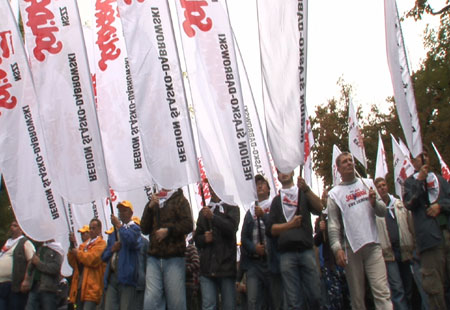
ARTUR ZMIJEWSKI, Democracies, 2009, filmstill
Single channel video projection or to be shown on 20 flatscreens, 2 hours 26 min Courtesy the artist, Foksal Gallery Foundation, Warsaw & Galerie Peter Kilchmann, Zurich |
|||
|
||||
|
||||
|
ARTUR ZMIJEWSKI Two Monuments / Democracies October 31st � December 23rd, 2009 Opening: October 30th, 6 p.m. � 8 p.m. Artist Talk Artur Zmijewski / Adam Szymczyk (director of Kunsthalle Basel) Friday, 11th December, 6.30 p.m. Galerie Peter Kilchmann is pleased to announce the third solo exhibition of Polish artist Artur Zmijewski, which features his latest video works Two Monuments (2009) and Democracies (2009). Two Monuments was set in Dublin, where Zmijewski organised meetings between migrant Polish and local workers to discuss the state of the labour market. Two meetings were held, the first in November 2008 and the second in May 2009. Zmijewski invited eight men to the first workshop and six women to the second. The proposed objective was to design a �monument� that sought to represent their position in regards to the labour market, and which also incorporated their personal situations and emotions. The next step was to place these "monuments" in a public space. In his video work, Two Monuments, Zmijewski examines the differences between two ethnic groups and the genders. In the past, thousands of Polish migrant workers migrated to Ireland, a country that until recently was experiencing an economic boom. The project was carried out within Zmijewski�s scholarship at Dublin�s �Fire Station�. Two Monuments will be on display at the Istanbul Biennale until 8th November. Democracies is a large project including 20 individual short films. Between 2006 and 2009, Zmijewski documented different public events. The short films cover from protests against Israeli occupying forces in the Gaza Strip, to the funeral service for J�rg Haider in Klagenfurt, riots involving nationalist football hooligans during the 2006 World Championship in Germany, the 1st May skirmishes in Berlin, to feminist demonstrations and the re-enactments of political events such as the 1944 Warsaw Uprising. Zmijewski comments on these films: I chose the title �Democracies�, because it is an inherent lie. Not all of those are democracies. The aforementioned events attest to this, sometimes in a brutally pragmatic manner and, on other occasions, in a subtle and seemingly unconfrontational way. Here, Zmijewski explores the idea of �democracy� and demonstrates its absolute boundaries, as well as its inherent elasticity. The question of power, the distribution of power and the struggle for power are inevitable within this presentation. Zmijewski�s recordings in Two Monuments and Democracies do not generalize collective human behaviour. Instead they represent a multi-faceted and profound demonstration, as the individual voices of single protagonists reemerge. These voices make a generalization of human behaviour impossible, and they mark Zmijewski�s sensibility towards human susceptibility. In this sense, Two Monuments and Democracies are a kind of social and political research. Two Monuments takes the form of a social experiment, carried out by the artist in order to reveal unpredictable results of human behaviour. In previous works, such as Repetition (2005), Them (2007) or Swiecie (2009), the artist also functions as a sociological catalyst of social moments. Artur Zmijweski (1966, born in Warsaw) represented the Polish Pavillion in 2005 at the 51st Biennale in Venice. In 2007 he participated at "documenta12" in Kassel as well as at the second Moscow Biennale of Contemporary Art in Moscow. The MOMA New York is currently exhibiting Zmijewski�s solo exhibition �Project 91: Artur Zmijewski� with a new film (29th Oct. until 1st Feb.) and the Kunsthaus Graz will be presenting "Democracies" as part of the steirischer Herbst festival until January 2010, along with other selected works. Artist Talk. On Friday, 11th December, at 6.30 p.m., an artist talk will take place between Artur Zmijewski and Adam Szymczyk, director of Kunsthalle Basel, (in English). In 2005, Adam Szymczyk curated Zmijewski�s solo exhibition in the Kunsthalle Basel, which was running at the same time as his exhibition at the Venice Biennale. Zmijewski�s monographic catalogue �If it hapened olny once it�s as if it never happened� available through the gallery, was published within this context. For press photos or further information, please contact Lilia Stankiewicz ([email protected]). DUNCAN MARQUISS There is no you October 31st � December 23rd, 2009 Opening: October 30th, 6 p.m. � 8 p.m. Galerie Peter Kilchmann is pleased to announce Duncan Marquiss� solo exhibition, "There is no you". Following his first exhibition in 2007 in our project room, the young Scottish artist presents a selection of his latest works. He will show a series of new drawings, frottage works, as well as a video piece. The following text is written by the artist himself: �We�re all schizophrenic, with defective emotional lives � flattening of affect, it�s called.� Philip K. Dick, Do Androids Dream of Electric Sheep, 1968 The frottage works are rubbings of clothes made with chalk on a thin fabric, presented in groups pinned to the wall unframed. To me the empty clothes suggest absent or invisible figures frozen in space, perhaps the abandoned clothes have taken on a life of their own. Once rubbed by the bodies of their wearers the clothes are now replicated through rubbing as flattened out doppelgangers. Frottage can have an uncanny semi-photographic quality, but like photography it is a reductive process that loses detail and mid tonal ranges - which Josef Alber�s described in his text Interaction of Colour, 1963 as the subtle human greys. The chalk I use in the frottage works is also used in my drawings to prepare a ground to work on. Vertical chalk strokes, or circles of dust rubbed into the paper, create spaces for the drawings to exist in. The chalk ground seems to reveal a space behind the page, yet the dust sits on top of the paper creating tension between surface and illusory depth. Several of the drawings use textured paper, which allows areas of the paper to remain untouched by pencil and chalk. The repeating microdots of exposed paper sit below the drawing, making images appear semitranslucent. The regular pattern of the paper�s texture creates a lattice comparable perhaps to the grain of film and photography or a silk-screen print mesh. Many of the drawings depict figures framed by boundaries of chalk strokes. Portraying a subject can simplify, stylise or misrepresent it, but my hope is that a drawing can become an object in it�s own right. The drawings often use negative presentation; figures without faces, features obscured by hoods or smudges of chalk; empty space that asks the viewer�s imagination to fill in the gaps. Luminous shadows and translucent colours make subjects seem like ghosts or projected holograms. Several of the drawings are based on photographs I took in department stores of mute mannequins and ecstatic displays of commodities. I find these shops depressing and fascinating; time seems distorted into a continuous present, surfaces are rich yet flat. In previous works I often used appropriated imagery as source material, borrowing images from cinema or art history. This is in part an investigation into how a person�s identity can be shaped by cultural artefacts, how they condition our tastes and imagination - consuming us as we consume them. The predominance of mediated experiences in contemporary life leaves us wondering how much of our identity is our own? At the rear of the gallery is a new video work, which shows a figure walking down a narrow pathway. We see this person from two camera angles, one from in front of them and one from behind. These two continuous shots are edited together frame by frame in an attempt to watch the scene simultaneously from two perspectives. This almost cancels each viewpoint out, creating instead a flickering image of a figure continually advancing and retreating in uncertain space. The persistence of vision is employed by cinema to animate still images, but in this work it superimposes images making them appear translucent whilst flattening the depth of the film frame. Like some of the drawings the video depicts an individual trapped within formal abstractions. Duncan Marquiss (born 1979 in Aberdeenshire, Scotland) lives and works in London. Before graduating from the Glasgow School of Art in 2005, Marquiss celebrated first successes in his young career: in 2003, he exhibited at �Zenomap� at the Scottish Pavilion at the Venice Biennale. The artist currently has works on display as part of the Scottish retrospective, "Running Time, Artist Films in Scotland 1960 to Now�, at The Dean Gallery, in Edinburgh, until the end of November. Another of Marquiss� current and ongoing projects is his participation in the LUX Associates Program in London. The artist will be present at the opening. For press photos or further information please contact Lilia Stankiewicz ([email protected]). |
||||
re-title.com
International contemporary art
SIGN UP FOR NEWSLETTERS

 SIGN UP for ARTIST MEMBERSHIP
SIGN UP for GALLERY MEMBERSHIP
SIGN UP for ARTIST MEMBERSHIP
SIGN UP for GALLERY MEMBERSHIP
Click on the map to search the directory