|
Galerie Peter Kilchmann: MAJA BAJEVIĆ | BERND RIBBECK - 27 Feb 2009 to 16 May 2009 Current Exhibition |
||||
|
MAJA BAJEVIC
|
|||
|
||||
|
||||
|
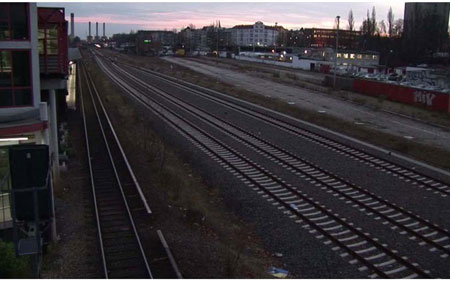
MAJA BAJEVIC Opening: Friday, 27 th February, 6 p.m. � 8 p. m. Exhibition period: 28th February � 4 th April 2009 EXTENDED until May 16, 2009 Galerie Peter Kilchmann is looking forward to announcing the second solo exhibition by Maja Bajevic. The artist will be presenting her latest video installation, �Space and Time�, as well as two earlier works called �En Attendant� (1995) and �Here�s looking at you, Kid" (1996). �Space and Time� is a double projection, shown on the front and the reverse of a projection screen in a dark room. Upon entering the room, at first only one film is visible. The first video shows a close-up of an alarm clock. It is a quarter past six, but the red second hand is stuck and only moves between 0 and 1. In the second video, we can see train tracks in a big city. This sequence was filmed at a distance, from a bridge and with a fixed camera position. It is dawn. A dramatic soundtrack was composed especially for this shoot, though there is hardly any movement visible within the image. When a train finally arrives at a very low speed and people get on it, the resulting scene of everyday life stands in stark contrast to the soundtrack. With her exceptional installation, �Space and Time�, Maja Bajevic has created a still life of the daily routine. She presents the fragmentation of concepts such as time and space. In the installation, everyday objects like the alarm clock do not represent time, but instead symbolise the space that can emerge between two seconds. Time does not matter anymore. By contrast, the arrival of the train becomes a symbol of a breakthrough in time. Through these two expressive images, Maja Bajevi� leads us into an exciting scenario for which the spectators themselves might imagine an ending. The journeys, often relating to migration, and the time factor are two of the main themes underlying Maja Bajevi�s work. The same applies to her work "En Attendant". On the floor close to the wall, we can make out a piece of grass riddled with worms and with the artist�s footprints in it. The artist wrote the following text on the wall with a pencil: Sometimes I want to scream, run, sleep�Sometimes I think that I don�t know anything. And I feel better.And then I think maybe I could go away somewhere,to, so to say, run away, why not?My legs are the fastest in running, my hands two weather vanes, scatterbrains, my head a balloon, and my legs?Not bad at all for runaways, so to say, they were made for it.And then I think�But I have been standing too long, and the earth has already gotten used to the shape of my feet. The final work is a video installation, displayed on a monitor, called �Here�s looking at you, Kid". This piece revolves around many of the questions asked within Maja Bajevi�s work. As a kind of performance, the artist stands in front of the camera and covers her face with black paint. Two fat tears are visible � a clownish and very touching moment. The artist created this work just after the war in Bosnia-Herzegovina (1992-1995). Maja Bejevic is one of the most important artists from Sarajevo. Today she lives in Paris and Berlin. During the last few years she has been invited to the Istanbul and Venice Biennials, as well as to the Documenta. Maja Bajevi� will hold a solo exhibition in Kunsthaus Glarus in September 2009, curated by Sabine Rusterholz. In this context she will create a new series of works called "Roadmovie". Last year, her first extensive monography of the years 1995 to 2007 was published, containing an interview with Angela Vettese and an essay by Lynne Cooke. The catalogue is available in the gallery. BERND RIBBECK Opening: Friday, 27th February, 6 p.m. � 8 p. m. Exhibition period: 28. th February � 4th April 2009 EXTENDED until May 16, 2009 Galerie Peter Kilchmann is pleased to announce the first solo exhibition of German artist Bernd Ribbeck (*1974, lives in Berlin). Several small format works on paper and wood (MDF) will be on display. Bernd Ribbeck is influenced by artists operating at the fringes of art history or whose works are orientated at spiritual ideas, such as Hilma Af Klingt (1882 � 1944, Swedish painter, spiritualist, theosophist and anthroposophist) and Emma Kunz (1892 � 1963, Swiss alternative practicioner and artist). Ribbeck is also interested in visionary thinkers who are sometimes detached from the world. Amongst these are architects of modern church buildings such as German Hans Scharoun (1893-1972), one of the key representatives of Organic Architecture. He designs peculiarly shaped buildings, which fuse modernist-rationalist ideas and clerical pretensions. Inspired by these artists and by exerting self-restraint as regards the format of his works, as well as in the choice of their shapes, Bernd Ribbeck aims to develop his own style. In his artistic language, the visionary represents the guideline. It is not primarily designed for application, but rather seeks to let other worlds proliferate. It is his enthusiasm and not the purpose of a quotation that creates images, which open up an epic space despite their abstraction. However, no narrative is being presented. The pictures act like statues alongside the story of a film. Bernd Ribbeck opens up a fictional world without explanations, creates icons without religions or, quoting Malewitsch: �naked icons of my era." Exhibitions: International 3 Manchester, Oldenburger Kunstverein (2009), Manifesta Trento (2008) Art 38 Basel Statements Galerie Kamm, Bonner Kunstverein (2007), Bielefelder Kunstverein, Kunsthalle D�sseldorf (2006). |
||||
re-title.com
International contemporary art
SIGN UP FOR NEWSLETTERS

 SIGN UP for ARTIST MEMBERSHIP
SIGN UP for GALLERY MEMBERSHIP
SIGN UP for ARTIST MEMBERSHIP
SIGN UP for GALLERY MEMBERSHIP
Click on the map to search the directory