|
Galerie Peter Kilchmann: JAVIER T�LLEZ - Rotations - 21 Jan 2012 to 25 Feb 2012 Current Exhibition |
||||
|
JAVIER T�LLEZ
Rotations January 21th to February 25th, 2012 |
|||
|
||||
|
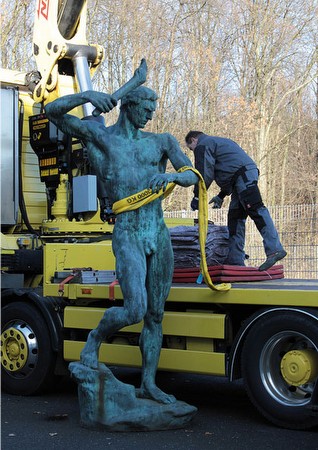
JAVIER TÉLLEZ Rotations January 21th to February 25th, 2012 Exhibition opening: January 20th, 6 – 8 pm Galerie Peter Kilchmann is pleased to present Rotations , a solo exhibition by Javier Téllez. Born in Valencia, Venezuela, in 1969, Javier Téllez currently resides in New York and Berlin. For almost two decades now mental illness has been one of the main subjects of Javier Téllez ʼ practice as an artist. Working often in collaboration with psychiatric patients, it is the aim of Javier Téllez to produce films and videos that attempt to challenge the stereotypes associated with mental illness, and – as Michele Faguet stated in one text on Téllez ʼ work – to “engage in an ethical manner with communities of individuals who live outside the models of normative behavior that define the parameters of a ʻsaneʼ society but that are constantly shifting in relation to the ideological structures that determine this social order ʼʼ. Therefore, important components of Téllezʼ projects are the specific social and political histories of the locations where they are developed, as can be seen with the two main pieces exhibited at the gallery. Rotations (Prometheus and Zwitter) (2011), a new film installation produced after a year-long DAAD residency in Berlin, focuses on the history of the psychiatric institution and its relation to historical events of the 20th century in the German context. The main protagonists of Téllez ʼ new films are two sculptures. One is Prometheus (1937) by Arno Breker, a monumental male figure that represents the mythological hero grasping a torch. The other figure is Weib und Mann oder Adam und Eva , also known as “Zwitter” (1920) by Karl Genzel, a small wooden figure depicting an hermaphrodite that holds a clock in its hand. Rotations (Prometheus and Zwitter) is an installation composed of two 35 mm silent films projections, showing these sculptures rotating at the same speed in different directions. The sculptures ʼ endless rotation is echoed in the installation by the film passing through the projectors in a loop, referring to the cinematic apparatus and its obsolescence as to the theme of repetition and difference in history. The films show the morphological similarities of the sculptures focusing in extreme details that display their materiality, but it is through the very disparity between the figures that meaning is articulated. The confrontation between both sculptures further attests to a shared history that is not revealed in the projected images and goes back to two parallel exhibitions organized in Munich by the National Socialists in 1937 – the infamous exhibition “Entartete Kunst ʼʼ and its counterpart, the “Grosse Deutsche Kunstausstellung”. “Entartete Kunst”, was an exhibition that toured trough Germany and Austria after its premiere in 1937 and consisted of modern art works that were chaotically displayed next to labels designed to inflame the public opinion against modern art, while promoting racial and political segregation. Works belonging to the Expressionist, Cubist, Dadaist and Neue Sachlichkeit movements were hung side by side in the exhibition with pieces by psychiatric patients in order to characterize the avant-garde artists as insane. A large number of artworks made by the mentally ill, including Karl Genzel ʼ s “Zwitter” were loaned for the exhibit from the Prinzhorn Sammlung, an art collection focusing on works of psychiatric patients and affiliated to the University of Heidelberg. Reproductions of Genzel ʼ s work were also juxtaposed with modern artworks in the pamphlet that advertised the “Entartete Kunst” exhibition. At the same time that modern art was denigrated by the “Entartete Kunst” exhibit, the Nazis promoted traditional paintings and sculptures, exalting the values of racial purity, militarism and obedience that characterized the Nazi ideology. Works that illustrated those values were selected to be part of the exhibition at the “Haus der Kunst”, exemplifying a ʻsaneʼ art imposed as normative, set against the works condemned as ʻdegeneratedʼ art. Arno Breker’s bronze statue “Prometheus”, originally commissioned by Joseph Goebbels for the garden of the Ministery of Propaganda was one of the centerpieces of the “Grosse Deutsche Kunstausstellung”. Breker ʼ s sculpture embodied in its heroic pathos the Aryan ideal that Hitler had previously associated with this mythological figure in his book “Mein Kampf”. The two German sculptors brought together in Tellez ʼ installation have obvious dissimilar artistic careers. Arno Breker was a protégé of Adolf Hitler and together with Leni Riefensthal and Albert Speer one of the most influential artists in Germany during the Nazi regime, while Karl Genzel was an outsider artist, and a psychiatric patient of the asylum in Eickeborn, diagnosed with schizophrenia. He was further one of the cases that Hans Prinzhorn analyzed in his groundbreaking book “Bildnerei der Geisteskranken (Artistry of the Mentally ill)” published in 1922. Bringing the unequal figures of Arno Breker and Karl Genzel together, Javier Téllez creates a multi-layered work, which not only attests to the instrumentalization of the Prinzhorn collection by the Nazi regime, but also poses questions of inherent complexity on the notions of normalcy and pathology that are still relevant today. Also on view in the exhibition is the film O Rinoceronte de Dürer (Dürer’s Rhinoceros) from 2010 in which Javier Téllez investigates the architectural structure of the panopticon. The film was shot entirely on location at the panopticon of the Miguel Bombarda Hospital in Lisbon, a psychiatric ward designed as a prison for the criminally insane. Built In 1896 and following the original plans of Jeremy Bentham, the panopticon accommodated 300 patients in narrow single cells grouped around a central tower. The prison was used until the year 2000 and has since become a museum. The fragmentary narrative of O Rinoceronte de Dürer (Dürer’s Rhinoceros) was conceived by the patients in a series of workshops conducted by the artist prior to the shooting of the film. The patients imagined themselves as inhabitants of the former insane asylum and acted fictional scenarios inside the cells. This reconstruction of the everyday life of the mental institution is complemented in the film with voice-overs quoting texts concerned with different architectural models related to the overseeing power of the gaze, like Jeremy Bentham ʼ s letter concerning the panoptic, Plato ʼs parable of the cave and Kafkaʼs short story The Burrow . This film was commissioned by the Calouste Gulbenkian Foundation, Lisbon, in 2010. Téllez exhibited at the 11 th Biennale de Lyon “Une terrible beauté est née”, curated by Victoria Noorthoorn in 2011. Recent single exhibitions include “Larger than Life” at the Museu Calouste Gulbenkian in Lisbon, Portugal and Marco, Museo de Arte Contemporánea de Vigo, Spain in 2010. The accompanying catalog can be obtained through the gallery. Javier Téllez will participate in TRACK at S.M.A.K. Ghent, curated by Philippe Van Cauteren and Mirjam Varadinis. |
||||
|
||||
re-title.com
International contemporary art
SIGN UP FOR NEWSLETTERS

 SIGN UP for ARTIST MEMBERSHIP
SIGN UP for GALLERY MEMBERSHIP
SIGN UP for ARTIST MEMBERSHIP
SIGN UP for GALLERY MEMBERSHIP
Click on the map to search the directory