|
Galerie Max Hetzler: HALFTONE: THROUGH THE GRID | VERA LUTTER - 14 June 2014 to 26 July 2014 Current Exhibition |
||||
|
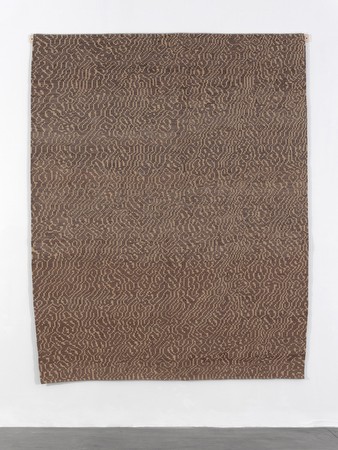
NAVID NUUR Local Study 3: The Eye Codex of the Monochrome, 2014
custom made rug (brown wool) 272 x 215 cm |
|||
|
||||
|
HALFTONE: THROUGH THE GRID Darren Almond, Tauba Auerbach, Mark Barrow & Sarah Parke, Jeff Elrod, John Houck, Navid Nuur, Albert Oehlen, Michael Raedecker, Ida Tursic & Wilfried Mille, Kelley Walker, Christopher Wool, Toby Ziegler Bleibtreustraße 45, Berlin-Charlottenburg June 14 – July 26, 2014 Opening: June 14, 6-8 pm 57, rue du Temple, Paris June 28 – July 30, 2014 Opening: June 28, 6-8 pm The grid is dead, long live the grid! For contemporary artists, grids are not anymore the result of Mondrian's or Malevich's modernist geometry, but a machine-generated object, endlessly reproducible without the intervention of a human hand. Call it halftone, bitmap or raster, it is always one of the many forms of mechanical or digital processing, by which an image or a three dimensional piece is turned into a multitude of coloured dots, or pixels, arranged in a logical matrix. This is how digital cameras, computers and printers handle images. Any shape can be transformed into mathematical data, and this data can be used again to produce an image displayed on a screen, printed on paper, on canvas or carved into any material. In a curiously ambiguous evolution, the technique offers an opportunity to work with as much as a form of mechanisation to fight against, while the man - machine relationship hesitates between cooperation and competition. Hence, a constant dialogue at the heart of the show: Albert Oehlen proposed in the early 90's, through his first Computer- paintings and drawings, to manually compensate for the deficiencies of the digitally generated image. Another influential pioneer, Christopher Wool works with the possibilities of reproduction of his artistic gesture, operating at the limit between the mechanical and the manual processes, adding in this case one further stage in this exchange by transposing the rasterised pattern into the warp and weft of a rug. A younger generation has now widely extended this reflexion, and new pictorial practices have appeared: Jeff Elrod composes striking hybrid images with analogue and/or digital processes, using computer softwares. Ida Tursic & Wilfried Mille create dense layered paintings dealing with the disappearance and the re-materialisation of images, questioning the clear distinction between figuration and abstraction, as does Toby Ziegler in his pictorial and sculptural works, deeply related to this reflection on the digitisation of images and the loss of information that can occur during their circulation. John Houck's Aggregates are first produced by computer software, but then creased and photographed, to become objects that exist between the digital and the analogue, between two and three dimensions. By means of precisely matching printing technologies and materials, Tauba Auerbach's transparent pieces and polarised images also play with our visual perception of the space works exist in. Michael Raedecker's paintings reveal the oldest analogue precursor of the rasterisation process: the drawing grid, while Mark Barrow & Sarah Parke use the loom, and weaving, as another early form of matrix-based image production, which echoes in the modern CMYK colour system. Meanwhile, Kelley Walker's pieces use the silkscreen, yet another analogue grid, to re-appropriate stereotypical media pictures. They interrogate what is constant and what is fluctuating in an image's shift from the glossies to the gallery. The relation between the mathematical system and the manual intervention appears clearly in the works of Darren Almond where mechanically produced objects form a rigid matrix, only to be disturbed again by the artist's intervention, rendering Almond's clocks abstruse, but strangely readable. In Navid Nuur's studies for The Eyecodex of the Monochrome, it is the materials used and the distance to the viewer that turn a dense computer-generated pattern into a smooth monochrome. In a show that will take place simultaneously in the Berlin and Paris venues of Galerie Max Hetzler, including a very wide range of media and different practices, grids become encoding and decoding devices, which logical rigidity is ceaselessly challenged by human interference. Halftone is organised by Pierre-Nicolas Bounakoff and Jean-Marie Gallais.A publication (English text) will accompany the exhibition. Vera Lutter Goethestraße 2/3, Berlin-Charlottenburg June 14 – July 26, 2014 Opening: June 14, 6-8 pm We are delighted to inaugurate an exhibition with works by Vera Lutter from the last four years in Goethestraße 2/3.Vera Lutter's fourth solo exhibition with Galerie Max Hetzler presents three of her latest work series. By using a camera obscura – a centuries-old technique that allows light falling through a tiny hole into a darkened room, projecting an upside-down, reverse image of the exterior world into the interior – she creates works which appear strangely alienated but familiar at the same time. Displayed as black and white negatives and due to an exposure process lasting days or even weeks, these unique photographs are void of any transient movement and show blurred, mirage-like silhouettes in front of an inky black sky. Despite their mystical appearance, one recognises many of the displayed places which often show well-known venues like the skyline of Manhattan, the Egyptian pyramids or the characteristic Renaissance architecture of Venice. The works presented in this exhibition depict less recognizable subjects but still provoke a similar ambivalent feeling of familiarity and disconcertment. Reverently the building of the medieval abbey Maria Laach raises brightly from the dark background. The monastery complex, build in 1220, is a paragon for late German Romanesque architecture and its distinctive construction and spiritual aura attracts numerous visitors. But in Lutter's photographs the place appears deserted. The long exposure time erases all temporary motions or reduces them to hazy contours with only the eight hundred years old facade of the church remains. Quite by contrast, there are Lutter's photographs of the radio telescope Effelsberg in the North Rhine-Westphalian town Bad Münstereifel. With a diameter of about 100 meters, the telescope is one of the largest of its kind and marks a milestone of technical progress. Lutter approaches the steel colossus from different angles as it stands in the tranquil landscape like a misplaced giant. Thus observed, the enormous dish of the telescope towers into the sky to explore distant gas and dust clouds, black holes and new stars. All of these works are characterised by a peculiar aesthetic that reminds us of X-rays or images from nightscopes. In her most recent series Cold Spring Lutter chooses a rather unusual subject for her work, a forest, located in the Hudson Highlands northern of New York. Different to earlier works no architectural or industrial structures become apparent nor do the photographs portray developments of urban or global life, but mere pristine nature. Again, time becomes the most important parameter. Lutter's specific technique allows her to capture an entire period of time rather than just a single moment. The light enables both the period of time as well as the occurring movement to become tangible. The dynamic, seemingly flowing contours of the forest floor and the brightly glowing transition from the horizon to the sky mark the specific interaction of light, motion and time that is so essential in Lutter's work. Vera Lutter, born 1960 in Kaiserslautern, lives and works in New York. Her works were presented in numerous solo exhibitions in international institutions, such as the Carré d'Art Musée d'Art Contemporain, Nîmes (2012); Fondation Beyeler, Basel (2008); Kunsthaus Graz (2004) and Museum of Contemporary Photography, Chicago (2002). Furthermore, she formed part of important group shows at the Museum of Contemporary Art Chicago (2012); Museo Nacional Centro de Arte Reina Sofia, Madrid (2010); Centre Pompidou, Paris (2009) and Museum of Modern Art, New York (2002), among others. Lutter's works are represented in prominent collections, such as the Centre Pompidou, Paris; the Metropolitan Museum of Art, New York; the Museum of Modern Art, New York and the Whitney Museum of American Art, New York. Press contact: [email protected] or (+49) 30 346 497 85-0 |
||||
|
||||
re-title.com
International contemporary art
SIGN UP FOR NEWSLETTERS

 SIGN UP for ARTIST MEMBERSHIP
SIGN UP for GALLERY MEMBERSHIP
SIGN UP for ARTIST MEMBERSHIP
SIGN UP for GALLERY MEMBERSHIP
Click on the map to search the directory