|
Galerie Max Hetzler: Andr� Butzer | Albert Oehlen - Interieurs | Group Show - 7 Sept 2013 to 19 Oct 2013 Current Exhibition |
||||
|
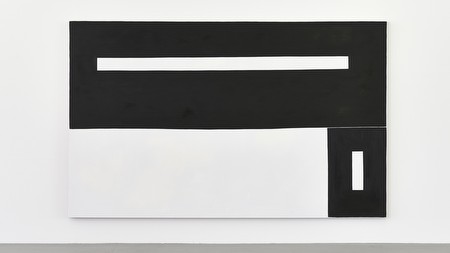
Andr� Butzer
Installation view, 2013 |
|||
|
||||
|
André Butzer Oudenarder Straße 16-20, Berlin-Wedding 06 September – 12 October 2013 Preview: 06 September 2013, 6 – 8 pm Galerie Max Hetzler is pleased to announce an exhibition of André Butzer, featuring new oil paintings, at Oudenarder Straße 16-20 in Wedding from 06 September until 12 October 2013. A continuous principle of Butzer's work is an intensive exploration of the limits and possibilities of the medium painting. The artist initially created pictures of intense chromaticity in the style of his 'Science Fiction Expressionism' that were partly characterized by a grotesque formal vocabulary and occasionally interspersed with figurative elements. Subsequently, an increasing abstraction prevailed, resulting in angled and at the same time moving lines and formations, usually painted in bright colors on a monochrome and flat gray surface. The exhibition focuses on recently created, so-called 'N-Bilder' ('N-images') which concentrate the energetic force of earlier compositions in alleged black and white surface ornamentation. Furthermore, all paintings are aligned to an imponderable measure 'N', which derives from the term 'NASAHEIM' ('NASA Home'), neologism by the artist. For Butzer, 'NASAHEIM' is an utopian, unattainable place, comparable to a threshold area where all colors are preserved. The painting as such consistently decays but at the same time renews itself in the sense of a permanent recreation. The brilliant canvas, rich in contrasts and potentially flooded with colour, becomes the base of ornamental structures spreading out upon the surface. The actual motive is the picture in its entirety, combined with its perception by the viewer. On closer examination, delicate, imaginary color shades emerge from the pictorial ground: reddish, bluish, yellowish and violet tones cause a bright colour flicker, giving the image a special optical acuity. As a consequence, the new paintings constitute a compelling development of Butzer's oeuvre as already defined by the formal structures created in his earlier works. The 'N-Bilder' ('N-Images') furthermore refer to the basic rules of artistic composition, the sheer proportions of the painting, setting them into slight motion at the same time. As in Cézanne's works, the opposites of life (upright) and death (horizontal) confront each other. Concerning the vivid as well as dark elements of the color panoply, Butzer considers his pictures as being the true artistic creators, while he as the author can only take second place. For the eye of the beholder he thus opens up new angles of vision on some of the most elementary topics of mankind. This is the fifth solo exhibition by André Butzer at Galerie Max Hetzler. André Butzer, born in 1973, lives and works in Rangsdorf near Berlin. His work was presented in several solo shows, such as in the Kestnergesellschaft, Hanover (2011); Kunsthistorisches Museum - CAC Contemporary Art Club at Theseustempel, Vienna (2011); Kunsthalle Nuremberg (2009) and Kunstverein Heilbronn (2004). He has furthermore participated in numerous important international group exhibitions including Kunsthalle Emden and MoCA - Museum of Contemporary Art, Los Angeles (2013); Museum für Konkrete Kunst, Ingolstadt/Kunstraum Munich (2012); Kunstmuseum St.Gallen (2011); Oldenburger Kunstverein; mumok, Vienna; ZKM - Museum für Kunst- und Medientechnologie, Karlsruhe; Kestnergesellschaft, Hanover (all in 2008); Rubell Family Collection, Miami (2007); Collection Goetz, Munich (2006); Museum der Moderne Salzburg; Carré d’art – Musée d’art contemporain de Nîmes; Museum am Ostwall, Dortmund; Kunstverein Ulm (all in 2005); Kunsthalle Hamburg; Kunstverein Graz; Kunstverein Frankfurt (all in 2003) and Kunsthalle Baden-Baden (2002). Albert Oehlen Interieurs Bleibtreustraße 45, Berlin-Charlottenburg 07 September – 19 October 2013 Preview: 07 September 6-8 pm Galerie Max Hetzler is pleased to open a new gallery space in Bleibtreustraße 45, Berlin- Charlottenburg with an exhibition of recent works by Albert Oehlen on September 7th, 6-8 pm. Simultaneously, Galerie Max Hetzler opens a second space at Goethestraße 2/3, Berlin-Charlottenburg, with a group show featuring paintings, collages and sculptures by Albert Oehlen, Markus Oehlen, Joyce Pensato, Matthias Schaufler, John Sparagana and Rebecca Warren. In the exhibition Interieurs we will present new large-scale works on canvas by Albert Oehlen made of cut-outs from advertising posters, mostly for German and Spanish supermarkets, as to be found on billboards. When in 2008 Albert Oehlen was asked why he had recourse to fragments of advertising posters in his new paintings, he answered: "I wanted emotions! At some points, I had to admit to myself that my approach to art was a bit sober. [...] At the same time, I'd always wanted to do Pop Art, big, colourful things with immediate appeal.” (Interview by Max Dax, in: Albert Oehlen 1991-2008, Galerie Max Hetzler and Holzwarth Publications, Berlin, 2008). The 'trashiness' of the advertisements is now all over the picture. "It seems that these days there are more advertisements that are anything but 'sophisticated', that just scream at you, adverts that foreground a ghastly red and yellow contrast, where white block capitals are given a black drop shadow. Blatant piles of consumer articles of one sort or another," says Albert Oehlen (idem). This material is precisely the starting point of Oehlen's new works. The compositions are all evocations of interiors, playing with shapes and textures of furniture elements, but also with architecture and perspective, as well as with characters' silhouettes. There is an obvious ambiguity between figuration and abstraction, produced by the contrast between the imagery of the advertisements and the new picture created. Some of the works from the series allude to Salvador Dalí's and Richard Artschwager's interiors. One can also observe the enigmatic recurrence of certain elements from one composition to another. Albert Oehlen began to work on this series in 2009; some Interieurs works are currently on view in the exhibition "Albert Oehlen, Malerei (Painting)" at mumok in Vienna until October 20th, 2013. The two new spaces of Galerie Max Hetzler are located in Charlottenburg and are walking distance from each other, offering a different context for the artists. The one in Bleibtreustraße is a typical Charlottenburg residential architecture in a Wilhelmine building. It has been used as Galerie Max Hetzler Temporary in 2011, on the occasion of Glenn Brown's solo show. The other space is a former post office built between 1881 and 1902 on Goethestraße 2/3 by the architect Wilhelm Tuckermann. Albert Oehlen, born in Krefeld in 1954, lives and works in Switzerland. Since 1981, he has been exhibiting regularly at Galerie Max Hetzler. Recent solo presentations of his work took place among others at mumok, Vienna (2013); Kunstmuseum, Bonn (2012); Carré d'Art, Nîmes (2011); the Museo di Capodimonte in Naples (2009); Musée d' Art Moderne de la Ville de Paris (2009); Whitechapel Gallery, London (2006); MOCA, Miami (2005); Musée Cantonal Des Beaux Arts in Lausanne (2004); Secession, Vienna (2004) and at the Kunsthalle Basel (1997). A fully illustrated catalogue distributed by Holzwarth Publications, Berlin, will accompany the exhibition. Albert Oehlen, Markus Oehlen, Joyce Pensato, Matthias Schaufler, John Sparagana, Rebecca Warren Goethestraße 2/3, Berlin-Charlottenburg 07 September – 19 October 2013 Preview: 07 September 6-8 pm Galerie Max Hetzler is pleased to open a new gallery space in Goethestraße 2/3, Berlin-Charlottenburg, with a group show featuring paintings, collages and sculptures by Albert Oehlen, Markus Oehlen, Joyce Pensato, Matthias Schaufler, John Sparagana and Rebecca Warren. Simultaneously, we will open another gallery space in Bleibtreustraße 45, Berlin-Charlottenburg, with recent works by Albert Oehlen. The six artists taking part in the group show are especially linked by an expressive gesture. The works on view range between abstraction and figuration, have a non-academic approach and combine different genres, thus challenging our conventional concept of reality and representation. With his two new pictures from the series Interieurs Albert Oehlen is raising the interaction between abstraction and figurative representation to a new level. The large-format canvases are composed of advertising fragments. The title Interieurs is only revealed at second glance: The blatant promotions are organized to create subtle illusionary spatial structures, in which silhouettes of figures or furnishings appear amongst signs and letters. The monumental sculptures by Markus Oehlen with their ornamentally corded cover also comprise an expressive gesture as well as a genre-spanning claim. While colour scheme, grid and organically curved lines evoke the artist's paintings, the use of technical or functional devices such as loud-speakers and car radios extend his experiments towards hybridity. American artist Joyce Pensato is subjecting the icons of American cartoons to an almost brutal dissolution by means of a gesture-painting inherited from Abstract Expressionism. Heads and figures are distorted, alienated or conflated to a totally new guise and displayed in threatening close-up on large format. By focussing on the black-white dichotomy, the monumental, expressive but also attentive application of paint obtains a graphic touch and the figures loose their assignability. The limits and possibilities of painting are also explored by Berlin based artist Matthias Schaufler, whose paintings at first glance appear to be purely abstract. Made of small-scale colour elements such as dots, speckles and short strokes in different density, these works also imply figurative elements which however remain undefined through scrappings and overlays. The collages by the American artist John Sparagana are entirely based on print media. Manifolded and cut according to a specific grid, several copies of the same magazine page provide the basis of the images. On some of them, the artist has exposed the invisible texture of the paper by abrasion. Grid, substrate and motif - in magazines usually perceived as a unit - are thus decomposed at different levels and presented as distinct elements before being put together again. The resulting image is overpainted with iconic motives of formalist pictures, thus submitted to additional abstraction. The sculptures by British artist Rebecca Warren also range between representation and abstraction. A rough, expressive formal vocabulary is combined with a subtle echo of significant sculptors in the history of art from Rodin to Giacometti and de Kooning. The spatial context and the relation between the objects are always involved in the disposal of the artworks. The painted bronzes with delicate slender silhouettes obtain their femininity through almost aggressively erupting sexual characteristics. Furthermore the untamed surface design forms an irritating contrast to the delicate colours used on the sculptures and pedestals. The two new locations of Galerie Max Hetzler in Charlottenburg offer different contexts for the artists: The space in Bleibtreustraße 45 is in a typical Charlottenburg residential Wilhelmine building. It has been used as Galerie Max Hetzler Temporary in 2011, on the occasion of Glenn Brown's solo show. The space on Goethestraße 2/3 is a former post office built between 1881 and 1902 by the architect Wilhelm Tuckermann. The new galleries are within walking distance from each other. Albert Oehlen, born in Krefeld, 1954; lives and works in Switzerland. Markus Oehlen, born in Krefeld,1956; lives and works in Munich. Joyce Pensato, born in Brooklyn, NY; lives and works in Brooklyn. Matthias Schaufler, born in Laichingen, 1964; lives and works in Berlin. John Sparagana, born in Rochester, NY, 1958; lives and works in Chicago and Houston. Rebecca Warren, born in London, UK, in 1965; lives and works in London. |
||||
|
||||
re-title.com
International contemporary art
SIGN UP FOR NEWSLETTERS

 SIGN UP for ARTIST MEMBERSHIP
SIGN UP for GALLERY MEMBERSHIP
SIGN UP for ARTIST MEMBERSHIP
SIGN UP for GALLERY MEMBERSHIP
Click on the map to search the directory