|
Galerie Francesca Pia: MAI-THU PERRET Alphabet: Paintings and Text Works 2004-2009 - 28 Nov 2009 to 20 Feb 2010 Current Exhibition |
||||
|
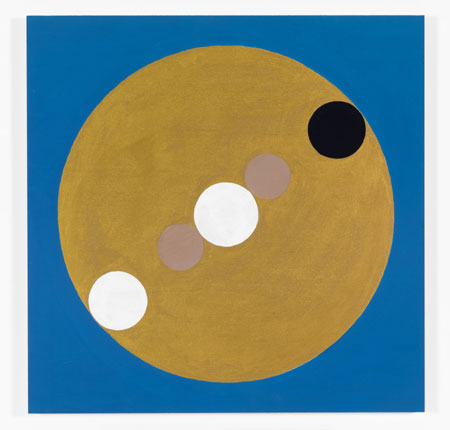
Mai-Thu Perret, Untitled, 2009
acrylic gouache on plywood Courtesy Galerie Francesca Pia, Z�rich |
|||
|
||||
|
||||
|
MAI-THU PERRET Alphabet: Paintings and Text Works 2004-2009 November 28, 2009 � February 20, 2010 Exhibition opening on Friday, November 27, 2009, 6�8 p.m. Fabrice Stroun: Can you tell us a bit about your decision to show abstract paintings, which are fairly recent, with a survey of your text works, which are older and in a way much more familiar? Mai-Thu Perret: There�s a formal simplicity to the juxtaposition which I find attractive. You know, text vs. image, glass vs. matte, this sort of thing. I don�t make too many two-dimensional works that hang on the wall, so maybe it�s just about flat stuff. It goes back to the question of language. The paintings always feel like symbols, signifiers for which you have lost the signified, or for which the signified doesn�t exist but which somehow drag you to search for it. As for the texts, they are fragments of stories, dispatches from a half-imagined world. I felt that it was logical to juxtapose these two different ways of dealing with meaning. FS: Let�s talk about the iconographic material that you are recomposing. I know your sources are quite varied, all the way from Indian religious painting to Constructivist works from the 1910s. MTP: There are so many different sources. In a way I am more interested in the succession of the images, in the way that one image comes after another, than in the image itself, although of course when I am making a particular painting I concentrate on it alone. The imagery, the formal language I borrow from is really all over the place. It�s almost anything that I can use to make an abstraction, although of course there are specific sources or worlds that I regularly return to. You mention Tantric painting and Constructivism. It�s about extremely reduced languages, the barest bones of a language or a signification, an elemental language of abstraction. I�ve always been interested in the way that all seemingly elemental languages are actually historical and have layers. Tantric painting to me is especially fascinating. On one level I just happen to like these kinds of shapes, probably because I have been exposed to them a lot, it�s fairly Pavlovian. But at the same time they complicate my reading of a more canonical tradition in abstract painting. A Tantric painting really messes up your understanding of� FS: �Kandinsky� MTP: �not even Kandinsky, because at least he was a mystic, but for example take Wladislaw Strzeminsky, whose paintings also have this elemental quality, or those of Rodchenko or El Lissitsky. You have this work which purports to be purely rational, or in the case of Strzeminsky, to be directly derived from a mathematical formula, and in fact other people have come to very similar formal conclusions from a completely different starting point. Of course if you pause to think about it a little longer mathematics are used in most mystical systems, but that�s another discussion. This text is an excerpt from a longer conversation available at www.francescapia.com Selected Exhibitions 2010 Haus der Kunst, Goldene Zeiten, M�nchen 2009 The Aspen Art Museum, 2013, Aspen 2008 San Francisco Museum of Modern Art, New Work, San Francisco Kunsthalle Sankt Gallen, Land of Crystal, St. Gallen 2007 Bonnefantennmuseum, Land of Crystal, Maastricht 2006 The Renaissance Society, And every woman will be a walking synthesis of the universe, Chicago Selected Collections - Bonnefantenmuseum Maastricht - Collection Kunsthaus Z�rich, Z�rich - Fonds National d'Art Contemporain (FNAC), Paris - Rubell Family Collection, Miami |
||||
re-title.com
International contemporary art
SIGN UP FOR NEWSLETTERS

 SIGN UP for ARTIST MEMBERSHIP
SIGN UP for GALLERY MEMBERSHIP
SIGN UP for ARTIST MEMBERSHIP
SIGN UP for GALLERY MEMBERSHIP
Click on the map to search the directory