|
Galerie Eva Presenhuber: Douglas Gordon | Gerwald Rockenschaub - 29 Aug 2009 to 31 Oct 2009 Current Exhibition |
||||
|
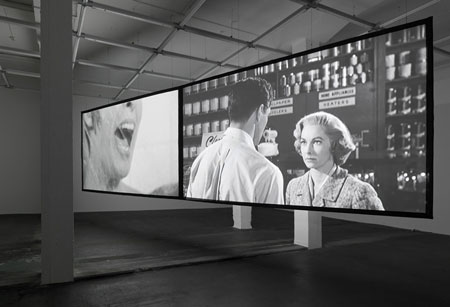
Douglas Gordon, 24 Hour Psycho Back and Forth and To and Fro, 2008
Video installation with two screens and two projections, rear projection screen Installation View, Galerie Eva Presenhuber, 2009 |
|||
|
||||
|
||||
|
Douglas Gordon August 29 to October 31, 2009 Opening: Friday, August 28, 6 � 8 pm Galerie Eva Presenhuber is pleased to open its 2009 fall season with a solo exhibition by Scottish artist Douglas Gordon. He will be presenting �24 hour psycho back and forth and to and fro�, a video installation projected on two large-format screens, as well as �Looking down with his black, black, ee�, a film shown on three monitors. In his oeuvre, Douglas Gordon explores antagonisms such as dread and temptation, death and life, innocence and guilt. This may be expressed, as in �Play Dead: Real Time�, by a camera circling a trained elephant that lies down as if facing imminent death, or, as in �B-Movie�, by showing a fly that, after wriggling its legs for a long time, eventually dies. The artist works with various media, such as film, installation, text, and sound, in addition to sculpture (i.e. in his skull pieces). His repertoire and conception revolve heavily around both the images of Christian iconography engraved in the collective mind of our culture and those conveyed by movie classics. In his video works, Douglas Gordon frequently uses original films that he alters by means of slow motion, repetition, rewind, or dissolve, thereby reinterpreting them. This approach allows him to transfer the myths, images, and projections of cinema to the realm of art. Douglas Gordon is probably best known for his way of dealing with Alfred Hitchcock�s �Psycho�. Gordon�s predilection for the movies of the famous British- American film-maker results from particular childhood memories: �When I was seven or eight years old, I watched movies such as �North by Northwest� and �Strangers on a Train�. I didn�t see �Psycho� until I was older, but I already knew quite a few things about the movie by then. I recall that my mother would always say: >You shouldn�t be watching that, you�re too young for it<�. These themes � what is allowed and what is forbidden, the good and evil, as well as his own memories � recur throughout the artist�s oeuvre. His first installation work was his 1993 film projection �24 hours Psycho�, which, according to Lewis Biggs, former director of Tate Liverpool, was �one of the defining icons of contemporary art in the last decade.� The version featured in our gallery, �24 hour psycho back and forth and to and fro�, was produced last year and presented at the Guggenheim Museum. In this piece, the same movie is shown simultaneously on two juxtaposed projection screens. The original movie, with a running time of 110 minutes, is slowed down and extended to 24 hours, which equals about 2 frames per second (as opposed to 24 frames per second in the original length). On one screen, the movie is projected backwards, while it runs forwards on the other. In the middle, the two of them overlap in the famous murder scene. This visual duplication adds a highly monumental and powerful touch to the tragic key scene. The lack of sound also removes part of the suggested sense of space. Thus, the movie appears like a (nightmarish) dream in which time and space do not correspond to our general experience thereof. Furthermore, the viewer may, in contrast to his usual visit to a cinema, move around the screens freely, watching one of the two movies from different angles or in its mirrored version. The temporal extension has an effect on our perception, too, for every one of the actors� moves, every detail of the equipment catches our attention. �To me�, says Douglas Gordon, �the point of �24 Hour Psycho� is that the plot takes place so slowly that you can never anticipate what happens next. The past confuses our memory. Because the images follow one another at such a slow rate, you cannot possibly remember them. The past continues, and the future never happens, so everything remains in the present. The present is where the future and the past converge continuously. As Heidegger said: It doesn�t really exist.� Through his manipulations, the artist dismantles place, time, and plot, whereas the image is given more importance. In other words, Douglas Gordon has invented a new way of approaching the medium of film. In his other work, �Looking down with his black, black, ee�, a film presented on three monitors, one can see crows looking down from the roofs of a Gothic church. Here, Douglas Gordon refers to the medieval idea of crows as symbols of misfortune. In medieval art, the crow was used to epitomize not only the bad and evil, but also death. The depiction of a crow sitting on a roof, for instance, was a mandatory attribute in the representation of witches. Another example that follows this tradition of associating crows collectively with negative connotations is Hitchcock�s 1963 movie �The Birds�. It is in literature, more precisely in a Scottish poem about a crow sitting on a treetop and looking down on a group of children, that the artist has found his inspiration for the title. These elements of menace (�looking down with his black� ee�) and fascination are central to Douglas Gordon�s video, too, resulting in questioning the criteria of good and evil. In the video, one must know, there is no plot that would lead to an unambiguous interpretation. Douglas Gordon�s works are characterized by immediacy and emotional presence. Moreover, with his found and self-shot films, he creates new contexts and challenges our patterns of perception. In 1996, his work won him the Turner Prize. Since then, he has been represented in exhibitions in major public museums in Europe, the US, Canada, and South America. In 2007, he was awarded the Roswitha Haftmann Prize in Zurich. Gerwald Rockenschaub August 29 to October 31, 2009 Opening: Friday, August 28, 6 � 8 pm Galerie Eva Presenhuber is delighted to present a new solo exhibition by Berlin-based Austrian artist Gerwald Rockenschaub (1952, Linz), titled �Simple Philosophy�. Gerwald Rockenschaub�s early works can be attributed to �neo-geo� (�new geometry�) painting, an art genre emerging in the 1980s that derives abstract form-finding from today�s environment and society, while referring to the abstract-geometric styles of 20th century art. Although Gerwald Rockenschaub has gradually turned away from the discipline of painting, his later installations and sculptures are based on similar ideas. In this context, his room installations are to be understood as minimalist objects on the one hand; on the other hand, they point to the exhibition conditions of contemporary art within the so-called �white cube�. In the late eighties, Gerwald Rockenschaub introduced a radical paradigm shift by drafting his objects on the computer and having them produced by specialized firms. With its tendency towards industrial design development procedures, the artist�s working method reveals a fundamentally interdisciplinary character. This is also expressed by his interest in electronic music, for instance. Working as a sculptor, graphic artist, and disc jockey, he thus left his mark on the aesthetics of the nineties � combining pop music with minimal, conceptual and contextual art. Gerwald Rockenschaub�s work incorporates space as an additional parameter: By placing his objects inside a room, he creates walkable sculptures. When the artist was featured in the Austrian pavilion of the 1993 Venice Biennale, he set up scaffolds on which the visitors could move through the room and thereby gain new perspectives. Every show starts with a thorough exploration and analysis of the exhibition premises, which then allows the artist, by means of � highly precise and concise � manipulation, to comment on them and offer new ways of experiencing them. In the exhibition room of our gallery, Gerwald Rockenschaub will be displaying different objects made of lacquered MDF (medium-density fiberboard) plates. When entering the room, the visitor will immediately catch sight of a dark brown wall that, measuring nine meters in length, in turn blocks the view of the rest of the exhibits. The existing spatial structure is both altered and renewed by the nature of the works. �The presence of some of my pieces�, says the artist, �respects the conditions of predetermined connections and struggles against every space-limiting physical barrier.� Upon walking further into the room, one will come across objects of different color. The rigorous geometry of the works is reminiscent of the minimalism of the 1960s, whereas their striking colorfulness appears to recall the playfulness of pop art. They evoke a variety of associations with familiar themes and objects: They make reference not only to the vocabulary of modernism, but also to phenomena of our everyday culture. It is often not clear whether to define the objects as elements of architecture, ready-mades, or autonomous sculptures in a traditional sense. All works may have a smooth structure and a seemingly cool surface, but thanks to their vivid coloration, they possess a sensual quality. Since Gerwald Rockenschaub conceives his works specifically in relation to a given exhibition space, every individual piece of art is linked to that space. The meaningful arrangement of these geometric works generates an area of tension that modifies the perception of both space and the works presented within. Rockenschaub aims to use his installations as some kind of generator for perception, playing on the viewer�s attitude of expectation and visual experience and stimulating his reason. �I endeavor to balance my way � to put it somewhat boldly � across the abyss that separates pure sensuality from pure intellect�, explains the artist. For further information, please contact Paula Stec at Galerie Eva Presenhuber. Upcoming exhibition at the gallery: Eva Rothschild, October 31 � December 23, 2009. Opening: October 30, 6 � 8 pm |
||||
re-title.com
International contemporary art
SIGN UP FOR NEWSLETTERS

 SIGN UP for ARTIST MEMBERSHIP
SIGN UP for GALLERY MEMBERSHIP
SIGN UP for ARTIST MEMBERSHIP
SIGN UP for GALLERY MEMBERSHIP
Click on the map to search the directory