|
Galerie Barbara Thumm: Christian Hoischen : Gekl�rt im rechten Winkel | Diango Hernandez : out-of-place artifacts (OOPArt) - 4 Sept 2008 to 4 Nov 2008 Current Exhibition |
||||
|
Christian Hoischen
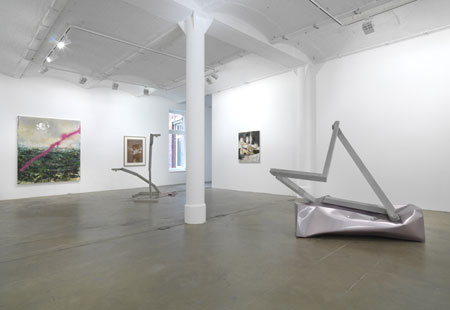
Installation view 'Gekl�rt im rechten Winkel' Galerie Barbara Thumm, Berlin 2008 |
|||
|
||||
|
||||
|
Dircksenstrasse 41, 10178 Berlin Christian Hoischen Gekl�rt im rechten Winkel Markgrafenstr. 68, 10969 Berlin Diango Hernandez out-of-place artifacts (OOPArt) Christian Hoischen Gekl�rt im rechten Winkel (Clarified in the right angle) 04.09.- 04.11.2008 Private view: 03. September, 7-9 pm We are delighted to announce the third solo exhibition by Christian Hoischen at the gallery. Luminous red, blue, and signal-yellow traces of graffiti wander across the surfaces of Christian Hoischen�s new paintings. Harmless cumulus clods, a heavily curtained window and three Eurofighters flying in formation have been conspicuously marked by the nonchalant employment of the spray can. With this aggressive gesture, Christian Hoischen broadens the repertoire of disturbances in his paintings, previously present in the form of spilled paint, splatters, scratches and blurring. Yet the destructive act is an integral part of the formative concept. Christian Hoischen�s artistic method consists in the application of coats of lacquer to a transparent fibreglass surface. In the process, the image is mirror-inverted � the foreground is painted or poured first, as is also the case with the traces of graffiti. Once the lacquer has hardened, the fibreglass is turned around and laminated onto a Styrofoam plate. The graffiti accordingly becomes a fundamental part of the pictorial idea and determines the composition to a decisive degree. The impression of spatial depth conveyed by the painting, however, is to be attributed to an unusual technique. In the details, the motifs reveal minimalistic colour progressions and material structures which evoke an image of elements scattered in a wild landscape. This impression is enhanced by the special surface aesthetic of the layers of lacquer. The picture appears to shine through glass now frosted-matte, now shiny-clear, thus evading the viewer�s visual grasp. The gaze encounters opaque layers of paint or, in areas free of paint, can make its way through to the grainy surface of the Styrofoam plate. The garish graffiti line heightens the colourful, material-bound iridescence, the work�s plasticity. Images from public printed media, advertising and film serve Christian Hoischen as motifs, which he shows in enlarged or severely cropped form. Stage magicians, athletes or politicians, explosions, car accidents and scenes of crude intimacy alternate with still lifes of a neglected potted plant or a purely functional stepladder. It is not the skilful reproduction of images already drained of meaning through their inflationary circulation that constitutes the quality of Christian Hoischen�s painting. It is his aggressiveness in the breaking open of perspectives, the openly fought conflict between overpainting and omission, and the scepticism toward the hierarchy of imagery which account for the strong lure of his works. Christian Hoischen continues his experimental handling of colour and form in his collages and works on paper. In �Malewitsch / Xavex Hedgefonds�, stringently formalized elements such as squares and straight lines are enhanced with cut-out, glued and spray-painted paper. All works, as well as the threads stretched across paper � now loosely, now forming an open trapezium � are presented behind glass, in some cases with passe-partouts in various colours, and in wooden frames. The artist�s �Leuchten� (lamps) are hybrids of the materiality of his paintings and the geometric transformations of his works on paper, translated into space. Reinforced concrete fragments of varying lengths with unworked ends jut out into the space of the gallery. The weakly shining light bulb mounted on the upper end places purist functionality and minimalist sculpture into a single, tension-filled context. In the large-scale sculpture, reinforced concrete elements clash with a lacquer-coated metal one, mutually deforming one another with all vehemence. The interplay sparked in the painting between disturbance/destruction and formation/construction is here taken to an uncompromising extreme. Text: Angelika Richter Diango Hern�ndez out-of-place artifacts (OOPArt) 06.09.- 25.10.2008 Private view: 05. September, 6-9 pm Galerie Barbara Thumm is pleased to present its first solo show �out-of-place artifacts (OOPArt)� on Diango Hern�ndez. The exhibition is taking place in cooperation with the Galerie Michael Wieseh�fer in Cologne, which will be opening its third solo exhibition on the Cuban artist concurrently with the Berlin show. On the occasion of these exhibitions, an artist�s book will be published with collages by Hern�ndez and a text (Guerrilla Warfare) by Ernesto (Che) Guevara. Diango Hern�ndez's solo shows at Galerie Barbara Thumm and Galerie Michael Wieseh�fer not only share the same title - �out-of-place artifacts (OOPArt)� - but are also inextricably interlinked, in the way that they constitute a continuous, both conceptually and material lycontinuous space. Both shows offer a complete impression and understanding of Diango Hern�ndez's project complexity. Forming a social revolution projection, together they are a powerful and metaphorical reflection on both, social and artistic contexts. The central piece at Galerie Barbara Thumm is �Shooting the Light�, an installation belonging to a series of three works dedicated to the theme of light. The two other works, �The Bay of Pigs� and �And the light had disappeared�, were shown at the group exhibition �Articulations� in Faro, Portugal this summer. Diango Hern�ndez is above all primarily interested in scrutinising the relationship between light and the history of power, two aspects which are quite often intimately linked. Thus the works refer metaphorically to the memory of concrete events: in �The Bay of Pigs�, the figure on the wall, traversed by several editions of the �Life Magazine�, functions as a tenuous physical and mental frontier between two realities, two sides of the same coin. �Might the light be an ephemeral error of darkness?�, asks Diango Hern�ndez. In �And the light had disappeared� � an immense drawing in which the white of the paper represents the light and the black of the pencil the darkness � Hern�ndez refers to the founding and clarifying gesture of the artist, who is a privileged witness to darkness and obscurity. In �Shooting the Light�, the third � and arguably the most powerful � piece in this light trilogy, the spectator participates actively in the construction or, perhaps more appropriately, the �destruction� of the installation. Once again working with the subject theme of boundaries, Diango Hern�ndez invites whoever enters the gallery space to �switch off� light bulbs by throwing stones. The most direct and enigmatic consequence of this act is to conceal the collages hanging on the wall. And the light had disappeared... The key word to access Diango Hern�ndez's artistic thought is �drawing�. In the work �We are unfinished drawings�, presented at the S�o Paulo Biennial, Hern�ndez uses the subject theme of the drawing as a space of frustration and of utopia that never truly fulfills his high expectations. Indeed, drawing � as a metaphor for the most inner individual expression � has been a particularly productive field of reflection and expression for the artist, in a �dialogue of the deaf� that he conducts with memory and the effects of the failed collective utopia that was the Communist revolution in Cuba. The two exhibitions share a series of collages of catalogue pages from illustrations of historic and valuable eighteenth-century European porcelain, depicting the aristocratic life and the exotic fantasies of the aristocracy of that time. �I have intervened in these pages in a very fundamental way: I have used pieces of cut-outs from porno magazines pages and I have glued them on top of the porcelain objects as a means of mocking them, adhering to one of the most important principles of a social revolution � to deconstruct the idea of the bourgeoisie, using for this purpose any kind of dirty strategy�. At Galerie Michael Wieseh�fer, Diango Hern�ndez presents the installation �The Only Book� a stylized iron bookshelf, holding a single but highly symbolical book, the first edition of Ernesto (Che) Guevara's famous treaty �La guerra de Guerrillas� (1960), as well as the comprehensive space installation �Cabin of Cutted Desires�, composed of a table converted in a ceiling lamp, 15 collages and a velvet curtain, which closures the room to obstruct the daylight. It is curious to note how drawing has been understood and used as a tool for thinking and as well as for inventing new forms of living and of conceiving reality in determined specific contexts. To draw is to project, to project ourselves imaginarily and materially into a given place, or feeling, or language, whatever� ; that will to experience the future is clearly linked to the secret and intimate exercise of drawing. In Hern�ndez's work, everything is to be understood as projection, as a desire for transformation, social transformation. Text: Nuno Faria |
||||
re-title.com
International contemporary art
SIGN UP FOR NEWSLETTERS

 SIGN UP for ARTIST MEMBERSHIP
SIGN UP for GALLERY MEMBERSHIP
SIGN UP for ARTIST MEMBERSHIP
SIGN UP for GALLERY MEMBERSHIP
Click on the map to search the directory