|
Galer�a Helga de Alvear: Elmgreen & Dragset | �ngela de la Cruz - 20 Jan 2011 to 5 Mar 2011 Current Exhibition |
||||
|
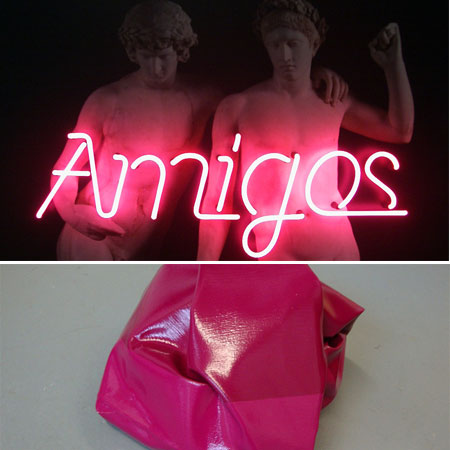
Elmgreen & Dragset, Amigos, 2010 (Detail)
Angela de la Cruz �Mini Nothing (Magenta)�, 2010 (detalle) |
|||
|
||||
|
||||
|
Elmgreen & Dragset Amigos 20 of January - 5 of March �ngela de la Cruz Transfer 20 of January - 5 of March Elmgreen & Dragset Michael Elmgreen (Copenhagen, Denmark, 1961) and Ingar Dragset (Tronheim, Denmark, 1968) have collaborated since 1995. Even though their early work revolved around performance, most of their production inhabits the language of sculpture and large scale installations. One of the central themes in their work is the role of homosexuality within our contemporary culture, seen both from a socio-political angle, and from an ironic point of view, critical to the gay clich�s themselves. In their hands, an iconic object such as the urinal (with clear reference to Marcel Duchamp) becomes a visual symbol with which to talk about the new gay rights to marry in contrast to a more promiscuous life style. In their investigations into today�s homosexual identity Elmgreen & Dragset have created functional, queer architectures such as "Cruising Pavilion" (1998), and shown this as a public sculpture and they have staged queer spaces by turning commercial galleries into abandoned gay clubs. The artists duo often recreate spaces that might appear real at first glance. A full scale 1980's New York metro station at the dawn of AIDS ("End Station", 2005) showed us how public space has changed since that time, and in "The Welfare Show" (2005), they transformed the posh Serpentine Gallery in London into a series of dull and sad looking institutional spaces. Latest they have erected a replica of a whole apartment block inside the ZKM museum in Germany for their solo exhibition "The One & The Many" (2010). But maybe the most well known of their works in this genre, is �Prada Marfa� � a Prada shop fully equipped with hand bags and shoes, located in the middle of the Texan dessert. Elmgreen and Dragset have taken part in important group exhibitions such as the 2009 Venice Biennale, or the 2007 M�nster Sculpture Projects. They have had solo exhibitions at the ZKM, Karlsruhe (Germany), 2010, MUSAC, Le�n (Spain) in 2009, the Malm� Konsthall (Sweden) in 2007, and Tate Modern (London), in 2003. They have also received significant public commissions, such as the Memorial to Homosexual Victims of the Nazi extermination camps in Berlin, and recently, they won the competition for the next 4th Plinth commission in Trafalgar Square, which will be inaugurated in the Olympic year of 2012. Angela de la Cruz Transfer Angela de la Cruz presents her first solo exhibition in Galer�a Helga de Alvear. The Galician-born artist (La Coru�a, 1965) studied Philosophy at Santiago de Compostela University, and, at the end of the 1980's, she moved to London with the intention of devoting herself to art. There, she completed her training at the Slade College and at the prestigious Goldsmiths College. Currently, she continues to live in London. In 1996, she starts to break the paintings. Literally. The canvas, sometimes along with the frame, is wrinkled, deformed, folded, and, finally, broken. Beyond the Fontana-like cut or a mere pictorial resource, De la Cruz submits her paintings to a deliberately physical and willingly transforming process with the decisive aim of extending the limits of the canvas until bringing it close to sculpture. Her intention is not only to abandon the flat surface in favour of the three-dimensional object, but to reveal the passage of the work in this physical process. The result ranges from the sacred and the sublime to irony or tenderness. A key step in her goal to reach the sculptural, was the incorporation of objects, furniture, that have been generally found or recovered from the street. Thus, chairs extend their legs with crude and obvious protheses that make balance all but impossible, cabinets are wrinkled in order to try to fir way too small boxes, and shelves fold like an accordion that has hit the floor. On several occasions, there has been talk of the parallelism, or, rather, the reflection of her biography in relation to the actions her work is subjected to. On other occasions, De la Cruz has even stated that she sees the frame as "an extension" of her own body. Finally, certain works have a symbolic relationship to the artist, especially in the geometric forms and the sizes and proportions she uses. The work of Angela de la Cruz uses colour in a very particular manner, by choosing tones on the edge of ugliness, eerily touching on displeasure. Paint is applied in masses, as if she wanted to make the spectator doubt whether the result is due to an obssessive manual determination, or, on the other hand, it has been produced in an industrial and mechanised way. Eventually, the sticky surface end up bringing the canvas close to the texture and shine of plastic. Finally, we should point out the sarcastic sense of humour with which the artist contemplates her own work, and which becomes evident in titles such as "Hung", "Squashed", or "Deflated", with which it almost seems as if she was mocking her creations. Angela de la Cruz has had solo exhibitions at the Camden Arts Centre (2010), the Culturgest Centre in Lisbon (2006), and the MARCO Museum, Vigo (2004). Recently, she has been nominated for the 2010 Turner Prize, and she has been awarded the important Paul Hamlyn Award. |
||||
re-title.com
International contemporary art
SIGN UP FOR NEWSLETTERS

 SIGN UP for ARTIST MEMBERSHIP
SIGN UP for GALLERY MEMBERSHIP
SIGN UP for ARTIST MEMBERSHIP
SIGN UP for GALLERY MEMBERSHIP
Click on the map to search the directory