|
Galer�a Helga de Alvear: Jane and Louise Wilson : Unfolding the Aryan Papers | Callum Innes - 25 Mar 2010 to 22 May 2010 Current Exhibition |
||||
|
Jane and Louise Wilson
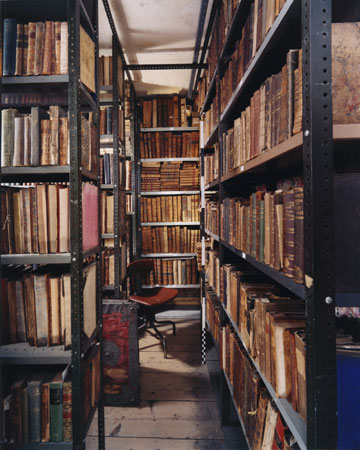
Oddments Room #VI, My Life in Four Continents, 2008 |
|||
|
||||
|
||||
|
Galer�a Helga de Alvear March 25th � May 22nd, 2010 Opening hours: 11:00 � 14:00 and 16:30 � 20:30. Exhibition opening: Thursday March 25th 2010, 20:00. Jane and Louise Wilson Unfolding the Aryan Papers Jane and Louise Wilson born in Newcastle 1967, based in London, and are considered to be a part of the Young British Artists (YBAs) generation. They were nominated for the Turner Prize in 1999 and have exhibited in important institutions and museums internationally. Since the 80�s they have been working collaboratively, their work predominately dealing with notions of our cognitive relationship between spaces, architecture and time. For the Wilson�s inaugural exhibition Unfolding the Aryan Papers at the gallery they are presenting works which resulted from their fortuitous access to the Stanley Kubrick archives. Known predominately for their films, the Wilsons have continually explored the states of consciousness and phenomenological associations with locations. In the exhibition there are several bodies of works which are derived from their research in the Kubrick archives - consisting of the film Unfolding the Aryan Papers, photographic works The Oddments Room, Stills from Kubrick-Ealing archive and sculptural works which is a new development in their practice. While exploring these extensive archives they discovered incomplete films scripts, one of which Unfolding The Aryan Papers was about the Holocaust. During further research they came across one of the original actors Johanna ter Steege who was cast for the role of Tanya, whom agreed to work with the Wilsons on this project. The focus of these works encompassing the idea of an archive and delves into a film never made � existing only in the documents and in the memory of Tanya. Unfolding The Aryan Papers film is a tapestry of film stills and original footage shot by the Wilsons with Tanya recounting her experience with Kubrick and quoting from the original script. The inventive use of the mirrors positioned at either side of the screen extends the film further, momentarily disorientated the audience while at the same time becoming encapsulated by the work, a visual stereo. Perhaps a reference to the archives themselves, a continuing and repetitive trail of film or as the image fades into obscurity becoming an endless memory for dually Johanna ter Steege and her character. In the photographic works shot in Maggs antiquarian bookshop in London, the title The Oddments Room relates directly to the Kubrick location archives and the location itself. The latter being a book hospital for incomplete first and second editioned books, awaiting pages to complete them. The yardstick in the doorway becomes like a �measure of space and scale, and a measure of time� in the words of the Wilsons. Replacing the yardstick is a lone figure dressed in 50�s dress, stands with her back to the audience in the doorway, as though on the threshold of what has passed and what potentially lays ahead. Stills from Kubrick-Ealing archive is a selection of black and white photographs which are manipulated copies taken from the original Kubrick archives, reveal his methodical fervor in accruing information for films. These photographs themselves become another generation of archive. Presented alongside the photographs are the life-size bronze cast yardstick sculptures, an element found in the photographs, however as the Wilsons point out it also becomes a physical reminder of space and of another age, as the imperial measurements become something of the past, otherworldly. This in turn reflects the interest held by the Wilson�s investigation into memory, history, space and time associated with locations, and how we relate to these places as we animate them with our presence. Jane and Louise Wilson are currently exhibiting with a major survey of their works at Fundaci�n Calouste Gulbenkian, Lisbon, which will travel to CGAC, Santiago de Compostela. Recent exhibitions include Talbot Rice Gallery, Edinburgh 2009; The Quad Gallery, Derby 2008. Selected exhibitions include MoMA, NY; MoMA San Francisco, Guggenheim, Bilboa and The Baltic Centre for Contemporary Art, Newcastle. Callum Innes Callum Innes was born in Edinburgh(United Kingdom) in 1962, and studied at the Edinburgh College of Art, where he graduated in 1985. Although his interest was aimed towards figurative painting, a decisive encounter with the work of Lucio Fontana drives him to become passionate about the possibilities of abstraction, a realm in which he has worked ever since. His work operates at the limits of the monochrome, upon which he develops processes of addition or subtraction from the painting to the canvas. Thus, on the already painted-on surface, he adds turpentine, which eliminates different quantities of layers of paint; from a sometimes subtle extraction to leaving hardly a trace of paint in other cases. In this manner, he incorporates the concept of time to the work: the erosion, and the process, become a fundamental element of the painting. This would be similar to "exposure" in the process of developing a photograph. It is also worth mentioning the relevance of the brush stroke, of the gestural, of the geometric format, and of the opposition between vertical and horizontal elements. Therefore, the gesture that leaves a trace, reveals and manifests the totality of the art work is fundamental. For Innes, colour has a strong emotional and sensual nature, with associated values which characterise it and oppose and relate to each other. Sometimes, the painting starts with a single homogeneous colour, which undergoes alterations whilst being overlapped by another colour. The result conveys, affects, and reflects mood. His work is developed in series defined by the technique and by the linguistic concerns of the works which inform them. The latter can develop over a long period of time, returning the them over and over again. His most famous series (Exposed Paintings) divides the canvas in geometric areas, where he has worked in different manners. The works presented in this exhibition at the Helga de Alvear Gallery are executed by preparing the canvas with a solution of glue and plaster, and then dividing it with a vertical line. Then, both parts are painted in the same colour, only to methodically eliminate the colour in one of them. In the central line we find the remnants of the process, almost as if it were a fossil record. Callum Innes has exhibited his work at the Tate St. Ives (U.K.), at the Irish Museum of Modern Art in Dublin (Ireland), at the Sydney Museum of Contemporary Art (Australia), or at the Bern Kunsthalle in Switzerland. In 1998, he received the NatWest Prize, and in 2002, the Jerwood Painting Prize. He was nominated for the Turner Awards in 1995. |
||||
re-title.com
International contemporary art
SIGN UP FOR NEWSLETTERS

 SIGN UP for ARTIST MEMBERSHIP
SIGN UP for GALLERY MEMBERSHIP
SIGN UP for ARTIST MEMBERSHIP
SIGN UP for GALLERY MEMBERSHIP
Click on the map to search the directory