|
Galer�a Helga de Alvear: Marcel Dzama Delila's Dance | Ettore Spalletti - 14 Jan 2010 to 13 Mar 2010 Current Exhibition |
||||
|
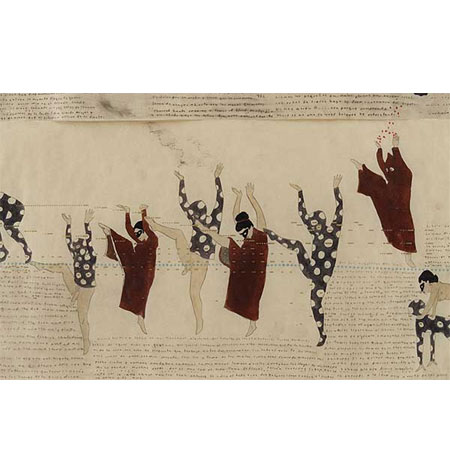
Marcel Dzama, "The possibilities of a rider�s song�, 2009
Tinta y acuarela sobre papel. (Detail) |
|||
|
||||
|
||||
|
Galer�a Helga de Alvear Jan 14th - March 13th, 2010 Opening hours: 11:00 - 14:00 and 16:30 - 20:30 Marcel Dzama Delila's Dance Marcel Dzama (1974, Winnipeg, Manitoba, Canada) presents his second solo exhibition in Spain, and first in Galer�a Helga de Alvear. His drawings, endowed with a unique and personal imagery, have become extremely popular in the past few years. Marcel Dzama's world is rooted in the history of traditional illustration, with visual references which refer us to the classics from the decades of the 20's and 30's of the last century. Nevertheless, it is as if the artist were presenting us with a perverse version of these. He has created a personal, perfectly identifiable iconography, with recurring characters who perform rather difficult to discern actions, creating an atmosphere, an aura, full of humour, irony, anxiety and absurdity. These are hybrid characters, personified animals, animate objects. Their actions are sustained on the limits of narrative, prompting the spectator to find a meaning, a linearity, which doesn't lead anywhere but which keeps the spectator guessing. It is as if we had access to a unique, not decisive moment, not knowing what happened before or what comes after. The works are realised in pencil, ink and watercolours with a restricted palette: there is a dominance of red, brown, green, khaki, grey and black. The paper background is always left white, emphasising that reference to traditional illustration and, occasionally, the artist adds a text, either a line as a title or filling up the whole page. He has produced a project specifically for this exhibition, in which he has given vent to Spanish motives. Almost as in a circus parade in which we see Don Quixote, bulls and bullfighters, flamenco dancers and a new character in his world; perverse, dressed in polka dots, and sexually ambiguous, these figures along with details borrowed from Goya's drawings and quotes from Federico Garc�a Lorca and from the Aragonese painter himself. Regarding The Dance of Delilah, the artist says: "I had recently embarked on the task of collecting the images piled up around me, and Delilah wasn't something I was expecting to do. It emerged from the concern with the meaning of existence, and, above all, the death of the anonymous masses. Thus, Delilah dances with uncertainty and plays with language, as if she really cared about one language or another. Beyond that, the rules are random, and nothing is familiar or usual, although they do join the rhyme and richness of the harmonies and the suggestions of the imagery. So, please, enjoy the dance." Along with the series of drawings, the artist also presents the video "The Infidels", in which two armies, a male and a female one, face each other in a battlefield, mixing choreography and details of great violence. Ettore Spalletti Ettore Spalletti was born in Cappelle sul Tavo (Pescara) in 1940, and started exhibiting in the early 80's. He has participated in the Venice Biennale on several occasions, and his work constitutes a landmark in the Italian art scene of the past decades. Without a doubt, the chief characteristic of his work is its formal simplicity: these are monochromes, usually in a recurring series of colours (grey, light blue, pink and white) which, in turn, provide the title of the work. From this very moment - that of titling the piece - Spalletti makes clear the purpose of his work: what you see is what it is. These are regular, and almost always pure shapes, in which, sometimes, there is a small transformation, a diagonal cut, which prompts the appearance of another plane: an apparently minimal nuance which, nevertheless, constitutes a fundamental change. His exempt works are "columns" or "glasses" which are still premised on geometric nature, while reclaiming their origin in the Classical world. For the artist, paintings and sculptures end up forming a unity with space. Technically, painting is applied following the methodology which the artist calls "impasto", and which relates these paintings to the tradition of the fresco, while at the same time making them gain materiality by emphasising tactile qualities, and sets them apart from easel painting in order to enter the realms of sculpture and the third dimension. He also uses pure materials: pigments and stones in their original colour, with no other manipulation but the cut and the point of view. Spalletti aims to withdraw from Minimalism, and reclaims his roots in the Italian Renaissance. Indeed, his colours are those of Piero de la Francesca or Fra Angelico, and his use of gold leaf (which could be severely criticized by Alberti) sets him definitely aside from Arte Povera. These are works that aim at beauty as an unequivocal form, that aspire to the sublime in an unquestionable manner, and that avoid coolness with a decisive commitment to sensuality. Here, every reflection, every highlight, every tactile sensation, is vital. Spalletti understands the contemplation of the art work as a relationship in which time and space do matter. Ettore Spalleti's work has participated in the Documenta 7 and 9 in Kassel, in the Venice Biennale on three occasions, in the M�nster Projects, and has been exhitited in Spain in the IVAM (Valencia) and La Caixa Foundation (Madrid and Barcelona). For further information, contact the gallery at the address below. [email protected] [email protected] Galer�a Helga de Alvear Doctor Fourquet, 12 28012 Madrid Tl. 91 468 05 06 Fax 91 467 51 34 |
||||
re-title.com
International contemporary art
SIGN UP FOR NEWSLETTERS

 SIGN UP for ARTIST MEMBERSHIP
SIGN UP for GALLERY MEMBERSHIP
SIGN UP for ARTIST MEMBERSHIP
SIGN UP for GALLERY MEMBERSHIP
Click on the map to search the directory