|
Galer�a Helga de Alvear: DJ SIMPSON PRUDENCIO IRAZABAL - Regiones del aire - 22 Sept 2009 to 19 Nov 2009 Current Exhibition |
||||
|
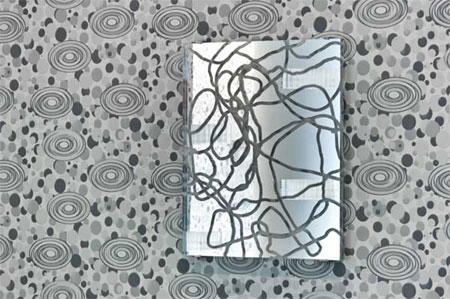
DJ SIMPSON
Untitled, 2009 Image � the artist, courtesy Galer�a Helga de Alvear |
|||
|
||||
|
||||
|
DJ SIMPSON Galer�a Helga de Alvear September 22nd 2009 - 19 November 2009 Opening hours: 11 am - 2 pm & 4:30 - 8:30 pm. Opening: Tuesday September 22nd 2009 at 8:00 pm It is with DJ Simpson's unique language that one becomes immediately seduced and drawn to investigate. On first appearance these works fall somewhere between the realms of painting and sculpture capturing the intrigue of the viewer. For his upcoming exhibition Simpson brushes, planes, punctures, carves, loops and cuts onto mirror laminated transparent Perspex creating heterogeneous landscapes. Usually working on an immense scale pieces has shifted his focus back to a more intimate scale. Gesturing with a routing tool rather than a paintbrush he is recognized for working with formica laminated to Plywood and multicoloured acrylic sandwiched together. Once forms appear on these monochromatic surfaces, a toxic organic-like fusion is revealed, reminiscent of Pollock for his unconventional use of medium to seemingly Dionysian compositions. However therein lies the dichotomy of Simpson�s practice as there are fields of tranquility and order, of control versus chaos. The forms realised in the works by the gesture of the routing and an axonometric tool are used to create ovals in the work which are formally used in architectural drawings, causing the fraught tension between the structured in the latter and fluid forms in the work. Shadows and figure are an important aspect within the composition as they constantly vascillate in the structure between the perspective shapes The use of wall paper becomes a backdrop for the works and perhaps a tool as a counterbalance between a repetitive system and the art historical and class associations with the use of wall papers. An Op Art reign descends as with the works of Bridget Riley, pulsing in a contemporary canonization of the baroque. After close inspection as with most wallpapers the walls reveal a pattern consistency, a planned structure, a mathematical system. The works hung on these wall reiterate the systems within themselves the constant being the material and the forms and patterns the variables, partially governed by the composition of the material. Like the wall paper there are variables as the technique used in surface printing are not always precise, this is visible in the mark left by the ink. Almost baroque, the installation of the works is reminiscent of the mirrored room in the palace at Versailles. It is no surprise that as one engages with Simpson�s work one is compelled to investigate and categorize this mark making process on this artifice, as a sculpture, a painting or drawing and where does it fit into the art historical modern art and abstraction. Simpson�s forges a reinterpretation of modernist abstraction and while the performative aspect of the works commands a visceral response. David Simpson (Lancaster, 1966) has shown in exhibitions in the Bloomberg Space, London (2009), Centre de Cultura de Palma, Palma de Mallorca (2008), MIMA, Middlesbrough (2007), Centre Contemporary Art Centre, Athens (2004), Museum PRUDENCIO IRAZABAL Regiones del aire Galer�a Helga de Alvear September 22nd 2009�19 November 2009 Opening hours: 11 am - 2 pm & 4:30 - 8:30 pm. Opening: Tuesday September 22nd 2009 at 8:00 pm In his second exhibition at Galeria Helga de Alvear, Prudencio Irazabal presents work produced in last two years. Born in Puentelarr�, �lava, in 1964, his professional career has been marked by American painting, following his moving to the States during the mid-1980's. He regularly exhibits in his city of residence, New York, in Los Angeles or in San Francisco. His work focuses on the specific characteristics of abstract painting, paying close attention to the developments of the past few decades. This doesn't imply he is following some kind of official canon, but, rather, in some aspects, his work actually goes against the grain of these axioms. Nevertheless, he always starts off from a very clear and meditated decision, which originates in a deep knowledge of these same theories. Without doubt, the most defining and also most easily recognizable aspect of Prudencio Irazabal's work is the importance and treatment of colour. This is the main motif of his work and its absolute protagonist. A deep analysis of perception allows the artist to masterfully execute the transition from one to the other, which happens in an almost imperceptible, but definitive manner. It is an aesthetic which sheds form as symbol and which has been often related to the aesthetic derived from the use of new technologies. Another fundamental issue is the value assigned to the surface of the painting; it is endowed with a misleading depth which is articulated or hidden, depending on the point of view. The layers of paint don't create any kind of relief, they are not "non-painterly" paintings in the traditional sense of Informalism, but, rather, it is a case of the artist actually reaffirming the flatness of the painted surface. Irazabal resolutely sheds the three-dimensionality of the canvas, both in its illusionistic and in its real connotations. In this very sense, one should point out the importance of finish in his work, which further emphasises flatness while at the same time turning the canvas into an exquisite object. This, in turn, relates to the artist's understanding of painting: as a celebration of the act of painting and of contemplating. Regarding his new pieces in this exhibition, it should emphasise the greater presence of drawing, which affects colour in a configuration described by Irazabal as "sculptural": "Now the final layers reveal their borders and constitute a reference to the mediated nature of perception. This seeing through, which has always been an essential concept in my work, is made evident through the singling-out of some of the final layers. The latter effect a trajectory which only apparently takes place on the surface, since, through a balanced play of resonances, the colours of these layers are inserted in the lower spaces, where they generate other colours and trigger a continuous backwards and forwards movement of the gaze." |
||||
re-title.com
International contemporary art
SIGN UP FOR NEWSLETTERS

 SIGN UP for ARTIST MEMBERSHIP
SIGN UP for GALLERY MEMBERSHIP
SIGN UP for ARTIST MEMBERSHIP
SIGN UP for GALLERY MEMBERSHIP
Click on the map to search the directory