|
Galer�a Helga de Alvear: GONZALO PUCH : �Introduction to Meteorology� - 8 May 2009 to 20 June 2009 Current Exhibition |
||||
|
Gonzalo Puch
Sin t�tulo, Fotograf�a color, 2009 |
|||
|
||||
|
||||
|
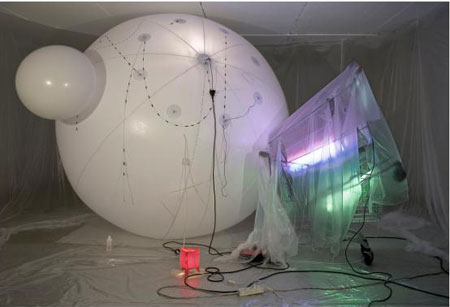
english below GONZALO PUCH �Introducci�n a la meteorolog�a� Galer�a Helga de Alvear 8 de mayo de 2009� 20 de junio de 2009 Horario: 11:00 a 14:00 y 16:30 a 20:30 h. Inauguraci�n: viernes 8 de mayo de 2009, 20.00 h. Esta es la primera muestra de Gonzalo Puch en la Galer�a Helga de Alvear. Su obra es ya de sobra conocida y representa una de las creaciones m�s originales dentro del panorama de la fotograf�a en Espa�a con una personalidad propia e inconfundible. El mundo retratado por Gonzalo Puch se compone de escenificaciones que, inicialmente, se desarrollaban en su estudio. Son verdaderos bodegones construidos en un entorno cotidiano, casi dom�stico, en los que destacan la nitidez y el instante detenido como principales caracter�sticas conceptuales. Como si la fotograf�a le sirviera para re-construir el mundo o, cuando menos, su mundo. Son creaciones hibridas sobre papel fotogr�fico que se relacionan con la escenograf�a y la escultura. El artista utiliza su entorno cotidiano (el aula donde imparte clases, el taller y el estudio) para realizarlas. Las composiciones se vuelven m�s complejas y ricas a medida que van entrando en ellas nuevos elementos y temas. Entre los m�s recurrentes se plantea la dualidad entre el Conocimiento y la Naturaleza. El primero se simboliza en teoremas, f�rmulas y diagramas dibujados en pizarras, en crisoles, redomas y alambiques. Por su parte la Naturaleza se hace presente a trav�s de plantas y flores. En sus primeras im�genes la presencia humana es escasa pero se ir� haciendo m�s frecuente con el paso del tiempo En estas composiciones se adivina un orden medido y meticuloso frente a un aparente caos, del mismo modo que parecen estar en equilibrio entre las dualidades que propone el artista: im�genes interiores en las que la luz proviene claramente del exterior, contraposiciones de objetos aparentemente opuestos entre si, escenas solitarias en las que se adivina la acci�n del hombre. Cuando su obra sale al exterior del estudio, la Naturaleza va ganando paso pero Puch la muestra degradada, afectada por la acci�n humana. Sus inicios art�sticos se desarrollaron en el �mbito de la pintura para extenderse luego a la escultura, la instalaci�n y, finalmente, la fotograf�a. Para su exposici�n en la galer�a Helga de Alvear, Gonzalo Puch vuelve de alguna manera a esos or�genes al traspasar de nuevo el marco de la foto y ocupar el espacio tridimensional de la sala de exposiciones. En esta ocasi�n Puch presenta una construcci�n que recuerda a las composiciones que aparecen en su obra fotogr�fica. De hecho, en la segunda sala presenta fotograf�as tomadas de y en esa misma edificaci�n. Podr�a ser un gabinete de ciencias o un laboratorio o el lugar de investigaci�n de un meteor�logo aficionado. Los elementos son los ya conocidos en su trabajo: aparatos que miden no se sabe qu�, diagramas de isobaras en las paredes, redomas burbujeantes y plantas que crecen desde dentro hacia el exterior del edificio. Y tambi�n volvemos a encontrar el humor y la poes�a, el orden y el caos, la acumulaci�n y el azar, lo cotidiano y lo excepcional. GONZALO PUCH �Introduction to Meteorology� Galer�a Helga de Alvear 8th May 2009 � 20th June 2009 Opening hours: 11 am � 2 pm & 4:30 � 8:30 pm Opening: Friday 8th May 2009 at 8 pm Though this is Gonzalo Puch�s first show at Galer�a Helga de Alvear, he is already widely recognised as having one of the most original and creative bodies of work in photography in Spain with his unmistakably unique language. The world portrayed by Gonzalo Puch is composed of settings he initially stages in his studio. Conceptually underpinned by the frozen instant and dazzling clarity, they are authentic still lifes built in an everyday, almost domestic, environment. It is as if the photograph would help him to re-construct the world or, at the very least, his own world. They are hybrid creations connecting with stage design and sculpture which the artist creates from his everyday (the classroom where he teaches, the workshop and the studio). The compositions become richer and more complex as they bring on board new elements and themes. Among the most recurrent is the duality between Knowledge and Nature. The former is symbolised in theorems, formulas and diagrams drawn on blackboards, crucibles, flasks and stills while the latter is made present in plant and flowers. Likewise, though the human presence was negligible in his early images it has become more frequent. Underlying these compositions one can discern a measured and meticulous order that opposes an apparent chaos, in the same way that there seems to be a balance between the dualities posited by the artist: interior images where the light clearly comes from outside, contrasts of apparently mutually opposed objects, or solitary scenes where the action of man has left its mark. When his work steps out of the studio and Nature takes on a greater role, Puch nevertheless shows how human intervention has impacted and degraded the landscape. After his beginnings in painting, Puch soon expanded his practice into sculpture, installation and, finally, photography. To a certain degree, for this show at Galer�a Helga de Alvear, Gonzalo Puch is making a return to those origins by stepping beyond the boundaries or frame of the photo and taking over the three-dimensional space of the exhibition room. On this occasion Puch presents a construction reminiscent of compositions that have appeared in his photographic work, which is evident in the gallery�s second room where he is presenting photographs which have been taken within the construction. It might well be a science laboratory or a research centre for some amateur meteorologist populated with elements recurrent in his work: apparatuses to measure who knows what, diagrams of isobars of the walls, bubbling flasks and plants that grow from inside towards the outside of the building. And again he fuses everything with his customary humour and poetry, with order and chaos, accumulation and chance, the everyday and the exceptional. |
||||
re-title.com
International contemporary art
SIGN UP FOR NEWSLETTERS

 SIGN UP for ARTIST MEMBERSHIP
SIGN UP for GALLERY MEMBERSHIP
SIGN UP for ARTIST MEMBERSHIP
SIGN UP for GALLERY MEMBERSHIP
Click on the map to search the directory