|
Galeria Fortes Vila�a: Sara Ramo | Paulo Nenflidio | Erika Verzutti - 9 Oct 2008 to 13 Dec 2008 Current Exhibition |
||||
|
Sara Ramo
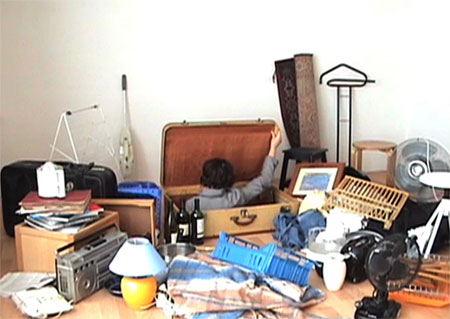
Translado, 2008 Video, 12' |
|||
|
||||
|
||||
|
Quase Cheio, Quase Vazio 09.10.2008 | 13.12.2008 Sara Ramo Galeria Aranhas 11.10.2008 | 13.12.2008 Paulo Nenflidio Galp�o 2 Pet Cemetery 11.10.2008 | 13.12.2008 Erika Verzutti Galp�o 1 Quase Cheio, Quase Vazio Sara Ramo Galeria Fortes Vila�a is pleased to present Quase Cheio, Quase Vazio [Nearly Full, Nearly Empty] by Sara Ramo. In her second solo show at the gallery, the artist presents artworks made using various supports including collage, video and slide projection, installation and photography. Quase Cheio, Quase Vazio concerns the different forms of perception, which, depending on the point of view, can be nearly full, or nearly empty. For Ramo �this day-to-day ambiguity is often defined one way or the other according to our predisposition for approaching a given theme�. The artworks, conceived especially for the show, also discuss the processes of change through the expressive power of determined objects. In the show�s only installation, Para Levar [To Go], Ramo has taken over a storeroom under the gallery�s staircase and completely lined it with cardboard to create a huge box. Its partly opened door and the small light inside invites the viewer to enter, even though the space is not high enough for an adult to stand up in. The artist explores the box as an object symbolizing physical and spatial change. The series of collages Por Todos os Cantos [All Over the Place], made with images from magazines, is arranged on one of the walls. In these artworks, the artist brings together two trends of her work with collage: the use of ready-made images � as in the series Nova Atl�ntida (2004) � and her abstract compositions, previously explored in the collages of the series Embolar (2005�2008). In the collages, Ramo overlays photographs of floors, corners, doors, tables, walls and stones, inventing new spaces where the notion of inside and outside is confused. In one of the three videos shown, the artist is seen next to a suitcase from which she takes a saw, a blanket, a lamp, a vacuum cleaner, a telephone, etc., as though there were no end to the space inside. After taking everything out, Ramo gets into the suitcase and closes the lid. In Bem Vindo [Welcome], various scenes of different doors surprise the viewer at every moment. The artwork Quase Cheio, Quase Vazio, from which the exhibition itself gets its title, consists of two synchronized projections. In this video, Ramo revisits the district in Madrid where she spent part of her childhood. Along empty, narrow streets, a ball inside a bubble-wrap bag, Styrofoam packing peanuts and a box alternate among the scenes. �They belong to the same group (box, Styrofoam protection and object) in this labyrinth that I propose, they never meet each other though they are in the same limbo,� the artist states. To complete the show, Sara Ramo presents Ocupa��o [Occupation], a series of different slides � projected repeatedly � of photographs depicting the empty rooms of a dollhouse. Quase Cheio, Quase Vazio confirms the singular way in which the artist transits between diverse languages, using a cohesive and delicate approach to deal with concrete themes in an oneiric way. Pet Cemetery Erika Verzutti Fortes Vila�a is pleased to present the exhibition Pet Cemetery by Erika Verzutti. The show transforms the exhibition space into a graveless cemetery, in which twenty-two new animal-shaped sculptures are set atop pedestals or arranged on the floor. For Verzutti, the �cemetery� is a �pretext to exercise different styles, reflect on cultural representation and on the use of bronze, common to the arts and to gravestones.� The artist has broken away from formal practice to reveal the structure of her artworks and incorporate accidents such as welds, scratches, splatters and paint runs. By recording the accidents in her creative process, the artist absorbs inabilities and peripheral happenings that would be neutralized by habit. Some of the sculptures shown, such as Egito [Egypt] and Marrakesh, are the unfolding of an investigation Verzutti began in 2006, when she started using fruits and vegetables as molds for casting metal. Here, the stability of the bronze is diminished by its combination with a variety of less-noble materials, including wool knitting, cold porcelain, stones and concrete. The artist also uses some of the objects employed during her creative process, such as brushes and easels. For Verzutti, the diversity of materials allowed for the incorporation of artworks by other artists, giving rise to five collaborative works. Leda Catunda has constructed � with her soft painting � a lake for the bronze frog; Efrain Almeida has collaborated in Infante [Infant] with a baby chicken sculpted from wood; Tiago Carneiro da Cunha worked together with the artist to create a zombie chicken in ceramic; a sculpture by Alexandre da Cunha made of tin cans and concrete has been transformed into a support for the bronze Bull Head; and Tonico Lemos Auad has used graphite stones to create a head for the sculpture that represents a horse. Still in 2008, the artist will be participating in the show Lives become Form, at MOT � Museum of Contemporary Art of Tokyo, curated by Yuko Hasegawa. Also in Japan she will be taking part in a residency of two months at Tokyo Wonder Site. In 2007, the first monograph on her work was released by Cobog� publishers. Aranhas Paulo Nenflidio Fortes Vila�a is pleased to present Aranhas [Spiders], Paulo Nenfl�dio's second solo show in S�o Paulo. In this exhibition, consisting of an installation entitled Teia [Web] in the form of a spider's web along with three spider-shaped sculptures, the artist presents kinetic works, for the first time, exploring visual effects based on physical movements. Hanging from the walls at a height of 1.7 m, Teia is a large, open and irregular structure that seems to hover in the air. Composed of stretched and overlain electrical wires and nylon line, this artwork also looks like veins or neural connections. In this work Nenfl�dio has maintained his characteristic use of sound: he has equipped the web with a device able to sense the viewer�s proximity, activating the emission of different kinds of harmonic and high-pitched sounds, at the threshold of audibility. This results in a jumble of sounds resembling the noise of a fax machine or Internet dial-up connection. The Aranhas are right nearby. These sculptures are intended to avoid any static condition, remaining in constant movement. They are open artworks that are reinvented at each moment, like the works by Dutch artist Theo Jansen, a key reference for Nenfl�dio. The sculptures are low-tech, made of fiberboard, electrical components, conduit or PVC pipes, motors, power sources, sensors and black electrical tape. They are able to walk about or climb the wall for up to thirty seconds in a predefined space. Sensors situated in their �eyes� detect the presence of the spectator and set the spiders� legs into movement. Wires that connect the spiders to small power sources act as ramifications of the Teia, interconnecting the various pieces of the set. For Nenfl�dio, �the artworks are related more with cybernetics than with kinetics, as they are automatons that create automatic music, as all the pieces together form a sonorous composition.� The set effectively realizes a central aim of this artist: the interaction/participation of the public with the work of art. In 2007, Paulo Nenfl�dio participated in the show Panorama, no MAM � Museu de Arte Moderna de S�o Paulo; in 2006 he took part in the exhibition Gera��o da Virada [The Turning-Point Generation] at the Instituto Tomie Ohtake. He received an award from the fifth edition of the S�rgio Motta Prize in Art and Technology, in 2005, and was conferred the Pampulha Grant in 2004. |
||||
re-title.com
International contemporary art
SIGN UP FOR NEWSLETTERS

 SIGN UP for ARTIST MEMBERSHIP
SIGN UP for GALLERY MEMBERSHIP
SIGN UP for ARTIST MEMBERSHIP
SIGN UP for GALLERY MEMBERSHIP
Click on the map to search the directory