|
Galeria Fortes Vila�a: Rodrigo Matheus | Jo�o Maria Gusm�o + Pedro Paiva | Nuno Ramos - 30 Aug 2008 to 27 Sept 2008 Current Exhibition |
||||
|
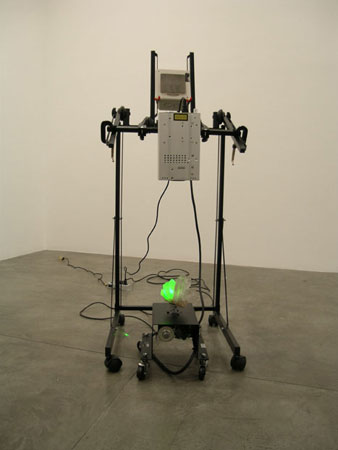
Rodrigo Matheus, Criptonita, 2008
Laser, quartz crystal, gyratory support, metal structure 134 x 51.5 x 58 cm |
|||
|
||||
|
||||
|
Galeria Rodrigo Matheus The World in Which We Live 04.09.2008 | 27.09.2008 In his first solo show at Galeria Fortes Vila�a, Rodrigo Matheus presents five never-before-shown works from his series O Mundo em que Vivemos [The World in Which We Live]. Among installations and objects Matheus explores ways of representing nature by means of mechanical or digital artificiality. O Mundo em que Vivemos evidences the fact that our perception of the world and of nature takes place, in many cases, by way of simulacra. In the work Untitled (Watercycle), a humidifier blows its fog incessantly under a bright light. Both the humidifier and the light are supported on tripods, their power cords in plain sight; yet, although the structure is revealed in its entirety, the artwork retains an aura of dramaticity and mystery. In the installation Workstation, Matheus constructs a nonproductive workstation, discussing the idea of �productivity� and �efficiency.� Six computers attached to a metallic structure are arranged facing each other. The monitors repeatedly display images of scenes extracted from video games. Matheus restages the original scenes of the games in the absence of the characters, icons and soundtrack, showing only sequences of landscapes and natural phenomena depicted in a fantastic way. Time in the videos is extended, while the camera lingers to focus on waterfalls, mountains, sunsets, clouds and stars, offering a moment for contemplation amidst a hectic life based on one�s work schedule. Completing the installation, �stonespeakers� placed under the tables emit recordings of various real, natural sounds. The wires, cables and screws appropriated by the artist are incorporated as formal, significant elements in the artwork. In Criptonita [Kryptonite], a raw crystal is placed on a rotating disc, from time to time passing under a laser beam that lends it an artificial brilliance. As art critic Rodrigo Moura has pointed out, �Matheus does not restrict himself to a specific support, but appears to articulate a range of mediums (painting, sculpture, works on paper, installation, architecture and visual programming) to approximate themes within the arts properly speaking to those of a more ordinary or applied visuality.� The artist held the institutional exhibitions Centurium, at the Museu de Arte da Pampulha, Belo Horizonte, Brazil, in 2006, and A Volta da Arquitetura [The Rebirth of Architecture], at the Centro Universit�rio Maria Ant�nia, S�o Paulo, in 2005. His work is also shown regularly in international galleries, and he has participated in important group shows at museums such as MAM (Museu de Arte Moderna) and MIS (Museu da Imagem e do Som), both in S�o Paulo. Galp�o 1 Jo�o Maria Gusm�o + Pedro Paiva Meteoritic 30.08.2008 | 27.09.2008 Meteor�tica [Meteoritic] is Portuguese artists Jo�o Maria Gusm�o and Pedro Paiva�s first solo show in Brazil. The show features never-before-shown works which include 16-millimeter film projections and bronze sculptures. Gusm�o and Paiva became known for their silent films which present a singular mix of philosophical thought and visual arts. Although at first sight their artworks seem to be purely scientific in nature, it soon becomes apparent that they defy any linear explanation. They are brief experiments, with no narrative, evincing a mysterious and even humorous character. Incomprehensible explosions occur in holes, without any explicit origin, effect or reason; veils of radiation pass through landscapes; men try to open giant stones with steel tools; blocks of ice are thrown into the sea, etc. Nevertheless, far from being merely unrecognizable images of illogical happenings, the work by Gusm�o and Paiva deals with dense themes such as subjectivity, freedom of choice and the very nature of existence. Making a reference to Fernando Pessoa, the duo says that their productions are �fictions that discuss the philosophy of poetry.� At this exhibition, Gusm�o and Paiva work with the concept of Meteor�tica, which is based in the experimental, aesthetic and philosophical idea of attributing to the being an informal origin, a generic multiplicity that precedes his/her/its material condition. As Gusm�o states, �like a meteor � which comes from the infinite and acquires a finite existence when it strikes the earth�s crust � Meteor�tica has to do with exploding from the void into existence.� All of the films are silent and they have a purposefully aged look to them, as though they were made in the first days of filmmaking. The duo customarily works with amateur actors, and many of the absurd scenes in their films are created with the help of low-tech special effects, apparent to the eyes of the spectator. In Sombra Magn�tica [Magnetic Shadow], the camera is a fixed plane and shows the shadow of a tree moving over a white tabletop spread over with steel filings. While the shadow passes, a visible magnetic effect takes place between it and the steel shavings. Inicia��o [Initiation] shows the scene of a head having its hair scraped off with a shaving knife, as though being prepared for a trepanation. In Chama Mete�rica [Meteoric Flame], a glassmaker takes a red-hot piece of molten glass from a high-temperature oven, rolls the glass in a glassmaker�s tube in lets a drop fall down in one continuous stretch to the floor. The glass burns the floor, causing flames to rise. As Jens Hoffman so aptly observed, �Gusm�o and Paiva essentially focus on basic questions related to ethics, metaphysics, epistemology, and logic that embrace ideas of existentialism and reject a fully rational understanding of the world.� The artists have shown previously at Wattis Institute for Contemporary Art, San Francisco, USA, in 2008, and at MNAC � Museu do Chiado, Lisbon, Portugal, 2005; their participation at group shows includes the 6� Bienal de Mercosul, A Terceira Margem do Rio, Porto Alegre, Brazil, in 2007, and at the 27th Bienal de S�o Paulo, in 2006. Galp�o 2 Nuno Ramos Fodasefoice 30.08.2008 | 27.09.2008 Galeria Fortes Vila�a is pleased to present the exhibition fodasefoice by Nuno Ramos. The artist is presenting, for the first time, sculptures made of glass and stones, which arise from formal variations of two straight lines and two curves. Ramos has been researching the combinational possibilities of this simple geometric repertoire for the last three years. This new imagetic vocabulary has recently resulted in forms that resemble scythes. In the sculptures shown in the gallery�s galp�o space, the scythes overlap and interconnect with each other, and are therefore nearly imperceptible. Transparent glass tubes simulate the handles of the scythes, passing through the glass blades and stones, and standing on the floor. Similar to test tubes, these tubes contain mixtures of various liquids such as Coca-Cola and petroleum, glucose and formol, wine and vinegar. The liquids stand in counterpoint to the solidity and geometry of the black granite, marble, glass and reddish quartz. The liquids articulate opposite meanings, such as life and death, enjoyment and bitterness, industrialization and nature. For Nuno Ramos the scythe opened a literary horizon. Exploring how the pronunciation of the Portuguese noun foice [scythe], which symbolizes death, is exactly the same as that of the reflexive verb foi-se [it went away], he created a short theatrical play. Presented for the first time in May this year at FUNARTE in Belo Horizonte, the performance involves the participation of two actresses. In the middle of the exhibition space there is a pile of straw and two loudspeakers; on top of them the actresses hold scythes, moving them slowly, while the loudspeakers shout �foda-se� [fuck it] and �foice.� � thus generating the meta-text �fuck death�. The video of this performance, made by Cao Guimar�es and Beto Magalh�es, completes Nuno Ramos�s show in the gallery�s galp�o space. Once again, Ramos reaffirms his interest in working in an interdisciplinary way with the languages of the arts, in this case, literature, theater and the visual arts. This year, the artist had solo shows at Funda��o Eva Klabin, Rio de Janeiro, at Funarte in Belo Horizonte, at the CCBB in Bras�lia and at Galeria Bernardo Marques in Portugal. Galeria Fortes Vila�a Rua Fradique Coutinho 1500 | 05416-001 S�o Paulo Brasil T +55 11 3032 7066 | F +55 11 3097 0384 Tuesday to Friday 10 am � 7 pm Saturday, 10 am � 5 pm Galp�o Fortes Vila�a Rua James Holland 71 | Barra Funda | 01138-000 S�o Paulo Brasil T + 55 11 3392 3942 | F + 55 11 3392 5969 Tuesday to Friday 10 am � 7 pm Saturday, 10 am � 5 pm |
||||
re-title.com
International contemporary art
SIGN UP FOR NEWSLETTERS

 SIGN UP for ARTIST MEMBERSHIP
SIGN UP for GALLERY MEMBERSHIP
SIGN UP for ARTIST MEMBERSHIP
SIGN UP for GALLERY MEMBERSHIP
Click on the map to search the directory