|
GALLERIA CONTINUA San Gimignano: MICHELANGELO PISTOLETTO | PASCALE MARTHINE TAYOU | SOL LEWITT - 25 Sept 2010 to 22 Jan 2011 Current Exhibition |
||||
|
MICHELANGELO PISTOLETTO
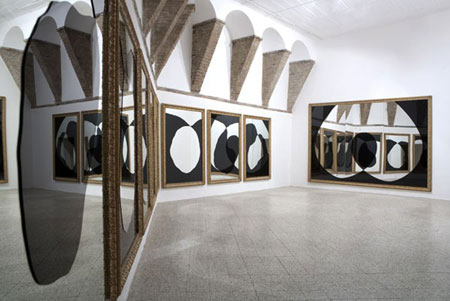
Buco Nero Installation view, GALLERIA CONTINUA San Gimignano, 2010 |
|||
|
||||
|
||||
|
25/09/2010 - 22/01/2011 MICHELANGELO PISTOLETTO 25/09/2010 - 22/01/2011 PASCALE MARTHINE TAYOU 14/02/2010 - 22/01/2011 SOL LEWITT PLANES WITH BROKEN BANDS OF COLOR (SAN GIMIGNANO) MICHELANGELO PISTOLETTO Buco Nero Galleria Continua is pleased to welcome back to its San Gimignano gallery space one of the great protagonists of the international art scene: Michelangelo Pistoletto. The artist is presenting a series of previously unshown works constituting a new project entitled Buco nero (Black Hole). The works conceived for this solo exhibition represent an effective evolution of some of the key concepts on which Pistoletto�s practice has been based since the start of his career in the early 1970s. One of the characteristic materials of the artist�s work, the mirror, is employed in two new wall installations. Talking of the mirror, the artist observes: �The mirror only exists if it reflects, otherwise it is nothing, it loses its function. Identifying myself in the mirror I wondered: If I am mirror how can I recognize myself� without a mirror? I had to give it a double so it could reflect and be/call itself mirror. Absurd, isn�t it? Then, cutting the mirror I saw a third mirror, its firstborn, also reflecting. And one could carry on to infinity. (�) The process of acting and breaking a mirror is a way of rendering physical the action of dividing-to-multiply. Without a physical action there is no metaphysics. And also of saying something about time. Time as �past�. Black forms remain on the broken mirror, the document of an act, an instant photo imbued with memory of a past. The mirror refers us to a creative act that is already �past�. That black was a �present�. The paradox is that the mirror becomes a witness both of pastness and of becoming. The mirror is the nothingness that contains everything, even that which has yet to become. In the mirror the present is possibility. There is also that which has not yet been revealed.� Silver and black mirrors in succession, circular and elliptical forms evoking the sign of infinity and the cyclical nature of time � this is the dominant theme of the works presented in the Arco dei Becci exhibition space. Between 1965 and 1966 Michelangelo Pistoletto produced and showed, in his studio, a set of works entitled Oggetti in Meno (Minus Objects), realized in the contingent dimension of time and based on the principle of differences, thereby breaking the dogma of the uniformity of individual artistic style. These works are considered fundamental for the birth of Arte Povera, the artistic movement theorized by Germano Celant in 1967, of which Pistoletto was a key protagonist. �(...) The works I do are not intended to be constructions or fabrications of new ideas, just as they are not meant to be objects that represent me, to be imposed on or to impose myself on others. Rather they are objects through which I rid myself of something � they are not constructions but liberations � I don�t regard them as plus objects but minus objects, in the sense that they carry with them a definitively externalized perceptual experience.� (M. Pistoletto, Minus Objects). The well placed by Pistoletto in the gallery�s exhibition space is in keeping with and pursues this line of thought. Exactly as on the threshold of a mirror painting, this succession of works that reference each other positions Michelangelo Pistoletto�s artistic practice in a temporal dimension that includes past, present and future. Principal personal exhibitions in museums: 1966 Walker Art Center, Minneapolis; 1967 Palais des Beaux Arts, Brussels; 1969 Boymans van Beuningen Museum, Rotterdam; 1973 Kestner Gesellschaft, Hanover; 1974 Matildenhohe, Darmstadt; 1976 Palazzo Grassi, Venice; 1978 Nationalgalerie, Berlin; 1979 Rice Demenil Museum, Houston; 1983 Palacio de Cristal, Madrid; 1984 Forte di Belvedere, Florence; 1988 P.S.1 Museum, New York and Staatliche Kunsthalle, Baden; 1989 Kunsthalle, Bern and Secession, Vienna; 1990 Galleria Nazionale d�Arte Moderna, Rome; 1991 Museet for Samditkunst, Oslo; 1993 Deichtorhallen, Hamburg; 1994 National Museum of Contemporary Art, Seoul; 1995 Museum 20er Haus, Vienna; 1996 Lenbachhaus, Munich; 1997 Museo L. Pecci, Prato; 1999 MMAO, Oxford; Henry Moore Foundation, Halifax and Galerie Taxispalais, Innsbruck; 2000 GAM, Turin, MACBA, Barcelona and Citt� di Castello-Fondazione Burri; 2001 Contemporary Museum of Bosnia, Sarajevo and Ludwig Museum, Budapest; 2003 MuHKA, Antwerp (�Pistoletto & Cittadellarte�); 2005 Galleria Civica, Modena; 2007 MAMAC, Nice; 2010 Contemporary Art Museum, Philadelphia. Michelangelo Pistoletto took part in the Venice Biennale in 1966, 1968, 1976, 1978, 1984, 1986, 1993, 1995, 2003, 2005 and 2009. He also participated in Documenta in Kassel in 1968, 1982, 1992 and 1997. Works by the artist are held in the collections of some of the world�s leading modern and contemporary art museums, including: MOMA, New York; Beaubourg, Paris; National Gallery of Modern Art, Rome; National Museum of Contemporary Art, Seoul; Contemporary Art Museum, Toyota; Reina Sophia Museum, Madrid; MACBA, Barcelona; Smithsonian Institute Hirschhorn Museum, Washington; Tate Modern, London. PASCALE MARTHINE TAYOU Transgressions Galleria Continua is pleased to present a new solo exhibition by Pascale Marthine Tayou in its San Gimignano gallery. Jean Apollinaire Tayou was born in Cameroon. In the middle of the 1990s he changed name, declining it in the feminine form to become Pascal(e) Marthin(e) Tayou. This marked the beginning of an unceasing artistic, geographic and cultural nomadism that has brought Tayou to prominence on the contemporary art scene. Tayou�s work, like his name, is deliberately fluid and eludes pre-established schemes. Multiple, ungovernable, gripping, profound, unexpected, proliferating and varied, it is always linked to the idea of travel and the encounter with what is other to self. Being a traveller is not just a condition of life for Tayou, but also a psychological condition capable of subverting social relations and the political, economic and symbolic structures of our lives. Tayou�s work is conceived in situ, in close association with the here and now. Every new exhibition project is viewed by the artist as a celebration of life and as a relational experience with everything, that is, with place, people, culture, history, and the materials and objects that populate that world. �A mix between salt and sugar�, is how the artist defines his shows. �This is life. We are happy then sad, and vice versa, and so it goes on. This is harmony: a little light, a little darkness. When I create a show I always try to play with this condition of the human being.� In Transgressions Pascale Marthine Tayou�s aesthetics once again embarks on a ceaseless return journey between the African continent and its perception by others. The works, for the most part new or realized in situ, form a path along which the artist invites us to meet various different characters, telling their stories and staging moments of life, places, atmospheres, realities and fantasies. The two life-size bronze sculptures in the entrance room represent a legendary figure of an Egyptian village. The sculptures are based on two small fertility talismans, and are accompanied by this ancient tale: a man who is physically incapable of taking part in a long battle stays at the village together with the women and children. When they return from the war, the menfolk realize that the number of young people in the tribe had greatly increased in their absence. The gallery of characters continues in the rooms adjacent to the entrance. Here, photographic landscapes form a background for other human figures made from crystal, a series of masks dot the walls, and a long ritual, to which one can only gain access through the gaze, permits us, for an instant, to share the intimacy and secrets of that world. For a solo exhibition held recently at the Goethe Institut in Johannesburg, South Africa, the artist produced the neon writings that spell out phrases and announcements appropriated by Tayou in one of the busiest meeting points of the city, and the series of gates, drawn by Tayou and enriched with a series of details: images and objects that are part of African tradition, and lots of colons, dark faces and Western clothes � a representation of postcolonial modernity, a reality that is undergoing constant transformation, infused with energy and vitality but also complex and contradictory. Mandela�s victory in the presidential elections in 1994, and the consequent policy of recruiting blacks into the administrative and public service sectors led to the birth of a new social category, the Black Diamonds. This is also the title of a new cycle of works the artist has produced for Transgressions. It consists of figures drawn on a wooden, dust-covered surface battered with holes and covered with masses of colourful, glistening sequins. In these works Tayou reflects on the many problematic issues relating to the extraction and trade in diamonds in many parts of the world (in this case, Angola, Congo, China). And he does so, as is his custom, starting from human beings and the history of the individual. The same theme is tackled in the installation positioned behind the gallery�s stage. Rounding off the exhibition is Me as my Mother (2004) and a large-scale installation in the stalls area. Here, using tables, chairs and televisions found locally, Pascale Marthine Tayou reconstructs the daily life of a domestic interior, where the rhythm of life is marked by cable television programmes. Pascale Marthine Tayou was born in Yaound� (Cameroon), in 1967. He lives in Ghent. Active since the middle of the 1990s, the artist has taken part in a number of important international exhibitions and events, ranging from Documenta 11 (Kassel, 2002) and the M�nsterland Skulptur Biennale (M�nster, 2003) through to the biennials of Istanbul (2003), Lyons (2005), Venice (2005 and 2009) and Havana (2006). Tayou has shown his work extensively in important museums and exhibition spaces around the world, including the Kunsthalle of Vienna, the Museum of Contemporary Art in Chicago, the Grand Palais in Paris, the SFAI in San Francisco, the Talpiot Beit Benit Congress Centre of Jerusalem, Tate Britain in London, the Mus�e d'Art Moderne et Contemporain in Toulouse and the Hayward Gallery in London. He has had solo exhibitions at: MACRO (Rome, 2004), S.M.A.K. (Gent, Belgium, 2004), MART (Herford, Germany, 2005), Milton Keynes Gallery (Milton Keynes, UK, 2007), Ch�teau de Blandy Les Tours (Blandy Les Tours, France 2008), Benedengalerie Culturcentrum (Kortrijk, Belgium, 2009), International Film Festival (Rotterdam, Holland, 2010), Malm� Konsthall (Malm�, Sweden), Gare Saint-Sauveur, lille3000 (Lille, France), Goethe Institut Johannesburg (Johannesburg, South Africa) in 2010 and the MAC (Lyons, France) in 2011. SOL LEWITT PLANES WITH BROKEN BANDS OF COLOR (SAN GIMIGNANO) Galleria Continua is pleased, and honoured, to exhibit a previously unshown wall drawing by Sol LeWitt in its San Gimignano gallery. Sol LeWitt (Hartford 1928�New York 2007) was one of the leading exponents of Minimalism, which emerged in the United States at the beginning of the 60s. Based on mental structures and concrete visual structures, his work was characterized by a constant spirit of inquiry, resulting in unquestionably and invariably original work. In his long artistic career, LeWitt managed to achieve a perfect balance between perceptual and conceptual quality, between the simplicity of geometric order and the search for beauty and intuitive creativity. LeWitt overturned the conventional rules of artistic practice and of the material production of artworks, dismissing, with his conceptual approach, notions of non-repeatability and of the importance of manual ability, attributing absolute priority to the idea: �The work is the manifestation of an idea. It is an idea and not an object.� In LeWitt�s view, his work was not essentially a manual practice but was first and foremost a question of producing a pure, Platonic idea, which could then be handed over to someone else for material execution, provided his instructions and the intentions of his idea were respected. This �making an idea the work� has meant that the output of this magnificent American artist can now be found around the world � in leading museums, public buildings, private homes, foundations and even in remote universities. After a solo show at the Galleria Continua in 1998, the artist�s work is once again going on display in San Gimignano. Planes with Broken Bands of Color (San Gimignano), an extraordinary wall drawing conceived by the artist in June 2004, is being realized for the first time on the wall for which it was planned. The structural principle of LeWitt�s artistic production is the ars combinatoria: cubes, circles, triangles, pyramids and lines, or, as in this case, rectangles and parallelograms are dismantled, reiterated and modulated according to standardized spatial proportions and combined in new ways. The artist reinvented the artistic process, playing on the variability and intermittency of the geometric structures that underpin Western notions of space. Colour is of the greatest value in all of LeWitt�s work. In Planes with Broken Bands of Color (San Gimignano) � as in Circle of Bands of Colors and Whirls and Twirls � the artist explores the optical effects created by the combination of colour and the geometric module. In this type of wall drawing, the form of the work obeys precise rules: the bands, for example, are of a standard width, and two bands of the same colour may not touch. At the end of the 90s and the beginning of the new century, LeWitt began using acrylics, and many works from these years, including the wall drawing on show in San Gimignano, include all the primary and secondary colours: red, yellow, green, orange, blue and purple. Geometry and poetry come together, then, in this work, offering viewers a new and exciting visual experience. In recent years the artist has been the subject of exhibitions at P.S.1 Contemporary Center, Long Island City (Concrete Blocks); The Addison Gallery of American Art Phillips Academy, Andover (Twenty-Five Years of Wall Drawings); and Wadsworth Atheneum Museum of Art, Hartford (Incomplete Cubes), which traveled to three art museums in The United States. |
||||
re-title.com
International contemporary art
SIGN UP FOR NEWSLETTERS

 SIGN UP for ARTIST MEMBERSHIP
SIGN UP for GALLERY MEMBERSHIP
SIGN UP for ARTIST MEMBERSHIP
SIGN UP for GALLERY MEMBERSHIP
Click on the map to search the directory