|
GALLERIA CONTINUA San Gimignano: KADER ATTIA, CARLOS GARAICOA, L�ZARO SAAVEDRA, NEDKO SOLAKOV, JOS� ANTONIO SU�REZ LONDO�O - 11 Feb 2012 to 31 Mar 2012 Current Exhibition |
||||
|
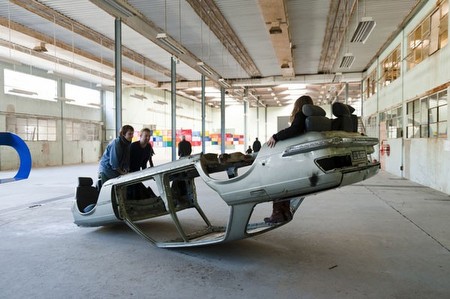
Kader Attia - Recovery as Resistance
2011, chequered skeleton of Mercedes Berlin, seats from different cars |
|||
|
||||
|
KADER ATTIA Essential Opening: Saturday 11 February 2012, Via del Castello 11, 6pm-12 midnight Until 31 March 2012, Tuesday-Saturday, 2-7pm Galleria Continua is pleased to present Essential, a new solo exhibition by Kader Attia. The project comprises a series of recent works, some of which have never been shown in Italy. A French artist of Algerian origin, Kader Attia quickly and forcefully made a name for himself on the international art scene. Taking the plurality of his cultural background as a point of departure, the artist tackles themes regarding the relationship between East and the West, with particular reference to the complex historic events associated with colonialism and its consequences. He investigates the concept of diversity, be it cultural or religious, sexual or socio-political. His works, often expressed in a symbolic language and with a minimalist aesthetics, explore the tensions, traumas and fears of our daily lives. “Between the moment in which a spirit imagines something it wants to realize and the moment in which the thing is realized, there exists a temporal void: a space.” It is that same infinitesimal space which Michel Foucault identified between the elaboration of a thought and the moment in which it is expressed verbally. This is the reflection chosen by Attia to introduce Mimetism (2011). The work consists of a sheet of lead placed on a pedestal. Lead is a ductile material, which can be manipulated in any way without it ever breaking. The viewer has the possibility to give this sheet any sculptural form whatsoever, expressing, through this action, the creative desire within us all. Mimetism is conceived as an endless sculpture which materializes the thoughts, emotions and fantasies of the viewer. Fullness and emptiness, the formal tension between presence and absence, and the metaphysical distance between artist, object and observer are the underlying concerns of Attia’s work. The artist is fascinated by what takes place in the physical and temporal space between two things. His practice focuses on the experience rather than the result, on the rendering visible of what is absent besides what is present. To resist is to remain invisible is what is written – white on white, imperceptible at first glance – on one of the walls of the gallery. Attia views this work as a gesture that can assume universal value: it can be realized in any part of the world and translated into any language, depending on the geographic context and the person who produces it. “Resistere è restare invisibili” is an affirmation that seems at odds with what happened in the recent Arab Spring, but not for the artist, who regards resistance as a daily practice, a natural rather than a cultural act. An evanescent, fleeting gesture is also represented in Revolution. Of the lemma that Attia traces with water on a large sheet of paper, there remains just the slight wrinkling produced by the water which has dried, and a video of the performance. Many of Attia’s works dwell on the theme of boundaries, of geographic borders, of physical and social barriers. Untitled (Concrete blocks) is a large installation made from a series of concrete blocks arranged in a spiral. Until the age of 16, the artist used to spend his summers at Bab el Oued, one of the poorest suburbs in Algiers. Near this neighbourhood is a pier named Roches Carrés. The beach – which once faced onto the sea and was an escape route for those desperately trying to leave the misery of the country by swimming out to a ship bound for Marseilles or Spain – was completely cemented over in the 70s and became a kind of pier built from large blocks of concrete. From then on access to the sea became difficult and dangerous; the ‘Roches Carré’ had not just created a full-blown frontier but also an insuperable psychological passage that dashed all hope of change. “This beach is the border separating these people from the continent, but above all from their dreams of a better life. This massive and strange construction imprisoned them in a cruel reality, as did the French slums where many immigrants ended up living. With the passage of time,” continues Attia, “I find it ironic that I grew up in the midst of concrete buildings in a poor Paris suburb, and that I often spent my summer holidays playing on the blocks of this beach, also made of concrete.” Also featuring in the show is Inspiration / Conversation, a video installation where two screens transmit the image of two faces in profile which, face to face, blow into an empty bottle. Recurring here once again is the concept of emptiness but also of a retrieved everyday object, which, through this action, becomes something else: a sculpture, a trunk, a body extension, a sexual organ. As the artist comments, “we must rediscover our vital, repetitive, orgasmic movements: a cry, a breath, a movement. Reappropriation is a natural gesture. This re-appropriation will take place through the absorption and the “translation” of the objects of our everyday environment, as has always been the case. In recycling plastic water bottles, there is no talk about the big problem of the lack of water in the future. Recycling plastic objects, as in this case, hides the reality of the problem of water. It is the invention of a moral for the protection of our existence from that of the environment in which we live.” Kader Attia was born into an Algerian family in 1970 in the Paris suburb of Seine-Saint-Denis. He currently lives and works in Berlin. Attia spent his childhood between France and Algeria, growing up in the cultural melting pot of the Paris neighbourhood in which he lived, the Islamic Maghreb and the world of the Algerian Sephardic Jews. The multicultural vision of Attia’s work is rooted in the artist’s own personal life experience: the inter-cultural conflicts experienced when he was a child, like the years spent in Congo, Venezuela and Algeria, are constantly recurring features of his work. Attia’s first solo exhibition was in the Republic of Congo in 1996, and his international artistic career has been on the up ever since. He showed for the first time in Italy in 2003, as part of the 50th Venice Biennale, curated by Francesco Bonami. In 2005 he was invited to take part in the 8th Lyons Biennial; in 2007, he realized his first solo show, Momentum , in the United States, at the Institute of Contemporary Art (ICA) in Boston. This was followed by two further personal exhibitions, Square Dreams at the BALTIC Centre for Contemporary Art in Newcastle (2007), and Black & white: signs of times , at the Centro de Arte Contemporaneo di Quarte in Spain (2008). In the same year he had a residency at the IASPIS in Stockholm, Sweden. In 2009 he took part in the Paris Triennial ( La Force de l’Art ) and the Havana Biennial, and also curated the show Periferiks at the Centre d’Art de Neuchâtel in Switzerland. He won an award at the Cairo Biennale in 2008, the Abraaj Capital Prize in 2010 and a place in the Smithsonian Artist Research Fellowship Program. In the same year he contributed to the Sydney Biennale, the Busan Biennale in Korea and shows at the Centre Georges Pompidou in Paris, the Arab Museum of Modern Art in Doha, Qatar, the Haus der Kunst in Munich, Germany. In 2011 he showed at the 4th Moscow Biennale, the Dublin Biennial and in many other internationally prominent venues, including the Tate Modern in London, the Mori Museum in Tokyo, the Centre Pompidou in Paris, and the Sharjah Art Foundation in Sharjah. In 2012 he is showing work in the group exhibition, Hajj, Journey to the heart of Islam , at the British Museum in London. Works by Kader Attia are housed in many private and public collections, including those of the Tate Modern, the ICA of Boston, the Musée d’Art Moderne de la Ville de Paris and the Collection Centre Georges Pompidou. CARLOS GARAICOA Sin Solución Opening: Saturday 11 February 2012, Via del Castello 11, 6pm-12 midnight El camino más largo comienza con una simple línea LÁZARO SAAVEDRA, NEDKO SOLAKOV, JOSÉ ANTONIO SUÁREZ LONDOÑO curated by Carlos Garaicoa Opening: Saturday 11 February 2012, Via Arco dei Becci 1, 6pm-12 midnight Both shows run until 31 March 2012, Tuesday–Saturday, 2–7pm Galleria Continua is pleased to present a new solo exhibition by Carlos Garaicoa, Sin Solución, in its San Gimignano gallery. Carlos Garaicoa belongs to a generation of internationally established Cuban artists. His multi-faceted practice and provocative works encompass sculpture, photography, drawing, video, installations and urban interventions. Taking his home city as a source of inspiration and as a laboratory, Garaicoa develops a model in which Havana is a metaphor not only of human nature, but also of the failure of 20th-century ideologies. The concept of utopia lies at the centre of his work: the contrast between utopia and reality has given rise to a series of ‘project’ works in which the investigative model extends out from Havana to take in other cities. Indeed, the city offers unlimited possibilities of representation, it is the place where imagination acquires form. For Garaicoa, artistic practice is both a tool and a language for engaging with the public and the private city. Sin Solución comprises a series of works created especially for the show, plus other pieces produced over the last year, in which the artist explores the importance of architecture as a way of deconstructing the complexity of the socio-political and historic narrative of a city. The stalls area of the former cinema-theatre is occupied by Fin de Silencio, a large installation which takes the urban reality of old Havana as a point of departure for developing a narrative charged with thoughts, forgotten places and spaces of the imagination. Presented for the first time in 2010 as part of a solo show of the same name in the former abattoir of Madrid, and then, the following year, in the show Penelope's Labour at the Giorgio Cini Foundation in Venice, the installation consists of seven tapestries reproducing the street paving of a shopping area of Havana. Garaicoa uses the names of shops embedded in the marble grit of pavements to create new slogans. La Lucha, El Pensamiento, Sin rival, Reina (“the struggle”, “the thought”, “without rival”, “queen”) are transformed, in his tapestries, into poetic, critical or nostalgic micro-narratives such as La lucha es de todos and Reina destruye o redime (“the struggle is for everyone”, “queen destroys or redeems”). In the Arco dei Becci gallery space Garaicoa is appearing for the first time in the guise of curator, with an exhibition of drawings entitled El camino más largo comienza con una simple línea. The show brings together the work of three artists in whom Garaicoa has always been greatly interested: Lázaro Saavedra, Nedko Solakov and José Antonio Suárez Londoño. He shares with them an approach to drawing that goes beyond its use as an expressive tool. In the work of Saavedra, Solakov and Suárez, the simple línea emphasizes the complexity of the medium, redefining the art object from an introspective and social point of view through political engagement. Lázaro Saavedra (Havana, 1964–) first made a name for himself as a visual artist in the 1980s, focusing on political and existential themes, and becoming an important point of reference for Garaicoa and a whole new generation of Cuban artists. Versatile, ironic and conceptual, his work takes the form of writing, performance and happenings, but also videos, installations and, naturally, drawings, which, in this exhibition, are being shown for the first time in Italy. The style of Nedko Solakov (Cherven Briag, Bulgaria, 1957–) is distinguished by the use of a subversive and subtle language that invariably poses a challenge for viewers and their reactions to the work and the exhibition space, dwelling as it does on the meaning of art but also on the mechanisms regulating expression within the art system. El camino más largo comienza con una simple línea offers Garaicoa the opportunity to engage in a conceptual dialogue with the Bulgarian artist, the point of contact being an investigation of the art system and political issues but also poetic reflection on emotions and human behaviour. The drawings of the Colombian artist Antonio Suárez Londoño (Medellín, 1955-) take us into an arcane microcosm of humour and imagination. Various sources intermingle in his work, ranging from youthful studies in biology to literary texts, popular proverbs, songs and news stories. His narratives, occasionally accompanied by texts in diary form, are peopled with images of animals, buildings, vehicles and ships, and points and numbers organized in an enigmatic classificatory system. For Londoño drawing is an intimate, daily practice which he pursues with an almost monastic rigour and dedication. Carlos Garaicoa (Havana, 1967-) divides his time between Havana and Madrid. After taking a degree in thermodynamics, he attended the Institute of Fine Arts in Havana between 1989 and 1994. He has shown in many solo and collective exhibitions, at Art in General and the MOMA in New York, at the Biblioteca Luis Angel Arango in Bogotá, the Museo de Arte Reina Sofía in Madrid and the Tate in Liverpool. He has participated in the 5th, 6th and 7th Havana Biennial, the 1st Johannesburg Biennale, the 17th Paiz Biennale in Guatemala, the 8th Shanghai Biennale in China, the 24th, 26th and 29th São Paulo Biennial in Brazil, Documenta XI in Germany, the 1st Yokohama Triennale in Japan and in the Venice Biennale in 2005 and 2009. His works are housed in many private and public collections, including the Museum of Modern Art and the Guggenheim Museum in New York, the Maison Européenne de la Photographie in Paris, the Art Gallery of Ontario in Toronto, the Museo Nacional de Bellas Artes in Havana and the Tate Modern in London. |
||||
|
||||
re-title.com
International contemporary art
SIGN UP FOR NEWSLETTERS

 SIGN UP for ARTIST MEMBERSHIP
SIGN UP for GALLERY MEMBERSHIP
SIGN UP for ARTIST MEMBERSHIP
SIGN UP for GALLERY MEMBERSHIP
Click on the map to search the directory