|
GALLERIA CONTINUA Le Moulin: LORIS CECCHINI - LEANDRO ERLICH - PASCALE MARTHINE TAYOU - 14 May 2011 to 2 Oct 2011 Current Exhibition |
||||
|
Loris Cecchini - 'solo show'
2011, general view |
|||
|
||||
|
||||
|
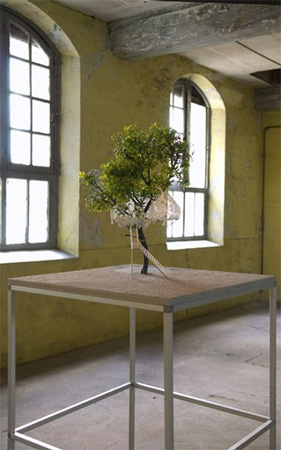
GALLERIA CONTINUA / Le Moulin LORIS CECCHINI Opening: Saturday, the 14th of May 2011 at 12 pm 14 May � 2 October 2011 Following Dotsandloops, the big anthological exhibition presented in Italy by the Luigi Pecci Centre for Contemporary Art in Prato in Tuscany and in France by MAM the Museum of Modern Art in Saint-Etienne, in 2009 Loris Cecchini exhibited at the Ch�teau des Adh�mar and at the Domaine D�partemental de Chamarande. During the summer of 2010 he exhibited at Galleria Continua in San Gimignano. During his last individual exhibition at Galleria Continua in San Gimignano, Cecchini worked on the concept of Solidsky (literally �solid sky�). He offered a set of images as a poetic suggestion, which activates the memory, leaving it open to multiple interpretations: a solid sky which is once again proposed here at Le Moulin. The semantic meaning of this solid sky should not be looked for, but rather the interpretation of numerous forms of envisions. These come alive in the old Le Moulin building where the artist has created fluctuating morphologies thanks to the construction of different realities hanging in a dimension which is both solid and evanescent. In this exhibition Loris Cecchini stages a world which lives in unstable balance between biographicalnarration and artifice. Cecchini�s works investigate both physical and metaphysical matter; they are about the nature of materials, nature in the poetic sense, and as an organic, biological and molecular element. As the artist explains to us, his works are ��fragments of nature which develop like matter projected in a permanent reference to nature and architectural structures. In this sort of expressive osmosis, the matter and the materials free themselves to become pure presence and sensitive matter, to the technology-nature osmotic relationship��. Waves, vibrations and other physical phenomena are suggestions which basically create works like Gaps. These resin casts emerge from the gallery walls in an impromptu way, like variations in the architectural surface, to create visual short circuits. The theme of habitat and architecture as a spatial and formal project, as a container and as a place occurs in the Rainbows Trusses cycle. These works are available as structures/sculptures capable of presenting nature and artifice as minimal landscape forms. They provide us with material for reflection about the concept of representation, sculpture, different levels of reality and the transformation of matter. The architectural elements become evanescent thanks to the transparency of the Plexiglas. The brightness vanishes in a play of light which crosses the matter. Inside they find the natural elements, organic and morphological forms. These heterogeneous elements present themselves like primitive kernels which are as much a reference to mutation as to the reformulating of private memory, like here with the bushes, the trunks and ivy branches produced in a fusion of bronze and brass. Loris Cecchini was born in Milan in 1969. He lives and works in Tuscany. He is one of the established Italian artists of last decade and one of the most appreciated on an international level. LEANDRO ERLICH Opening: Saturday, the 14th of May 2011 at 12 pm 14 May � 2 October 2011 Galleria Continua / Le Moulin is pleased to announce the new exhibition of Leandro Erlich in France. Erlich is regarded as a prominent figure on the international art scene. He came to the attention of the art-going public when he was very young: in 2001 he was invited to represent his country in the 49th Venice Biennale. Soon afterwards he contributed to the Biennials of Istanbul, Shanghai and S�o Paulo. In 2005, Maria de Corral once again invited him to show at the Venice Biennale, and the following year he had a large-scale exhibition at the MACRO in Rome. Disorientation, ambiguity, perceptual bewilderment � these are some of the sensations aroused by the works of Leandro Erlich. Starting from the presupposition that reality and appearance blend in with each other, the artist creates places with uncertain boundaries. The point of observation is continually subject to inversion (interior/exterior, high/low, inside/outside), resulting in images that trigger illusory sensations in the viewer. Through this transgression of limits, the artist dwells on the absoluteness of rules and the institutions that reinforce them, and proposes as an alternative the temporal dimension of narrative and the imaginative power of artistic creation. The artist uses materials and tools that range from photography to scenographic environmental installations. References to the world of film can also frequently be detected in his work; Erlich makes no secret of his admiration for directors like Hitchcock, Polanski and Lynch, who, he argues, �have used the everyday as a scenario for creating a fictional world obtained through the psychological subversion of everyday spaces�. In Changing Rooms the artist also simulates the construction of an environment that is a familiar part of our everyday lives. But after crossing the threshold, the boundaries between reality and representation seem to become blurred, and the viewer finds him or herself projected into an illusory space where the parameters of perception have altered and the real world is transformed. Erlich is showing one maquette aswell: Elevator (2008). The model reproduce to scale an important project the artist is due to realize in Europe in the coming months. Elevator will go on display in a solo exhibition at the Museo Reina Sofia in Madrid. Leandro Erlich was born in Buenos Aires, Argentina, in 1973, and divides his time between Buenos Aires and Paris. He made his artistic debut with a contribution to a collective show in 1991, but the breakthrough came some years later, in 1999, when he won a grant to continue his training in the United States. His experience in Houston proved fundamental for his development as an artist; in fact, while he was there he produced Swimming Pool, which he showed the first time he participated in the Venice Biennale and which is now part of the permanent collection of the 21st Century Museum of Contemporary Art in Kanazawa. It comprises a cube covered with a thin layer of Plexiglas over which there flows a film of water. The inside of the pool can thus be walked over as if it were a giant aquarium. In 2001 he showed at the El Museo del Barrio in New York and in 2003 he went to the Centre d�Art Santa Monica in Barcelona with El Ballet Studio. In 2004 he took part in the Nuit Blanche in Paris. In 2005 he showed at Le Grand Caf� - Centre d�Art Contemporain in Saint Nazaire, France and at the MACRO in Rome. In 2006 he contributed to the Echigo-Tsumari Art Trienal in Japan. He has been invited to many important contemporary art biennials, including: I Bienal de Artes Visuais do Mercosul, Porto Alegre, 1997; Whitney Biennial, New York, 2000; VII Bienal de La Habana, 2001; 49th Venice Biennale, 2001; III Shanghai Biennial, 2002; XXVII Bienal Internacional de S�o Paulo, 2004; 51st Venice Biennale, 2005. In 1992 Leandro Erlich won a grant from the Fondo Nacional de las Artes, Buenos Aires; and in 1994 the Borsa Taller de Barracas, Fundacion Antorchas, Buenos Aires. In 1998 he attended the Core Program at the Museum of Fine Arts in Houston, Texas. In 2000, having won the Premio Leonardo, he was at the Museo Nacional de Bellas Artes in Buenos Aires; in 2001 he won an award from the Joan Mitchell Foundation in New York and, in the same year, the UNESCO Prize at the Istanbul Biennial. In 2002 he did an artist�s residency at the Cit� Internationale des Arts in Paris and in 2005 he was awarded an Artiste en r�sidence at Les R�collets. A number of important exhibition projects wre scheduled for 2008 at the Biennial of New Orleans, USA; the PS1 Contemporary Art Center in New York and the Museo Reina Sofia in Madrid. Recently, Leandro Erlich participated at the Biennials of Liverpool and Singapore. PASCALE MARTHINE TAYOU Transgressions Opening: Saturday, the 14th of May 2011 at 12 pm 14 May � 2 October 2011 Galleria Continua / Le Moulin is pleased to present a solo exhibition by Pascale Marthine Tayou. Jean Apollinaire Tayou was born in Cameroon. In the middle of the 1990s he changed his name, declining it in the feminine form to become Pascal(e) Marthin(e) Tayou. This marked the beginning of an unceasing artistic, geographic and cultural nomadism that has brought Tayou to prominence on the contemporary art scene. Tayou�s work, like his name, is deliberately fluid and eludes pre-established schemes. Multiple, ungovernable, gripping, profound, unexpected, proliferating and varied, it is always linked to the idea of travel and the encounter with what is other to self. Being a traveller is not just a condition of life for Tayou, but also a psychological condition capable of subverting social relations and the political, economic and symbolic structures of our lives. Tayou�s work is conceived in situ, in close association with the here and now. Every new exhibition project is viewed by the artist as a celebration of life and as a relational experience with everything, that is, with place, people, culture, history, and the materials and objects that populate that world. �A mix between salt and sugar�, is how the artist defines his shows. �This is life. We are happy then sad, and vice versa, and so it goes on. This is harmony: a little light, a little darkness. When I create a show I always try to play with this condition of the human being.� This perspective is embodied in the artist�s most important exhibition projects in recent years. It can be seen in Human Being @ Work, the large installation presented at the Venice Biennale in 2009, a microcosm teeming with life that functions by way of accumulation and profusion, the stratification of matter and the superimposition of planes and volumes, and which recounts a reality consisting of rituals and the everyday, necessities and contradictions. Then there is Matiti Elobi, realized at the castle of Blandy-les-Tours in France in 2008. And finally there are his most recent solo shows, Always All Ways. Omnes viae Malm� ducunt (Malm� Konsthall in Sweden, and, from 24 February to 15 May 2011 at the MAC in Lyon) and Traffic Jam (Lille, France, 2010), two extraordinarily rich and complex projects where old and new forms enact the metamorphosis of the world, redefining postcolonial issues through the European experience and analysing the identity and cultural conditions created by globalization. In Transgressions Pascale Marthine Tayou�s aesthetics once again embarks on a ceaseless return journey between the African continent and its perception by others. The works, for the most part new or realized in situ, form a path along which the artist invites us to meet various different characters, telling their stories and staging moments of life, places, atmospheres, realities and fantasies. The two life-size bronze sculptures represent a legendary figure of an Egyptian village. The sculptures are based on two small fertility talismans, and are accompanied by this ancient tale: a man who is physically incapable of taking part in a long battle stays at the village together with the women and children. When they return from the war, the menfolk realize that the number of young people in the tribe had greatly increased in their absence. The gallery of characters continues here, photographic landscapes form a background for other human figures made from crystal, a series of masks dot the walls, and a long ritual, to which one can only gain access through the gaze, permits us, for an instant, to share the intimacy and secrets of that world. For a solo exhibition held recently at the Goethe Institut in Johannesburg, South Africa, the artist produced the neon writings that spell out phrases and announcements appropriated by Tayou in one of the busiest meeting points of the city, and the series of gates, drawn by Tayou and enriched with a series of details: images and objects that are part of African tradition, and lots of colons, dark faces and Western clothes � a representation of postcolonial modernity, a reality that is undergoing constant transformation, infused with energy and vitality but also complex and contradictory. Mandela�s victory in the presidential elections in 1994, and the consequent policy of recruiting blacks into the administrative and public service sectors led to the birth of a new social category, the Black Diamonds. This is also the title of a new cycle of works the artist has produced for Transgressions. It consists of figures drawn on a wooden, dust-covered surface battered with holes and covered with masses of colourful, glistening sequins. In these works Tayou reflects on the many problematic issues relating to the extraction and trade in diamonds in many parts of the world (in this case, Angola, Congo, China). And he does so, as is his custom, starting from human beings and the history of the individual. With Me as my Mother (2004) and a large-scale installation in the stalls area. Here, using tables, chairs and televisions found locally, Pascale Marthine Tayou reconstructs the daily life of a domestic interior, where the rhythm of life is marked by cable television programmes. Pascale Marthine Tayou was born in Yaound� (Cameroon), in 1967. He lives in Ghent. Active since the middle of the 1990s, the artist has taken part in a number of important international exhibitions and events, ranging from Documenta 11 (Kassel, 2002) and the M�nsterland Skulptur Biennale (M�nster, 2003) through to the biennials of Istanbul (2003), Lyons (2005), Venice (2005 and 2009) and Havana (2006). |
||||
re-title.com
International contemporary art
SIGN UP FOR NEWSLETTERS

 SIGN UP for ARTIST MEMBERSHIP
SIGN UP for GALLERY MEMBERSHIP
SIGN UP for ARTIST MEMBERSHIP
SIGN UP for GALLERY MEMBERSHIP
Click on the map to search the directory