|
Fruitmarket Gallery: CHILDISH THINGS - 19 Nov 2010 to 23 Jan 2011 Current Exhibition |
||||
|
|
|||
|
||||
|
||||
|
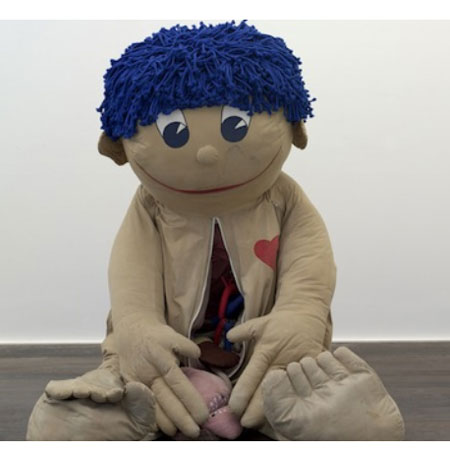
CHILDISH THINGS 19 November 2010 - 23 January, 2011 Louise Bourgeois, Helen Chadwick, Robert Gober, Susan Hiller, Mike Kelley, Jeff Koons, Paul McCarthy Childish Things is The Fruitmarket Gallery�s second collaboration with David Hopkins, Professor of Art History at the University of Glasgow; acknowledged authority on Marcel Duchamp, dada and surrealism; increasingly renowned writer on contemporary art; and curator of the popular 2006 Fruitmarket Gallery exhibition Dada�s Boys: Identity and Play in Contemporary Art. more.. This exhibition focuses on a very specific moment in the post-dada/surrealist take-up of toys and early childhood as themes in art. Centred on the work of certain British and American artists who came to prominence in the 1980s and early 1990s, the show sets in dialogue a number of seminal works on the theme of toys, childhood, child development and the cultural conditioning of children. The exhibition examines the work of a small group of internationally significant artists from America and Britain whose work references toys or playthings, children�s entertainment or child-related objects. It sets up a series of �conversations� between the objects on display in order to explore an interconnected set of themes: Jeff Koons� celebrations of kiddy-kitsch are set against Mike Kelley�s and Louise Bourgeois� evocations of more sinister or abusive parent-child relations; Susan Hiller�s anthropologically-inflected exploration of the aggression underpinning the social conditioning of children, as in the Punch and Judy show (An Entertainment) is placed in counterpoint to Paul McCarthy�s monstrous consumerist/sexual hybrids and Robert Gober�s playpen is seen alongside Helen Chadwick�s objects which deal with her early adaptive response to playthings. The exhibition seeks to look at the art of the 1980s and early 1990s art in a new way. The usual critical contexts informing art of this period (postmodernism, post-conceptualism, identity politics) are de- emphasised, and questions about attitudes to childhood, to play and to social conditioning � understood via post-surrealist fantasy idioms � are brought into prominence. The show aims to be playful � on one level, it possesses something of the ambience of a toy-shop or toy museum, but the emphasis is ultimately on a much �darker� poetics of childhood. |
||||
re-title.com
International contemporary art
SIGN UP FOR NEWSLETTERS

 SIGN UP for ARTIST MEMBERSHIP
SIGN UP for GALLERY MEMBERSHIP
SIGN UP for ARTIST MEMBERSHIP
SIGN UP for GALLERY MEMBERSHIP
Click on the map to search the directory