|
Petzel Gallery: TROY BRAUNTUCH || JOHN STEZAKER - Nude and Landscape - 10 May 2013 to 13 June 2013 Current Exhibition |
||||
|
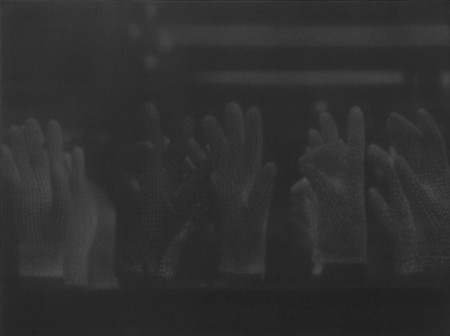
Troy Brauntuch, Untitled (Gloves behind glass), 2011
Conte on cotton 30 x 40 x 1.3 inches, 76.2 x 101.6 x 3.4 cm |
|||
|
||||
|
TROY BRAUNTUCH May 10 - June 13, 2013 Opening reception: May 10th, 6-8pm 456 W 18th Street “The word in language is half someone else, and The word in language is half someone else’s.” — Mikhail Bakhtin That Texas summer was so hot; dried dust permuted continuously. Reddish, yellow and brown hazes influenced the measuring of distance and sight. The fire spread rampantly. It quickly scorched the trees, removing moisture from objects until they evaporated into light, silky flakes falling at ease, transfigured by the blaze. A camera sits on a table and the flames are recorded in the reflection of the lens. It watches the fire until the flames touch its face. The film turns to ash and images become ash; there are now no more images. The once “A Kind of History” is spread into the air. The camera’s content comes to light and is shared throughout the space. Soot buries all remaining objects and billows outwards as visitors walk through these ruins. Attaching to the facades, the ash re-covers every surface of the building’s interiors. Or are they exteriors? Troy Brauntuch’s surfaces, pigments and residue of images for this show, his fourth at Petzel Gallery, locate themselves amongst the haze of an American mythology and the space in which all things are recorded…and then forgotten. Sheets of soot arrange and re-arrange the history of the object and the horizontal picture plane that catches them. Lying on the surface and softly erased, pigments depict interiors and exteriors that become indistinguishable through ruin, appropriation and reflection. The pictures are constantly in view of and in conversation with one another. Motion and gaze set off a chain of events. The far-reaching consequence of the outward image and the uncertainty of what these subjects are seeing. The Blue haze gradually gives way to emergency and taillights of the State Trooper’s vehicle. The road is empty, becoming smaller and more vague; the dashed lines disappear on the asphalt. Who is out there? There is no one out there. The yellowish-grey racehorse is now being put to sleep; the half drawn fabric is pulled further up while the stall door turns silently on its hinges. The horse’s ears stand to catch the sound of the man entering. The horizontal iron bars appear over the dim, black background. Stretched across his face, entrapping the eye, the silver bull lifts his head to glimpse at the man behind camera. Across the room, the fugitive sits low in the back of a car ready for departure, hands cuffed behind, body forced to slump. The palms of his eyes push outward through the echo of the thin, black power lines reflected on the window. The youthful head has charred bands across his face. A woman figure enters the scene. In some light, the image is heavy; in another light she seems to float on the surface. The dress weighs down onto the picture-plane. As she is pulled forward for a moment, the light hits every fold: she soon recedes because she knows she is leaving. In the drawing room 4.35, the image rusts away; an arranged interior used for describing space without the aid of a camera. The dirty-red spined objects hook onto a wooden structure that is covered by a thin bed sheet. The prop-room has little to offer the students and the youthful class is tired from the heat. The heavy white-plaster statue is rolled out once again and remnants of its pusher are evidenced by the charcoal-stained fingerprints. -Christopher Culver, 2013 JOHN STEZAKER Nude and Landscape May 8 – June 13, 2013 Opening reception: Friday, May 10th, from 6:00 – 8:00 PM Petzel Gallery is pleased to present the exhibition John Stezaker: Nude and Landscape from May 8 – June 13, 2013. This is the artist’s third exhibition with the gallery. There is an accompanying catalogue published by Ridinghouse that highlights the work. The book contains an essay by the curator Sid Sachs, who first presented Nude and Landscape at the University of the Arts in Philadelphia in 2012. Born in Worcester, United Kingdom in 1949, Stezaker was educated at the Slade School in London where his teachers included William Coldstream, Ewan Uglow and Richard Wollheim. As one of the youngest members of the first British Conceptual Art group in the 1960s, Stezaker was also conceptualism's earliest defector - to an image, rather than concept-based practice, and as such, became a key bridge-figure between the conceptual art generation and the Pictures generation in America. Stezaker's media-image appropriations, however, tended to be more intimate in scale than spectacular, as was also the case with his American contemporaries like Richard Prince and Cindy Sherman. For the most part, this decision was based on the artist’s intention and desire to retain the formal image in its original state and scale. Influenced by the thinking on the media image by the French Situationists of the 1960s, Stezaker focused on cinematic imagery, although through the 1970s his attachment moved from current media images to earlier images (predominantly 1940s film stills, publicity portraits, and old postcards). The artist has stated that Joseph Cornell gave him the confidence for this regression or 'time travel,' as he has referred to it, as a means of evading the imperative of contemporaneity in modern art. He also found intellectual support for his decision in the thinking of Walther Benjamin and Maurice Blanchot, who he stated freed him to yield purely to image fascination and to image obsolescence. Stezaker's work with cinematic imagery remains his best known. He has, however, worked with a number of other found image sources over the past 30 years. Most notably, the topographic images that make up his 'Bridge' collages and the anatomical nude images that make up his 'Fall' and 'Expulsion' series. This show is dedicated to these series of collages. In the early 1980s, when Stezaker first switched from the cinematic imagery of the 1970s to the nude, he declared it to be a part of a desire to move from an engagement with the culture of the image to the nature of the image. Over the years since then, his work on film still collages tends to alternate between works based on the nude or on land/cityscapes, depending on his interest in aspects of the nature or culture of images. Whether from landscape sources or artist anatomy books, the material sources of Stezaker's images tend to be vintage. Thus, these oddly harmonious yet disquieting landscapes take on an aura of the remembered past, and the "truth" of photographic reality collapses into a recombinant modernist hybrid. Stezaker lives and works in London. Exhibiting since 1969, the artist has become much more prominent in the last decade with extensive solo exhibits in Europe, Asia and the United States. He has had over forty one-person exhibitions and has exhibited in Adelaide and Sydney, Australia; Graz, Austria; Brussels, Belgium; Hong Kong, China; Copenhagen, Denmark; Paris and Avignon, France; Berlin, Bremen, Cologne, Düsseldorf, Frankfurt, Freiberg and Münich, Germany; London, Edinburgh, Birmingham, Cambridge, Liverpool, Norwich, Oxford, and Southhampton, Great Britain; Rotterdam, Holland; Tel Aviv, Israel; Kyoto and Tokyo, Japan; Brescia, Milan, Rome, and Venice, Italy; Lisbon, Portugual; Lucerne, Switzerland; and Houston, Los Angeles, Miami, Minneapolis, New York, and Saint Louis in the United States. |
||||
|
||||
re-title.com
International contemporary art
SIGN UP FOR NEWSLETTERS

 SIGN UP for ARTIST MEMBERSHIP
SIGN UP for GALLERY MEMBERSHIP
SIGN UP for ARTIST MEMBERSHIP
SIGN UP for GALLERY MEMBERSHIP
Click on the map to search the directory