|
Fondation Cartier pour l'art contemporain: Beatriz Milhazes | William Eggleston - 4 Apr 2009 to 21 June 2009 Current Exhibition |
||||
|
Beatriz Milhazes
Fondation Cartier pour l'art contemporain April 04 - June 21, 2009 |
|||
|
||||
|
||||
|
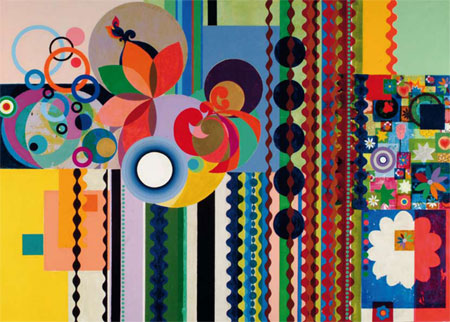
Beatriz Milhazes April 04 - June 21, 2009 The Fondation Cartier pour l�art contemporain is pleased to present an exhibition of the work of Beatriz Milhazes, one of the most celebrated Brazilian visual artists today. Offering an overview of her work of the past decade, the exhibition will include a selection of large-format acrylic paintings as well as a remarkable new collage that she has created specifically for the show. The Fondation Cartier has also commissioned the artist to produce a special architectural installation for the exhibition. Using a technique closely related to collage, she will apply motifs made of translucent adhesive vinyl directly onto the glass walls of the Fondation Cartier, creating an effect that is evocative of stained-glass. Reflecting her interest both in natural forms and rigorous geometry, this striking installation will enter into a powerful visual dialogue with the architecture of Jean Nouvel and the surrounding garden. Brazilian Heritage The work of Beatriz Milhazes occupies a unique position between Latin American and Western traditions. It is thus not surprising that she showed an early interest in the work of Brazilian writer and poet, Oswald de Andrade (1890�1954) and that of his well known companion, the painter Tarsila do Amaral (1886�1973). Andrade�s Manifesto Antropofago (1928) called upon Brazilian artists to develop their own unique culture by �devouring� European styles and melding them with elements derived from local culture. Tarsila do Amaral�s painting expressed this philosophy, combining the bright colors and tropical imagery of Brazil with the surrealism she discovered in Europe. Inspired by her predecessors, Beatriz Milhazes embraces a dizzying kaleidoscope of influences, following an approach that she describes as �culture eating culture.� Her canvases havean undeniably Brazilian flavor, filled with an abundance of brightly colored, highly decorative motifs. Much of the artist�s inspiration comes from the high and low art present in her native country, including sources as varied as ceramics, lacework, jewelry design, carnival decoration, and Colonial baroque architecture. The delicate arabesques of tropical flowers and leaves have also found their way into her painting, revealing the artist�s fascination for luxurious vegetation. Other references for these works, which revisit the traditional genres of landscape and still-life, range from the contemplative works of Albert Eckhout�a 17th century Dutch painter who recorded the plants and animals of Brazil�to themodernist landscape designs of Roberto Burle Marx, known for his design of Copacabana beach promenade in 1970. European Modernism The paintings of Beatriz Milhazes express many of the formal preoccupations inherent in the history of abstract painting, from the vibrant color of Matisse to the rigorous structural composition of Mondrian. The underlying square fields of color that serve as the background for many of her works and the overlaying motifs, call to mind the work of early modernist abstract artists such as Kupka, Klee, and L�ger. The artist has stated: �I am seeking geometrical structures, but with freedom of form and imagery taken from different worlds.1� Classical music, particularly the opera, as well as popular music such as bossa nova or tropicalia, motivate the �choreographed spontaneity� of the artist�s compositions. Stripes, rays, lines and circular forms evoke a synchronized rhythm while the dynamics of color articulate harmony and dissonance. This clearly relates Milhazes compositions to those of other 20th century masters who have explored the relationship between music and art, such as Kandinsky and Delaunay. The use of intensely vibrant colors, such as fuchsia, gold or orange, endows her canvases with an explosive energy that many have compared to the breathtaking rhythm of fireworks. Artistic Technique To create this elaborate network of forms, Milhazes has developed a technique that is closely related to monotype and collage. The artist first paints the motifs and drawings of her work on translucent plastic sheets. She then applies them to the canvas and peels the plastic off, superimposing images and colors in a variety of combinations. During the transfer process, part of the motif sometimes tears, leaving portions of itself behind. These accidents create interesting surfaces marred by subtle imperfections. The slow and laborious process leads to rich palimpsests of overlaid images, some fully present, some masked, some only ghostly silhouettes. During the past several years, the artistic production of Beatriz Milhazes has continued to expand, recently branching out into arenas such as, theatre sets, site-specific installations, and design work, including fabric and tapestry. She has also created two artist�s books, one in conjunction with the MoMA and one with the Thomas Dane Gallery, London, which explore the realms of printmaking and collage. Through her diversity of practice and multiplicity of sources, Beatriz Milhazes erases all distinctions between the high and the low, the national and the international, the classical and the contemporary, leaving her free to explore the entire realm of visual expression. 1 Paolo Herkenhoff, Beatriz Milhazes, Francisco Alves Editora, Rio de Janeiro, 2006. Beatriz Milhazes Born in Rio de Janeiro in 1960, Beatriz Milhazes entered Rio�s renowned Escola de Artes Visuais do Parque Lage in the early 1980s. She emerged on the Brazilian art scene in the midst of what was known as �the return to painting� of the Gera�ao Oitenta (the 1980s Generation), which followed the more austere conceptualist art that dominated the country in the 1970s. Publication Beatriz Milhazes Artist�s book realized in collaboration with Beatriz Milhazes. Fondation Cartier pour l�art contemporain, Paris Hardback, 50 color illustrations Publication date: April 2009 William Eggleston April 04 - June 21, 2009 For the last three years, American photographer William Eggleston has photographed the city of Paris as part of a commission for the Fondation Cartier pour l�art contemporain. Taken throughout different seasons, these new images by one of the fathers of color photography portray the local and the cosmopolitan, the glamorous and the gritty, the everyday and the extraordinary. This exhibition also provides an exceptional occasion to bring together William Eggleston�s distinctive pictures and his recent paintings, an unknown aspect of his work that has never before been presented to the public. The Paris series of photographs forms the Fondation Cartier�s third commission to William Eggleston, following the Deserts (2000) and the Kyoto (2001) series. After his very first retrospective in 2001, this exhibition marks his second solo show at the Fondation, reflecting its commitment to artists over time. The Paris Series Although William Eggleston has frequently photographed internationally, his work is most closely associated with the American South, where he has always resided. The Fondation Cartier�s commission has brought about an unexpected encounter between this photographer, whose practice has often been considered local and intimate, and a city whose imagery is strongly prominent in our collective imagination. During several trips, William Eggleston has explored Paris to capture the many colors of the city. He has also renewed a long tradition of photographing Paris, as seen in the work of such greats as Eug�ne Atget or Henri Cartier- Bresson. These historical predecessors become reference points for Eggleston�s new series of Paris photographs, to which he incorporates his unique style. The series remains, as much of Eggleston�s work, an adventurous balancing act, remarkably distinct in its approach to Paris as a subject for photography. Pictures of the Everyday �When people ask me what I do,� Eggleston has said, �I say that I am taking pictures of life today.� Many of the images of the Paris series express this concern for the everyday. He captures two children playing at a caf�, motorcycles at a stoplight, reflections in car windows, graffiti on buildings, anonymous passers-by. William Eggleston has often spoken of his desire to photograph �democratically.� For him, this means that everything may potentially yield a picture, and every element within the picture should be of equal importance and interest. In a city of glorious monuments, his eye is continuously on subjects one would normally overlook; he finds strange beauty in the kitsch, the neglected and the disused elements of city life. Uncommon Cityscapes However, Eggleston�s characteristic �shotgun� approach, which involves a distinctive coordination of the hand and eye, brings to these most commonplace city subjects an element of the unfamiliar. As he swings the camera to meet its target, the artist creates awkward angles of view and cuts off figures within the picture frame; Eggleston photographs each subject only once, capturing the instant. He confronts the world with the disorienting eye of an alien observer, as he spontaneously records with seeming ingenuity the unexpected side of the mundane. In many photographs, the restricted vision of a close-up or an off-kilter point of view makes it difficult for the viewer to contextualize the scene, thus stimulating the imagination. Painting and Music Alongside these photographs, William Eggleston will present a series of his littleknown colorful and abstract paintings and drawings in small notebooks. This alternative form of expression provides a counterpoint to the instantaneous nature of photography. The colors and forms in these small works also reveal Eggleston�s love for the early Modernist abstract painter, Wassily Kandinsky, and in particular his interest in the relationships that exist between painting and music. These paintings also provide insight into the unique way in which William Eggleston�an accomplished pianist and an admirer of Johann Sebastian Bach�composes his photographs. Using color as a structural element alongside form, his photographs, like his paintings, acquire the dynamic yet highly structured rhythms of Johann Sebastian Bach. William Eggleston Born in 1939 in Memphis, Tennessee, William Eggleston grew up in Sumner, Mississippi. While attending university in the South, he purchased his first camera and discovered the work of Henri Cartier-Bresson and Walker Evans. In the early 1960s, Eggleston moved to Memphis, where he continues to reside, and started experimenting with black and white photography. However, by the end of the decade he had started creating primarily color photographs. In 1976, John Szarkowski, Director of Photography at the MoMA, organized an exhibition of Eggleston�s work, one of the institution�s first solo shows of color photographs. This marked a turning point for the medium, which had been used almost exclusively for commercial aims. Since this historic exhibition, the internationally acclaimed photographer has been the subject of numerous exhibitions all over the world, as well as of various publications. A retrospective of his work was recently presented at the Whitney Museum of American Art in New York. Publication William Eggleston, Paris A facsimile of the artist�s book, entirely created by William Eggleston on the occasion of the exhibition, will unite his photographs of Paris with his paintings. Fondation Cartier pour l�art contemporain, Paris / Steidl, G�ttingen 2 volumes, hardback, 100 color reproductions Publication date: April 2009 Press Information Linda Chenit assisted by Anne-Sophie Gola Tel +33 (0)1 42 18 56 77/65 Fax +33 (0)1 42 18 56 52 [email protected] Images on line: fondation.cartier.com |
||||
re-title.com
International contemporary art
SIGN UP FOR NEWSLETTERS

 SIGN UP for ARTIST MEMBERSHIP
SIGN UP for GALLERY MEMBERSHIP
SIGN UP for ARTIST MEMBERSHIP
SIGN UP for GALLERY MEMBERSHIP
Click on the map to search the directory