|
Fondation Cartier pour l'art contemporain: Raymond Depardon - Paul Virilio Native Land, Stop Eject - 21 Nov 2008 to 15 Mar 2009 Current Exhibition |
||||
|
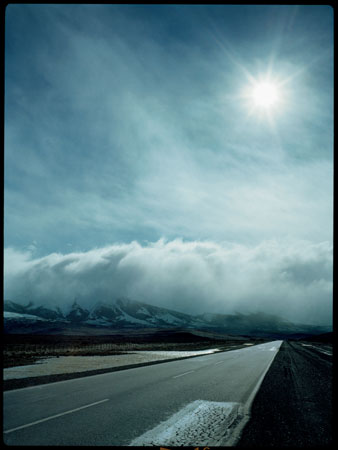
Argentina, 2005
Photo � Raymond Depardon |
|||
|
||||
|
||||
|
�Raymond Depardon and I are both concerned by the same question: what is left of the world, of native lands, of the history of the only habitable lanet today?� Paul Virilio While the world has reached a critical moment in its history, where the environment conditions what humans do and what they will become, the exhibition Native Land, Stop Eject proposes a reflection on the notions of being rooted and uprooted, as well as related questions of identity. Whereas Raymond Depardon gives a voice to those who wish to live on their land but are threatened with exile, Paul Virilio examines and challenges the very idea of sedentariness in the face of the unprecedented migrations taking place in the contemporary world. The exhibition is, therefore, a confrontation. It is at once a contradictory and complementary dialogue between filmmaker and photographer, Raymond Depardon, and urbanist and philosopher, Paul Virilio. Depardon�s work has often explored native lands, and, particularly, the world of farmers, giving value to speaking and listening. His capacity to combine both the political and the poetic is clear to anyone familiar with his work. Through his writing, Paul Virilio has spent much of his time working on notions of speed, exodus, the disappearance of geographic space, and the pollution of distances. Native Land �Let us listen to these people, be they Chipaya, Yanomami, or Afar. Let us listen to these people and give them a chance to speak, so we can hear them express hemselves in their language, with their own way of speaking, their own facial expressions.� Raymond Depardon This notion of being rooted�the relationship that a population nurtures with its land, its language, and its history� finds its full expression in the monumental projection of a film by Raymond Depardon, made especially for this exhibition. Accompanied by sound engineer, Claudine Nougaret, Depardon travelled to Chile, Ethiopia, Bolivia, France, and Brazil to meet with nomads, farmers, islanders, and indigenous peoples, all of whom were either threatened with extinction or living on the periphery of globalization. They express themselves in their mother tongue languages, anchored in their native soil (�I was born in my language,� says one woman), and voice their anger and pain in view of the numerous threats and fears that plague their lives. �After travelling all over the world to �give a voice� to [�] endangered minorities [�], I felt the need to confront my own world, one that is suffering from the �disease of speed� denounced by Paul Virilio.� Raymond Depardon Raymond Depardon thus goes on to share his first-hand experience of global-ization and the world�s shrinking distances in the form of a silent filmed journal. After celebrating and �giving a voice� to those who wish to remain on their land, he travelled to cities around the world from East to West in 14 days� Washington, Los Angeles, Honolulu, Tokyo, Ho Chi Minh City, Singapore, Cape Town�accompanied solely by his camera. Stop Eject �I�m nostalgic for the world�s magnitude, of its immensity.� Paul Virilio Depardon�s travel journal�a long-distance imaginary dialogue with Paul Virilio�brings us to the second part of the exhibition Stop Eject, curated by Virilio, and designed by American artists and architects, Diller Scofidio + Renfro, in collaboration with Mark Hansen, Laura Kurgan, and Ben Rubin. �The nature of being sedentary and nomadic has changed. [�] Sedentary people are at home wherever they go. With their cell phones or laptops, [they are] as comfortable in an elevator or on a plane as in a high-speed train. This is the sedentary person. The nomad, on the other hand, is someone who is never at home, anywhere.� Paul Virilio Virilio questions one�s capacity to settle somewhere and take root. The acceleration of movement or, using his terms, �the great migratory mobilization,��it is estimated that roughly 200 million people will be forced to relocate by the year 2050�challenges the very notion of sedentariness. This exodus, unprecedented in human history, linked to globalization and to climate change, encounters the end of geographical space, or �the disappearance of the world�s vastness,� created by the current transportation and telecommunications revolution. The current urban exodus replacing the rural exodus of the past, the re-urbanization of the world, as Paul Virilio describes it, are factors that announce the emergence of the �ultracity,� the city of urban exile, the city of departure, similar to the train or bus stations and airports of today, orthe spaceports of the future. In this way, Paul Virilio questions the future of �native land� as a notion, reflected in the literal translation of the French exhibition title, Terre Natale, Ailleurs commence ici [Native Land, elsewhere starts here]. This elsewhere that begins here prefigures global mobilization, and is illustrated through a visual tornado of news clips that are literally choreographed on almost 50 screens. The exhibition�s final room is entirely dedicated to cartography, proposing a dynamic visualization of global human migrations and their causes via a circular and immersive projection. The visitor is surrounded by a sphere that circles the room, leaving behind a new imprint of migratory data in the form of animated maps, texts and trajectories with each orbit. This exhibition has benefited from the participation of Fran�ois Gemenne, researcher and professor of migratory movement linked to climate change at Sciences Po (Centre d��tudes et de recherch� internationales) and at the University of Liege (Centre d��tudes de l�ethnicit� et des migrations). Chief curator: Herv� Chand�s, General Director of the Fondation Cartier pour l�art contemporain Conversations As part of the exhibition, Native Land, Stop Eject, the Fondation Cartier, in collaboration with Sciences Po Paris, has organized five conversations under the supervision of Paul Virilio and Fran�ois Gemenne. They bring together scientists, economists, philosophers, architects, and internationally renowned specialists. An inaugural conversation between Raymond Depardon and Paul Virilio entitled �Au d�tour du monde� will take place on December 1, 2008 and will be followed by four other conversations: �After Poznan, the State of the Climate,� �Migrations or Repopulation?�, �Geodiversity, Biodiversity, and Cultural Mutation,� and �The Ultracity.� Full program details on fondation.cartier.com Publications Native Land, Stop Eject The exhibition catalogue explores the notions of the homeland, of taking root, of uprootedness, and the identity questions that are attached to these notions. Fondation Cartier pour l�art contemporain, Paris Softback, dustjacket, 20.5x28 cm, 308 pages/300 color and black and white illustrations Previously unpublished texts by Bruce Albert, Michel Agier, Marc Aug�, Raymond Depardon, Diller Scofidio + Renfro, Mark Hansen, Laura Kurgan, Ben Rubin, Fran�ois Gemenne, Peter Sloterdijk, and Paul Virilio Photographs by Raymond Depardon ISBN: 978-2-86925-083-3 Price: 39.50 � Publication date: November 2008 Raymond Depardon, Hear Them Speak Taking the form of a travel diary, this book collects one hundred color Polaroid photographs in which Raymond Depardon gives a voice to populations attached to their language and land. Co-published by Fondation Cartier pour l�art contemporain, Paris/Steidl, G�ttingen Hardback, 16x21 cm, 168 pages 100 color Polaroids by Raymond Depardon ISBN: 978-2-86925-086-4 Price (tentative): 20 � Publication date: November 2008 Nomadic Nights On the occasion of the exhibition Native Land, Stop Eject, the Nomadic Nights are putting on a special program of performances and concerts. Online calendar on fondation.cartier.com Raymond Depardon Born in 1942 in Villefranche-sur-Sa�ne, Raymond Depardon renewed the photography and film reporting genres in his work as a filmmaker, photographer and special correspondent. Co-founder of the Gamma agency in 1967, he joined Magnum Photos in 1978. Raymond Depardon�s filmed work, be it documentary or fictional, prolongs the resolve to confront reality already sensed in his photography. His film, Modern Life, the last chapter of his trilogy on the farming world, will be released in France on October 29, 2008. Paul Virilio Born in 1932 in Paris, Paul Virilio is a professor at the �cole Sp�ciale d�Architecture in Paris, where he was director and president from 1968 to 1998. An urban planner and essayist specialized in strategic questions about new technologies, Paul Virilio has written a number of major works and participated in numerous publications in France and abroad. In 2003, he collaborated with the Fondation Cartier on the exhibition Unknown Quantity. Diller Scofidio + Renfro, Mark Hansen, Laura Kurgan, and Ben Rubin Based in New York, Diller Scofidio + Renfro is an interdisciplinary studio that fuses architecture with the visual and performing arts. Elizabeth Diller is a professor at Princeton University School of Architecture. Ricardo Scofidio is a professor at the Cooper Union. Richard Renfro, who was recently the Cullinan Visiting Professor at Rice University, joined the agency in 2004. Ben Rubin is a visual artist and sound designer who founded EAR Studio in 1993. He teaches at the Yale School of Art. Laura Kurgan is an architect and artist. She is the Director of the Spatial Information Design Lab and Visual Studies at the GSAPP at the Columbia University. Mark Hansen is a statistician. He is an Associate Professor of Statistics at theUniversity of California, Los Angeles. Press Information Linda Chenit assisted by Anne-Sophie Gola Tel +33 (0)1 42 18 56 77/65 Fax +33 (0)1 42 18 56 52 [email protected] Images on line: fondation.cartier.com Press opening on Tuesday, November 20 261, boulevard Raspail / F- 75014 Paris Tel. +33 (0)1 42 18 56 50 Fax +33 (0)1 42 18 56 52 fondation.cartier.com |
||||
re-title.com
International contemporary art
SIGN UP FOR NEWSLETTERS

 SIGN UP for ARTIST MEMBERSHIP
SIGN UP for GALLERY MEMBERSHIP
SIGN UP for ARTIST MEMBERSHIP
SIGN UP for GALLERY MEMBERSHIP
Click on the map to search the directory