|
FAURSCHOU Foundation Beijing: GABRIEL OROZCO: CHICOTES - 28 Sept 2013 to 23 Mar 2014 Current Exhibition |
||||
|
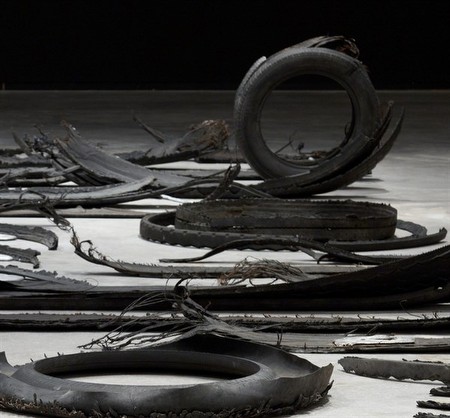
Gabriel Orozco, Chicotes, 2010 (in detail)
Tires and aluminium, dimensions variable Collection Faurschou Foundation. Photo: Anders Sune Berg |
|||
|
||||
|
FAURSCHOU FOUNDATION BEIJING GABRIEL OROZCO: CHICOTES 28.09.13 - 23.03.14 Rising to global prominence in the early 1990s, Gabriel Orozco (b. 1962) is today one of the foremost contemporary artists, and Faurschou Foundation is showing his work in Beijing. Gabriel Orozco lives in Mexico City, New York and Paris, and inspired by his many travels all over the world, his works span a variety of practices: painting, photography, installation and sculpture. Gabriel Orozco often works on the basis of the place in which he finds himself, and has a remarkable feeling for exploiting the history and textures of his materials. With great ease and sharp powers of observation, he puts together found objects and materials recycled from everyday use, which he manipulates lightly. Chicotes, the large installation that fills the whole exhibition space at Faurschou Beijing, is typical of Gabriel Orozco's reworking of found, everyday material. It consists of burst tires that he has picked up along the freeways in Mexico. The Spanish word chicotes can be translated as 'whips,' but is also used as a colloquial term in Mexico for these fragments of exploded car tires that lie everywhere along the roads as a result of the frequent over-use of the tires. The force of the explosion has ripped the edges of the pieces of rubber to shreds, and after lying out in the wind and weather they now look like something organic—roots, bark or seaweed. The pieces are neatly arranged—almost in the way we know from museum exhibitions of archaeological finds. Here and there Gabriel Orozco has melted aluminium over the tire fragments, perhaps as a reference to the whole tire with its rim, as if the heat from the speed has melted the metal. There is something disturbing about this whole archaeology of urbanity. The idea of speed and 'danger' is supported by the strong smell of rubber in the space. The tire fragments also point to global economic differences and to the potential danger to which we expose ourselves every day as a fundamental condition of life. Walking and observing are an important part of Gabriel Orozco's practice, and in his many photo series too, mundane motifs are often emphasized—objects that most of us do not notice at all in daily life, but which have great poetry and significance: an old punctured football that has gathered rainwater in it like a little landscape within the landscape; a bicycle wheel that has drawn the traces of a puddle round and round in eternal circles—which will soon be dried up and gone. Structures, traces, patterns—nature's own and random ones; others are interventions by Gabriel Orozco; oranges placed around a row of tables, stones stuck into a metal fence like a horizon line, tins of cat food on a stack of melons. Gabriel Orozco's overarching theme is his interaction with the world around him, and his art consists of displays of this world. His works unite the industrial with the organic, the geometrical with the random, the infinitesimal and the universal, the banal and the significant, the moment and eternity. The world is full of things and life that is lived, and in sensual, exploratory and playful ways and often with some part of himself inserted into and affecting his surroundings, Orozco helps us to see things that most of us miss or pay little attention to. Gabriel Orozco was born in Veracruz in 1962, and lives and works internationally. Recent solo shows include Kunsthaus Bregenz (2013), Deutsche Guggenheim Berlin (2012), the Solomon R. Guggenheim Museum in New York (2012), Tate Modern (2011), Kunstmuseum Basel (2010) and the Museum of Modern Art New York (2009). He has participated in the Venice Biennale (1993, 2003 and 2005), the Whitney Biennial (1997), and documenta X (1997) and XI (2012). FAURSCHOU FOUNDATION Faurschou Foundation consists of two privately funded exhibition spaces open to the public in Beijing and Copenhagen, established by Luise and Jens Faurschou. For 27 years they have mounted exhibitions of internationally acclaimed artists both in Denmark and abroad. With passion and an eye for quality Luise and Jens Faurschou uncompromisingly pursue their ambition to present highly esteemed contemporary art to the public. With confidence in and commitment to the artists chosen, they develop their art collection. Their collection is now partly accessible at the two exhibition spaces, where they curate exhibitions in collaboration with some of the world’s best artists, curators, museums and galleries. Admission to the exhibitions is free. FAURSCHOU FOUNDATION BEIJING 798 ART DISTRICT NO4 JIUXIANQIAO ROAD CHAOYANG DISTRICT BEIJING CHINA 100015 OPENING HOURS TUESDAY-SUNDAY 10-6 |
||||
|
||||
re-title.com
International contemporary art
SIGN UP FOR NEWSLETTERS

 SIGN UP for ARTIST MEMBERSHIP
SIGN UP for GALLERY MEMBERSHIP
SIGN UP for ARTIST MEMBERSHIP
SIGN UP for GALLERY MEMBERSHIP
Click on the map to search the directory