|
Espacio Minimo: SUSAN COLLIS Twice Removed - 10 Dec 2009 to 6 Feb 2010 Current Exhibition |
||||
|
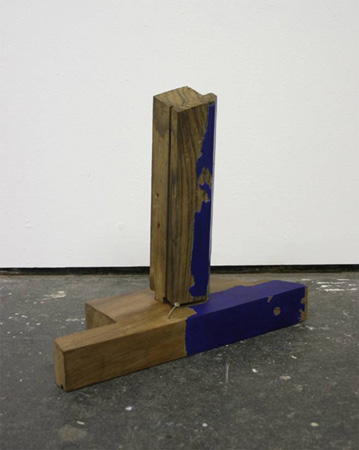
Susan Collis, Where was I?..., 2009
|
|||
|
||||
|
||||
|
SUSAN COLLIS Twice Removed 10th December to 6th February 2009 Private View: Thursday, 10th December at 20:00 Espacio Minimo Gallery presents British artist SUSAN COLLIS�s first solo show in Spain. COLLIS�s installation was recently included in the �Frame� section at FRIEZE Art Fair in London, and has been commissioned to create the image for the next edition of THE ARMORY SHOW in New York. Twice Removed, is the exhibition title chosen by the artist, a clear reference to her working process in which, making use of precious and valuable materials, she recreates humble and discarded objects. In her practice SUSAN COLLIS deploys a kind of camouflage, a game of illusion and confusion that turns her projects into formal and conceptual re-workings of the idea of trompe-l�oeil. First impressions would make us think we are looking at the remnants of a dismantled exhibition; wall plugs, bent screws, broken pieces of wood with nails sticking out of them that are covered in paint and ridden with woodworm, dirty floors and walls, stained bits of cloth, etc. Upon closer inspection we find the plugs are made from coral or turquoise, the screws and nails are made of gold or platinum, the drips of paint are in fact mother-of-pearl, the worm-holes are small gems, the blue paint on a timber frame turns out to be incrusted lapis lazuli, and the stains on the cloth are delicately embroidered. For the execution of these works the artist makes use of a variety of techniques and investigative strategies that question aspects of perception, value, and craftsmanship. COLLIS carries out an inverse archaeological exercise, a false process of aging. But this apparent accidental nature is the fruit of a slow and meticulous process. COLLIS is interested in how our perception of value changes as we discover that these are carefully elaborated, intentional, and that the materials that we mistook for common and valueless are in fact economically and decoratively precious. Another series of work is based on creating exact facsimiles of objects using a variety of materials and production methods. These are seemingly ready-made sculptures, but the craftsmanship involved in making them is to be added to their conceptual weight. In this way the complete futility of these recreations have their ornamental function maximised, as well as maintaining an illusion of functionality. As Rosemary Shirley writes in SUSAN COLLIS�s exhibition catalogue titled �Don�t Get Your Hopes Up�: �The gallery is a space charged with its own codes of behavior, and in order to show ones self as an initiate it is necessary to at least appear as if you know what you�re looking at. Collis� work confounds even this most basic assumption, creating uncertainty and even embarrassment in the viewer...Collis disturbs the usual shorthand involved in a gallery visit, things often taken for granted such as the dividing line between �the art� and �the rest of the world�. This dividing line usually designates elements such as marks on the wall, dire extinguishers, safety barriers, screw holes and mirror plates as invisible. Through disrupting the hierarchy of objects, and re-situating these one invisible details as the main event, Collis collapses the distinctions between significant and insignificant and opens up for re-evaluation our assumptions about the gallery space, our behavior within it and where exactly we should be looking... This dissolution of boundaries however does not result in the liberation of the viewers gaze, the eye no less manipulated in this exhibition that it is by the gilded frames of the National Gallery, In order to engage with this work the viewer must embark upon an exploration of the space; a list of works reveals that there are indeed works present, the next step in finding them� �At first confounding the viewer and then inspiring delight in its illusory qualities, Collis� work creates a complex network of contradictions and revelations. It effectively questions the structures and methods of its own production, together with the viewer�s most basic assumptions about artistic productions and display. Discovering the work of Susan Collis generates problematic and meanings that will reverberate every time you enter a gallery space, or see a paint splash on the street, it can be a rewarding experience, if you know where to look at� SUSAN COLLIS (United Kingdom, 1956), lives and works in London. She regularly shows with European and American galleries, and has recently taken part in distinguished collective shows such as An Archaeology, Project Space 176, The Zabludowicz Collection, London 2007, Out of the Ordinary, The V&A; Museum, London 2007, Out of the Ordinary, Tullie House, Carslile 2009, At Your Service, The David Roberts Foundation, London 2009, Bizarre Perfection, The Israel Museum, Jerusalem 2009, The Sculpture Show, Eastside Projects, Birmingham 2009, Apparently Invisible, The Drawing Center, New York 2009� Her works form part of important public and private collections such as The Arts Council Collection, UK, Museum of Israel, Jerusalem, The David Roberts Foundation, London, The Zabludowicz Collection, London, Paul Smith, London, Doris Lockhart Saatchi, London, Progressive Art Collection, USA.. SUSAN COLLIS Twice Removed 10 Dic. 2009 / 06 Feb. 2010 a galer�a Espacio M�nimo presenta la primera exposici�n individual en Espa�a de la artista brit�nica SUSAN COLLIS que acaba de presentar una instalaci�n en la secci�n �Frame� de la �ltima edici�n de FRIEZE Art Fair en Londres y que ha sido comisionada para crear la imagen de la pr�xima edici�n de THE ARMORY SHOW en New York. Twice Removed, expresi�n inglesa que alude a ciertas conexiones familiares como la espa�ola �primos segundos�, es el t�tulo elegido por la artista para esta exposici�n, en clara alusi�n a su proceso de trabajo en el que objetos humildes, previamente desechados, son rehechos por ella en materiales preciosos. SUSAN COLLIS realiza en sus instalaciones un interesante trabajo casi de camuflaje, un juego ilusorio de confusi�n que convierte sus proyectos en un renovado trompe-l�oeil formal y conceptual. Aparentemente puedes ver en ellas los restos del montaje de una exposici�n, algunos tacos en las paredes, tornillos doblados, maderas sueltas y rotas con clavos, carcomas, restos de pinturas�, suelo u objetos manchados, telas manchadas, etc. Al observar con detenimiento, los tacos de la pared son en realidad de coral o turquesa, los tornillos y clavos de oro o platino, las manchas de pintura son de madreperla o las carcomas peque�os brillantes, los restos de pintura azul en un trozo de marco, incrustaci�n de lapisl�zuli, las manchas en los trapos son en realidad minuciosos bordados, etc. Para la ejecuci�n de sus obras, la artista se vale de una variedad de t�cnicas y estrategias de investigaci�n que cuestionan aspectos como la percepci�n, el valor y el trabajo-la artesan�a del arte. COLLIS ejecuta un ejercicio arqueol�gico a la inversa, un falso proceso de envejecimiento que juega con nuestra capacidad de discernir entre lo que creemos o esperamos ver y lo que realmente estamos viendo. Objetos cotidianos que presentan, aparentemente, las huellas, del uso y el desgaste del paso del tiempo. Pero esta aparente accidentalidad es, por el contrario, fruto de un meticuloso y lento proceso de trabajo. A COLLIS le interesa el cambio de valoraci�n que hacemos al descubrir que realmente son elaboraciones cuidadosas, intencionadas, y que los materiales usados para realizarlas, que cre�amos err�neamente comunes y sin valor, son preciosos econ�mica y decorativamente. Otra serie de trabajos se basan en la creaci�n de objetos facs�miles variando los materiales y los m�todos de producci�n. Se trata de aparentes ready made, que a�aden a su peso conceptual el valor de la artesan�a. De esta manera, la completa inutilidad de estas recreaciones maximizan su funci�n ornamental al tiempo que mantiene su ilusoria funcionalidad. Como dice Rosmary Shirley en el texto del cat�logo de la exposici�n de SUSAN COLLIS, �Don�t get your hopes up�, (�) Los espacios est�n cargados de c�digos de distinta �ndole que imponen nuestra manera de comportarnos. En el caso concreto del espacio expositivo de una galer�a de arte, el m�nimo necesario para mostrarse como iniciado en la materia es, al menos, parecer que sabemos lo que estamos viendo. El trabajo de SUSAN COLLIS confunde incluso los supuestos m�s b�sicos de la relaci�n entre obras de arte, espacio expositivo y observador. COLLIS trastorna la relaci�n habitual que mantenemos con los objetos en la visita a una galer�a. Al trastocar su jerarqu�a, resitu�ndolos, los detalles que una vez fueron invisibles son ahora el acontecimiento principal. Lejos de significar una liberaci�n de la mirada, la ruptura de la relaci�n habitual entre observador y objeto pasa a un nuevo nivel en el que el espacio necesita ser explorado para descubrir los objetos. La lista de lujosos materiales que los conforman marca el doble descubrimiento: por una lado, la satisfacci�n de haber encontrado la pieza y, por otro, la fascinaci�n del material. Primero, confundiendo al espectador y, luego, deleit�ndolo con sus ejercicios ilusionistas, el trabajo de SUSAN COLLIS crea una compleja red de contradicciones y revelaciones que incitan a cuestionarnos de forma efectiva tanto las estructuras y m�todos de producci�n art�stica, como los supuestos m�s b�sicos sobre los espacios expositivos y los valores del arte. (�) SUSAN COLLIS (Reino Unido, 1956), vive y trabaja en Londres. Expone con regularidad individualmente en galer�as europeas y americanas y ha tomado parte en destacadas exposiciones colectivas como An Archaeology, Project Space 176, The Zabludowicz Collection, Londres 2007, Out of the Ordinary, The V&A; Museum, Londres 2007, Out of the Ordinary, Tullie House, Carslile 2009, At Your Service, The David Roberts Foundation, Londres 2009, Bizarre Perfection, The Israel Museum, Jerusalen 2009, The Sculpture Show, Eastside Projects, Birmingham 2009, Apparently Invisible, The Drawing Center, New York 2009� Su obra est� representada, entre otras importantes colecciones p�blicas y privadas, en The Arts Council Collection, UK, Museum of Israel, Jerusalen, The David Roberts Foundation, Londres, The Zabludowicz Collection, Londres, Paul Smith, Londres, Doris Lockhart Saatchi, Londres, Progessive Art Collection, USA� |
||||
re-title.com
International contemporary art
SIGN UP FOR NEWSLETTERS

 SIGN UP for ARTIST MEMBERSHIP
SIGN UP for GALLERY MEMBERSHIP
SIGN UP for ARTIST MEMBERSHIP
SIGN UP for GALLERY MEMBERSHIP
Click on the map to search the directory