|
Galerie Eric Dupont: PASCAL CONVERT - PASSION - 15 Mar 2014 to 14 June 2014 Current Exhibition |
||||
|
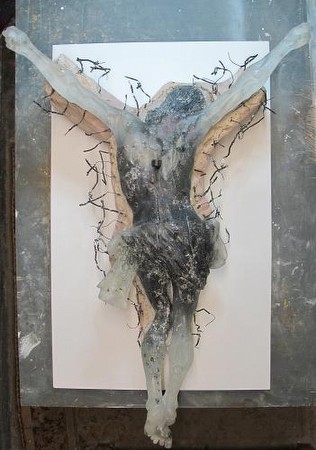
PASCAL CONVERT, Cristallisation n�1, 2014
Verre, pl�tre, m�tal, charbon de bois, 135 cm x 90 cm x 25 cm �p. Ma�tre verrier Olivier Juteau, Vue d'atelier D.R., Courtesy Galerie �ric Dupont |
|||
|
||||
|
Pascal CONVERT PASSION 15 March – 214 June 2014 For his new exhibition at Galerie Eric Dupont, Pascal Covert presents a series of works which question the relationship between sacrifice, sacrilege and sacred. Sacred as representations of the Divine and as works of art, the old, near life size sculptures of Christ, modelled in the round, have undergone the sacrificial act of cristillisation. Olivier Juteau, master glass blower, has been creating Pascal Convert’s works for many years. He describes, with precision, the ritual that permitted the transmutation of wood into crystal: a cruel procedure of destruction, allowing a reinjection of meaning. Find an old wooden Christ. Brush the surface of the wood to free it of any dust. Remove any questionable bits of putty from earlier restoration. Clean off any excess plaster. Find and remove any pieces of metal by passing a magnet over the body of the Christ. Fill any unwanted holes and if necessary, restore any missing parts with wax. With a small brush, apply the first layer of fireproof plaster, making sure not to miss even the slightest detail. Put the supply jets and wax nozzles in position. Construct the metal framework containing the pressurised liquid glass. Pour a fireproof mould over the Christ. After 48 hours, open the mould and put it horizontally in the kiln. Steam the mould at 120°C, until it doesn’t emit any more vapour. Bake until the temperature reaches 550°C and admire the burning of the wooden original. Progressively increase the temperature of the kiln until it reaches 880°C. At this point, start pumping the molten glass into the mould. Stop the process when the glass starts overflowing, be careful to do this slowly, it takes around 20 hours. Let the temperature drop to 580°C and leave it for 48 hours. Allow it to cool down very slowly for about 6 weeks, until it reaches an ambient temperature. Take the object out of the kiln and carefully start to remove the sculpture from the mould. If necessary, strengthen the fragile bits of plaster, which the artist wishes to conserve, with resin. Repair the inevitable cracks and if necessary, fill in any empty spaces. Brush the surface of the sculpture and buff to finish. This terrible recipe resembles a “peaceful killing” (1). Yet, from an initial feeling of dread when faced with this decisively iconoclastic gesture, comes the impression of finding oneself in front of the phantom sea of crystal blended with fire (2). The horror, the horror of the martyr’s divine flesh appears in another way in the second work. Hung on the walls, the diptych work in etched blue glass opens like the pages in a giant book with the strange writing of a manuscript on its pages. Collectively titled “Treblinka”, the Yiddish texts are written in blue ink. These texts are extracts from a collection of 8 exercise books, written between 1942 and 1944, from the Kielce region in Poland. As the written by the author, a survivor of Treblinka, “there are so many testimonies that it is impossible to bring them all back, even orally”. Here, despite everything, a few fragments (3). At the back of the gallery, a reminder of Pascal Convert’s search for meaning in 3 images, 3 media icons (Pietà du Kosovo, Madone de Bentalha, Mort de Mohamed Al Dura) and a woman’s face, swallowed by the mass of glass, screams an inaudible, bloodccurdling scream of desperation… 1. Georges Bataille in his article “Documents” about the Apocalypse of SaintcSever. 2. The Apocalypse of John, 15:2. 3. Echoing Georges Didi-Huberman’s title: Des images malgré tout (Images despite everything). Galerie Eric Dupont 138 rue du Temple 75003 Paris T + 33 1 44 54 04 14 www.eric-dupont.com [email protected] |
||||
|
||||
re-title.com
International contemporary art
SIGN UP FOR NEWSLETTERS

 SIGN UP for ARTIST MEMBERSHIP
SIGN UP for GALLERY MEMBERSHIP
SIGN UP for ARTIST MEMBERSHIP
SIGN UP for GALLERY MEMBERSHIP
Click on the map to search the directory