|
David Kordansky Gallery: Ruby Neri - Sculpture Drawing a Blank (On Forgetting, Refusal, Censure and Impotence) - 7 July 2012 to 18 Aug 2012 Current Exhibition |
||||
|
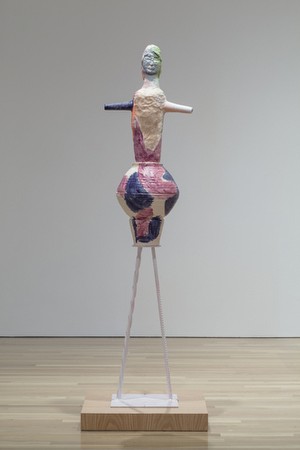
Ruby Neri, Untitled (standing figure), 2012
plaster, steel, ceramic, 64 x 15 x 10.25 inches (162.6 x 38.1 x 26 cm) |
|||
|
||||
|
Ruby Neri Sculpture July 7 – August 18, 2012 Opening reception: Saturday, July 7, 6:00–9:00pm David Kordansky Gallery is very pleased to announce Sculpture, an exhibition of new work by Ruby Neri. The show will run from July 7 through August 18, 2012, with an opening reception on Saturday, July 7 from 6:00 to 9:00pm. Neri's work is marked by a commitment to figurative forms that are modeled expressively by hand and animated by the application of unabashed colors. Her practice, which includes painting, plaster and bronze sculpture, and ceramics, reveals an uncommon intimacy with the ebb and flow of diverse physical and mental energies. This exhibition focuses exclusively on the artist's recent object-based work, and will include sculptures that draw in equal measure from ceramics and painting, primitivism and modernism, and an array of West Coast figurative lineages. The objects are made from plaster, steel and clay, and marked with both paint and glazes. In scale they range from smaller, pedestal-based works to looming, life-sized figures that stride welcomingly toward the viewer. Neri has long embraced a fluidity of forms and media, so that the objects that result are as much about mutability as they are about static conglomerations of material. For this reason, it is possible to read her work in terms of the devotional intensity common both to tribal and outsider art. (The sculptures on view in this exhibition bear a resemblance to Oceanic totems, for example.) At the same time, having come of age in the midst of the Bay Area Figurative Movement, and as an original member of the Mission School, Neri remains aware of the ways in which the art historical canon has absorbed certain tendencies that might previously have fallen outside of it. The works in Sculpture make the most of this ability to key numerous, and even competing, formal reverberations with a single gesture. Neri's use of ceramic vessels (and fragments of vessels) as figurative elements is a prime example. So while the torsos and hips of a number of works in the exhibition have been built like vases, their utility as functional objects has been repurposed. Rather than being used to contain other materials, these vessels act as structural supports, intermediary zones between the heads and legs of each figure. The legs that support the vessels, on the other hand, have been treated in a variety of ways that allude directly to the functional properties of the substances of which they are made. In particular, figures whose legs are made from unadorned steel rods create an unlikely juxtaposition of strength and precarity. In other cases, the rods function as armatures, and have been covered with modeled plaster. Regardless of the combinations of materials that constitute them, each of the sculptures provides numerous surfaces and textures for the application of paint. In fact, painting represents one of the main creative thrusts of the body of work. Whether developing and deepening the faces of the figures (and the attitudes they project), or experimenting with her own signature as a form of gesturation, Neri refuses to abide by accepted notions of the divisions between media, so that sculpture seems to lead to painting and vice versa. By allowing herself such freedom, she creates the conditions for great emotional range. Her work has become recognized for its ability to channel both psychological expressiveness and profound optimism. In this respect, Neri's vision is indicative of the kind of openness specifically associated with California, and even more broadly, an aesthetic position oriented toward the cultural, geographical, and spiritual expanses of the Pacific. Ruby Neri is currently featured in Made in L.A. 2012, Hammer Museum, Los Angeles. Her work was also seen recently in American Exuberance, Rubell Family Collection, Miami; and At Home/Not at Home: Works from the Collection of Martin and Rebecca Eisenberg, Center for Curatorial Studies, Bard College, Annandale-on-Hudson, NY. Drawing a Blank (On Forgetting, Refusal, Censure and Impotence) I'm explaining myself. I'm talking to you with a drink in one hand. At the open bar in the lobby of the reception for what's-his-name. Except when I get to my point I pause. There's a name I'm missing. Maybe it's yours. What I've forgotten is perhaps more important than what I've said. And you're politely waiting. And I stutter some half-sentences that don't come close to what I meant. But you nod anyway. Later that night at home in bed in the dark I'll recall just what it was I wanted to say. I'll open my eyes and look at the ceiling and simultaneously congratulate and berate myself for such a statement. Drawing a Blank (On Forgetting, Refusal, Censure and Impotence) curated by Matthew Brannon and Jan Tumlir July 14 - August 18, 2012 Opening reception: Saturday, July 14, 6:00-9:00pm Robert Barry Carol Bove Barbara Bloom Troy Brauntuch Tom Burr Andrew Cameron Michelle Elzay Morgan Fisher Wade Guyton Richard Hamilton Adrià Julià Louise Lawler Frank Stella Yves Tanguy David Weldzius Drawing a Blank is a group show of works culled from various periods, modern and contemporary, in which the appearance of expressionless vacancy and equipoise may be seen as a foil for troubled thought. Within the context of Psychoanalysis, the question that one cannot answer is seized as the key. The patient who draws a blank is not exactly oblivious; the language just is not forthcoming. That one gets stopped there in silence, rather than simply making something up and moving on, indicates a self-censoring block, and this in turn indicates to the sensitive nature of what now eludes articulation. To the analyst, the mind that goes blank is not barren, but pregnant with thought. This blank precisely marks out and delimits the space of withholding, and under prolonged scrutiny, it will begin to show through. The analyst's questions are prescriptive, designed to make something appear in the mind of the patient: words pull on other words, on thoughts and on images. These are the instruments of the psychic surgery that is the talking cure, but here in the context of art we are not talking cure, though we deploy these instruments nevertheless. In art, drawing a blank has long been standard practice, and here as well one might want to probe a little bit further. Clement Greenberg placed the entire evolution of the avant-garde in service to blankness when he wrote that its first priority was to rid works of meaningful content, as this was "infecting the arts with the ideological struggles of society." Ostensibly, the course of radical reduction would lead to a succession of ever more evacuated objects that could be understood by anyone anywhere in the same way precisely because there was nothing left in them to understand. Yet even as we approach the zero-degree, and perhaps especially there, questions arise as to just what it is we are left with. In hindsight, we can see that whatever it is that we most wanted to lose in the void of the emptied-out work has remained behind. The course of radical reduction would lead not only to the positive truth of a medium's irreducible essence, but to a condition of suggestive mediality, a haunted substrate or screen. The Black Paintings of Frank Stella and Richard Hamilton's cover design for the Beatles' so-called "White Album" constitute two of this exhibition's thematic signposts, for in them the pursuit of the void is explicitly framed in terms of avoidance, and thereby also in terms of confrontation. Increasingly, in the works that follow their recalcitrant lead, this will become the whole point of the operation: to resume the subtractive process as a form of historical excavation, and to draw submerged contents up and out, as though through the blank that first called attention to their vague presence. |
||||
|
||||
re-title.com
International contemporary art
SIGN UP FOR NEWSLETTERS

 SIGN UP for ARTIST MEMBERSHIP
SIGN UP for GALLERY MEMBERSHIP
SIGN UP for ARTIST MEMBERSHIP
SIGN UP for GALLERY MEMBERSHIP
Click on the map to search the directory