|
David Kordansky Gallery: Brian Calvin, Charles Garabedian, Zach Harris, John McAllister | Alan Michael: Res Gestae - 19 Nov 2011 to 21 Jan 2012 Current Exhibition |
||||
|
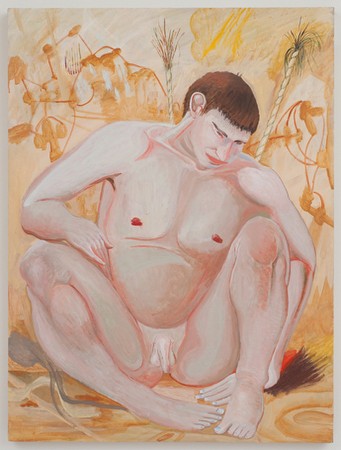
Charles Garabedian, Study for the Iliad
(man sitting cross legged, yellow background), 1992 acrylic on panel, 48 x 36 inches (121.9 x 91.4 cm) |
|||
|
||||
|
Brian Calvin, Charles Garabedian, Zach Harris, John McAllister November 19, 2011 - January 21, 2012 Opening reception: Saturday, November 19, 6:00-9:00pm David Kordansky Gallery is very pleased to announce an exhibition of paintings by Brian Calvin, Charles Garabedian, Zach Harris, and John McAllister. While it will consist mostly of new work, the show will also feature paintings by Charles Garabedian dating back to 1982 that synthesize these four Los Angeles-based artists' pursuit of a highly personal, even idiosyncratic visual vocabulary. For more than 40 years, Garabedian has served as a trailblazing example of an artist willing to take on the central narratives of the art historical tradition from the geographical, intellectual, and spiritual periphery. In particular, his poetic use of the figure, often with a nod to ancient or classical literary sources, has long provided an alternative to what is traditionally understood as the development of postwar American painting. The younger artists in the exhibition continue to use figuration as a vessel for abstract forms, literary narrative, and conceptual meditation. They employ the medium of painting itself in a similar manner, using it to address the broader and deeper concerns that drive artists back to the studio again and again. Due to the varied nature of their respective practices, the differences between these artists are what unite them. Indeed, insistence on difference––from accepted notions of style and good taste, and from the strains of abstract and conceptual painting that seem to dominate the contemporary landscape––can be said to be one of the defining factors of their work. Brian Calvin, for instance, has become known for paradoxically figurative paintings in which the figures are perhaps not the primary subjects of inquiry. They are, rather, containers for an array of themes and variations concerning paint, formalism, and composition. As such, the figures seem to arise from confluences of material fact and aesthetic or philosophical puzzlement. This can be seen in the range of his recent paintings. In an acrylic-based work, a female figure is shown in extreme close-up, her face painted black, surreal landscapes painted into her fingernails. In an oil-based painting, meanwhile, it is the plasticity of facial forms that is especially pronounced. And in portraits that occupy neither of these extremes, haunting gazes and subtly modeled skin tones override purely formal considerations. Like the classical themes that drive many of Garabedian's paintings, the figures in Calvin's work seem to direct the visionary gaze both inward and outward. They become the dispersed locus of an historical third eye, one that scans the past for insight into the present as well as distant projections of the future. Zach Harris embodies this approach in paintings that depict imaginary landscapes set in layers of geometric relief. Like sculptural landscapes built around pictorial landscapes, Harris' hand-crafted wooden surrounds are calibrated in terms of their colors and shapes so that the eye moves between the implied world inside the painting and the material, sculptural fact of the object itself. Intense patterning serves as both an organizing principle and a means of accessing a sensory realm that exceeds the explicity visual. The work shares its force of intention with cultural artifacts as diverse as Tibetan mandalas, astrological charts, and the Arcadian vistas of Poussin, i.e. visual documents in which aesthetic function bridges the intimate world of introspection and the public context of architectural space and design. His paintings create (and by implication are creations of) worlds within worlds, environments where mental and physical planes are regarded as ever-evolving functions of one another. Garabedian's large-scale works also allow for this kind of immersive experience, as do the invented scenes in John McAllister's paintings. Here too, the landscape genre serves as a window through which to view a less tangible world, a vision of painterly interiority comprised of art historical reference and rogue optical patterning. McAllister's use of a Nabis-like palette to demarcate both flat geometric motifs and dimensional vistas evokes landscapes that are equal parts Southern France and Southern California. Furthermore, the compressed layering of imagery that surrounds them seems to draw inspiration from the all-over array of windows spread across digital desktops as much as it does from the century-old advances of Matisse. There is no separation between the decorative, the functional, and the sublime. Though the work is manifestly representational, what it represents is the strange, unseen familiarity at the core of everyday things. In recent years Brian Calvin's work has been included in Knock, Knock!, Anderson Gallery, VCU Arts, Virginia; Electric Mud, Blaffer Gallery, The Art Museum of the University of Houston; If Everybody Had an Ocean - Brian Wilson: an Art Exhibition, Tate St. Ives, St. Ives (travelled to CAPC, Bordeaux, France); After Cezanne, Museum of Contemporary Art, Los Angeles; Baja to Vancouver: The West Coast and Contemporary Art, CCA Wattis Institute of Contemporary Arts, San Francisco; and Red Eye, Rubell Family Collection, Miami. Recent solo shows have been held at Anton Kern Gallery, New York and Corvi-Mora, London. Charles Garabedian was the subject of a major 2011 retrospective at the Santa Barbara Museum of Art. Other recent solo exhibitions include shows at L.A. Louver, Venice, CA and Betty Cunningham Gallery, New York. His work is currently on view in Under the Big Black Sun: California Art, 1974-81, Museum of Contemporary Art, Los Angeles; and L.A. Raw: Abject Expressionism in Los Angeles 1945–1980, From Rico Lebrun to Paul McCarthy, Pasadena Museum of California Art; these are both part of the broad Getty initiative Pacific Standard Time. Over the course of his career he has been included in some of the most important international survey exhibitions, including the Whitney Biennial, the Corcoran Biennial Exhibition of Contemporary American Painting, and the Venice Biennale. Zach Harris was recently included in New Age End of the World, Taxter and Spengemann, New York and Shape of the Problem, Elizabeth Leach Gallery, Portland; he also curated Midnight at Malibu – a nocturnal survey of contemporary Los Angeles Artists at Meulensteen Gallery, New York. Solo exhibitions include Max Protetch Gallery, New York and Elizabeth Leach Gallery, Portland. John McAllister's work will be featured in the upcoming exhibition American Exuberance, Rubell Family Collection, Miami. Other recent group exhibitions include Impossible Vacation, White Flag Projects, St. Louis and Harlequin, Sister, Cottage Home, Los Angeles. He has been the subject of solo shows at James Fuentes LLC, New York and Ribordy Contemporary, Geneva. Alan Michael Res Gestae December 17, 2011 – February 4, 2012 Opening reception: Saturday, December 17, 2011, 6:00–9:00pm David Kordansky Gallery is pleased to announce Res Gestae, an exhibition of new work by Alan Michael. Concerned with a densely cross-referential network of reflection, repetition, and subtly conflicting stylistic choices, Michael's practice represents an investigative, even experimental, approach to the contemporary fascination with reference material and the narratives that accompany images and objects of all kinds. The exhibition will consist of oil paintings and oil and silkscreen works on canvas. Michael's attention to detail, and his deep understanding of the history of the medium, bring the work into conversation with a surprising lineage of photorealist, pop, and appropriation-based forbears. Res Gestae, the show's title, is commonly understood as Latin for 'things done,' and was part of the Roman emperor Augustus's funerary inscription, itself regarded as an early, mortuary-inspired version of a CV. In legal terminology, the phrase is also used to describe facts incidental to a case but nonetheless admissible as part of deliberation. Michael seems to refer to both uses throughout the works made for the exhibition, in which the juxtaposition of images both directly and tangentially related to fashion poses questions about the formulation of artistic personae. Long interested in how branding reflects both the cultural landscape and the vertiginous carousel of subjectivity and self-identification, Michael takes an oblique look at the development of individual style. Of particular interest are the places and moments when general cultural ambience is on the verge of giving way to differentiations of celebrity or commercial success. The exhibition itself functions as a kind of inwardly turned hall of mirrors. Images are repeated on several canvases, their color tones altered from one to the next; paintings of well-known figures like the designer Kenzo Takada or the stylist Terry Jones alternate with imagery that has been appropriated from fashion industry wholesale magazines or decontextualized advertising; and text-based works using images of a book about the cult midcentury designer J.M. Frank are seen alongside paintings of retro student fashion designs from the 1980s. The amateur, the subcultural, and the rarefied are treated with the same apparent objectivity, resulting in an evenness of tone that is all the more startling for its seeming detachment. Even the technical elaboration of these works establishes a sense of disorientation, as Michael's essentially conceptual practice draws from strategies that can be read as antithetical to his concerns. This can be seen clearly in his willingness to incorporate repetition, and therefore reference to photographic reproduction, in the kind of technically accomplished photorealist painting style historically used to mimic photography, not enact its procedures from within. Though highly labor-intensive, these paintings do not prevent Michael from engaging altogether contemporary issues of seriality and authorship––to the contrary, they allow him to take on such issues from an uncannily embodied position. Furthermore, the question of how an artist incorporates reference material is addressed in terms of influence as well as subject matter: techniques initially popularized by relatively unfashionable pop artists like Richard Hamilton or Alain Jacquet are utilized for their paradoxical ability to disrupt established connections between popular culture and artistic trends. While this allows Michael to engage in a wide-ranging critique of the uses of images, it also allows him to uncover the ways in which subjectivity––i.e. the simultaneously inward and outward gaze that defines each viewer's position in the physical and ideological world at large––is a function of projections, visual and linguistic translations, and idiosyncratic attachments to certain signifiers of class and taste. This closeness of observation finds its analogue in the care and intensity with which Michael approaches the selection of his source materials, as well as the physical production of his work. In recent years, Alan Michael's work has been featured in Space Oddity, CCA Andratx, Mallorca, Spain; BigMinis: Fetishes of Crisis, CAPC, Museum of Contemporary Art, Bordeaux, France; Depression, Marmes Centre for Contemporary Culture, Maastricht, Netherlands; The Associates, Dundee Contemporary Arts, Dundee, UK; and The Tate Triennial, Tate Britain, London. In 2008 he was the subject of Mood: Casual, a solo exhibition at Tate Britain, and Touch Void, a solo exhibition at the Talbot Rice Gallery, University of Edinburgh. Other recent solo shows include exhibitions at HOTEL Gallery, London and Galerie Micky Schubert, Berlin. Michael lives and works in Glasgow. |
||||
|
||||
re-title.com
International contemporary art
SIGN UP FOR NEWSLETTERS

 SIGN UP for ARTIST MEMBERSHIP
SIGN UP for GALLERY MEMBERSHIP
SIGN UP for ARTIST MEMBERSHIP
SIGN UP for GALLERY MEMBERSHIP
Click on the map to search the directory