|
Cristina Guerra: JUAN ARA�JO - LA SILLA DEL DIABLO - 26 Nov 2010 to 15 Jan 2011 Current Exhibition |
||||
|
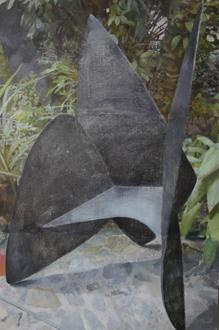
Juan Araujo, La silla del Diablo, 2010
oil on wood 60 x40 cm |
|||
|
||||
|
||||
|
JUAN ARA�JO LA SILLA DEL DIABLO 26 November to 8 January extend until 15 January Opening 25 November | 10 pm Only Anthropophagy brings us together. Socially. Economically. Philosophically. The only law in the world. A masked expression of all individualisms, of all collectivisms. (�.) Tupi, or not Tupi that is the question. (�) Before the Portuguese discovered Brazil, Brazil had discovered happiness. (�) Joy is the acid test (1.) Oswald de Andrade, Anthropophagic Manifesto (Excerpt) , 1928 The tropical place where the devil sits The images by Juan Araujo (Caracas, 1971) are a deep reflection on the painting-architecture relationship that is often expressed through the binomials of fiction/reality; the two-dimensional/three-dimensional and nonmateriality/ materialisation. Yet his game of associations does not end here. Araujo uses records that function as intermediaries between the two artistic forms as his working material, such as reproductions of books and digital or printed photographs, among other things, forming an archive of fundamental works from the History of Art, just like a veritable Imaginary Museum going from works by major architects (particularly South American ones like Niemeyer, Acayaba and Barragan) to visual artists (Alejandro Otero, Geraldo de Barros, Kandinsky, Calder, among others). We may thus state that each of his works is a sort of hypertext. Besides a reflection on the art system in its many variants, it is a meditation on reproducibility and, in the final instance, on the aspect of the simulacra and the current status of the image. In this aspect Araujo is close to Marcel Duchamp in his concept of the ready-made, but, however, he goes beyond this with re-creation in painting. Despite the external references, at first sight the (less than cautious) observer may find an almost personal register in Araujo�s images, in an attitude like a graphic journal of places visited that have a certain �literary� resonance. This mysterious quality places him close to an almost fantastic realism in the sense of leaving the possible interpretations open, setting up doubt about what one is seeing. Juan Araujo�s paintings are also a homage to the way that globalisation, as a universal movement, is being less of a uniforming factor than was ideally intended. His works are a song to Latin American architecture and to the way that it simply interprets that which was a truly international movement Laden with humanist Utopia: Modernism. The title of this exhibition clearly gives us some clues about this question. La Silla del Diablo [The Devil�s Seat] is a chair designed by Alexander Calder that pays homage to Carlos Villanueva, a Venezuelan architect who planned the Caracas University City in 1954, then proposing a synthesis of the arts, a Gesamtkunstwerk, convoking for this purpose artists ranging from Calder, Arp and Vasarely, among other names from the modern international art scene. This reference is a metaphor for Araujo�s work, which is also an attempt through painting to construct a total work, and is simultaneously a reflection on the failed Utopia of a modernism that invaded rural Venezuela to be used by the dictatorship of the time. Finally, this work is also the introduction of a geometric shape within a bio-diverse and apparently antagonistic natural context, bringing to the surface the specificities of the art of the South American continent: hot, exuberant, emotive, intuitive and thus going against the rationality of the discipline of modernist and above all Western design. Nevertheless, the functional aspect of this chair is doubtful in itself, given the feeling of some discomfort or even the danger of falling, diverting attention from its desirable ergonomics to its clearly aesthetic quality or, if we wish, to its failings as a functional object. The concept of Tropicalism might be poorly applied in Araujo�s work, but it becomes fundamental for understanding the spirit of his images. As a cultural movement that developed in Brazil, Tropicalism was a cry of revolt against outside influence, although it appropriated it. This question was clearly expressed in what Oswald Andrade called the Anthropophagic Movement, which swallowed everything that came from the culture exported by powers such as Europe and the USA and regurgitated it after it had been mixed with Brazilian popular culture and identity, which helped to define the latter as heterogeneous, diverse, mestizo and hybrid. In this movement, in the small or alter modernisms (Borriaud), the forms divulged by the supposed United States and European universality are appropriated in a particular manner by the countries that receive them and conjugates them. It is perhaps due to this factor that Araujo brings works by Kandinsky into a dialogue with Marx�s gardens, among other examples in this exhibition. The tropical and exotic side of the world thus currently stops looking at the previously colonizing countries with a lack of trust, and it is the latter who instead lose their strength and long for a renewal that might bring them life, in the same way that Araujo brings new life to architecture (or its reproduction) through painting, humanising it . Carla de Ultra Mendes Juan Araujo�s works are present in several different public and private collections, of note among which are the Tate Modern, London; the New York Museum of Modern Art (MoMA); the Caracas Museum of Contemporary Art, Centro Gallego de Arte Contempor�neo, Santiago de Compostela (CGAC); Inhotim, Centro de Arte Contempor�nea, Belo Horizonte; Teixeira de Freitas Collection, Lisbon; Carlos Ros�n Collection, Pontevedra; Eskandar & F�tima Malekl Collection, London; and Adriana Cisneros Collection, Miami. 1) Andrade, Oswald de, �Piratininga Ano 374 da Degluti��o do Bispo Sardinha�, Revista de Antropofagia, Ano 1, N�. 1, May 1928. |
||||
re-title.com
International contemporary art
SIGN UP FOR NEWSLETTERS

 SIGN UP for ARTIST MEMBERSHIP
SIGN UP for GALLERY MEMBERSHIP
SIGN UP for ARTIST MEMBERSHIP
SIGN UP for GALLERY MEMBERSHIP
Click on the map to search the directory