|
Cristina Guerra: CHRISTIAN ANDERSSON - NEVE R O DD O R EVEN - 17 Sept 2010 to 15 Oct 2010 Current Exhibition |
||||
|
CHRISTIAN ANDERSSON
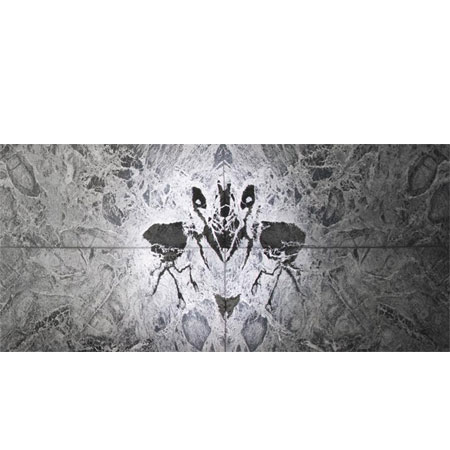
Are we not draw onward, we few, drawn onward to new era, 2009 [detail] Lamba print, 3 flashes, 3 tripods, timer | 125 x 800 cm |
|||
|
||||
|
||||
|
CHRISTIAN ANDERSSON NEVE R O DD O R EVEN Opening 16 September | 10 pm 17 September to 15 October What do the Baghdad Batteries, The Barcelona Pavilion, the Rorschach test and the Sistine Chapel all have in common? Not much, actually. Except for the fact that they all are points of departure for works featured in Christian Andersson's second solo exhibition at Cristina Guerra Contemporary Art . Any common ground, however, they might share is less a result of being referenced in the same exhibition than of being deployed along a similar line of inquiry. Interested in the historical and psychological mechanisms that ensure a given object, idea or phenomenon its accepted place in space and time, Andersson has created a body of work that examines the notion of the anachronism, the revelation that invariably attends it , and its epistemic ramifications and/or hold on reality. Of all the works in the exhibition, Paper Clip (The Baghdad Batteries) , 2009, most explicitly puts all of these questions into play. Based on the discovery near Baghdad in 1936 of what is purportedly an ancient battery, the installation consists of 49 replicas of the object (clay pots) , whose interior compound (copper, iron and vinegar) and combined force supposedly produce enough electricity to magnet i ze a paper clip to an iron rod. If this is indeed the case, the existence of the battery antedates Alessandro Volta's 1800 invention by more than a millennium. Faced with what to all intents and purposes seems to be an anachronism, the viewer i s first of all bound to wonder if this is true or even possible, and secondly and consequently become the site of a minor epistemological breakdown by virtue of the struggle to assimilate such revisionist information. But is this a bona fide anachronism, i.e., a projection of the present into the past? In other words, a historical impossibility? Or does it not rather challenge the self-assured logic of linearity that undergirds the anachronism? Perhaps it all depends on where you stand, as in another work in the exhibition Sistine Chapel (B.C.) 2009. For this literal and disfigured slice of time, the artist has created a table top out of black glass � which, for him, represents a piece of time�broken off the end, and placed it at folded, vault-like angle on top of the table (broken and scrambled time) . A reproduction of a B.C. comic strip, which has been placed upside down in the interior of the vault , can be read in the reflection of the table only from a single angle. Not as simple as it may initially seem, the comic strip features two supine cavemen marveling at the shapes they see in the clouds, such as, apparently, The Sistine Chapel. This observation, however, is immediately followed by the revelation of its anachronistic impossibility (represented by a shared stoner-like "Whoa!") , given that the Sistine Chapel hasn't even been built yet . The flawed logic upon which such a revelation is predicated is hard to hold in the mind, as the only thing more farfetched than these two cavestoners seeing a renaissance masterpiece from an as of yet un-conceived Western canon in a cloud is their realization of such an impossibility, of catching themselves in flagrant d�lit of an anachronism. Inverting the image and investing it with an anamorphic resolution, Andersson literally reflects the ideal viewing position presupposed by such wishful thinking, while again complicating its assimilation to the point of aporia If these works critically exaggerate the inherent instability of the anachronism, are we not drawn onward, we few, drawn onward to new era (2009) highlights the dubiousness of potential revelation that generally seals the anachronistic deal. For this work, Andersson has surreptitiously inserted certain optical associations into the complex history of Mies van der Rohe's 1929 Barcelona Pavilion, which was destroyed in 1930 and rebuilt in 1986. He has taken a photographic reproduction of the onyx walls of the 1986 remake, whose symmetrical, butterfly patterns are evocative of Rorschach tests, and somehow merged the famous blots into the reproduction, which are rendered visible only for a split second every few instants with the aid of a back l i t flash. Germanely, although conceived in 1927, the Swiss psychologist Hermann Rorschach's test was not used until 1931, two years after the original pavilion was built. Andersson's semi-explicit commingling of the two investigates to what extent such a conflation is an intuitive response to its mere possibility. I t ' s as if the generic image of the Rorschach test was so thoroughly imbedded in the collective cultural consciousness that the perception of it in patterns which antedate it is a perceptual knee-jerk reaction. Thus does the work not only explore how revelation (in this case "assisted") � that which is implicitly associated with incontestable truth � become something to be doubted, but also how the past tends to dissolve into the indistinguishable soup of the present. Because time and history as such have a way of undoing themselves without our even noticing it, much like, say, the circular logic of the palindrome of the work's title are we not drawn onward, we few, drawn onward to new era undoes the progressive logic of beginning and ending. Chris Sharp |
||||
re-title.com
International contemporary art
SIGN UP FOR NEWSLETTERS

 SIGN UP for ARTIST MEMBERSHIP
SIGN UP for GALLERY MEMBERSHIP
SIGN UP for ARTIST MEMBERSHIP
SIGN UP for GALLERY MEMBERSHIP
Click on the map to search the directory