|
Cristina Guerra: Christian Andersson - 13 May 2008 to 21 June 2008 Current Exhibition |
||||
|
Christian Andersson
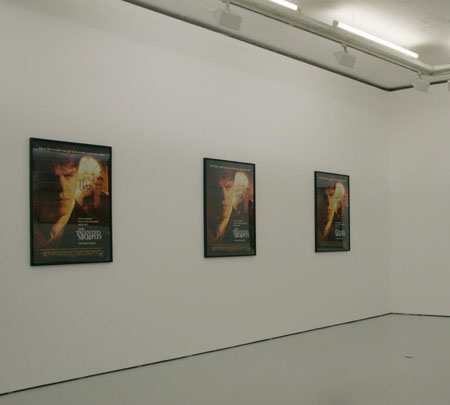
Matt Damon (Near Mint), 2007 2/5, 3 framed posters, 106 x 73.5 cm |
|||
|
||||
|
||||
|
Christian Andersson May, 13 � June, 21 Opening: Thursday May 13 - 10 p.m. Cristina Guerra Contemporary Art is pleased to announce that it will be presenting a one-man show by Christian Andersson on the evening of Tuesday, May 13th. This show � the artist�s first in Portugal � presents a group of four recent and new works where Andersson, a rising Swedish artist, continues to deal with the unstable and transitory nature of perception through sleight of hand and optical illusion, but more specifically, where themes of evidence, duplication and transformation are differently explored. In Memo, 2008, the exhibition�s centerpiece, Andersson recreates the inside of an office cubicle with shelves, carpets, wastepaper bins and other miscellaneous, commonplace �props�. Within this nondescript, lifeless interior, a facsimile of reality in itself, nothing remarkable seems to take place with the exception of a certain trace, a ghostly slither of light that moves back and forth, unremittingly. The attentive viewer soon realizes that this almost invisible light corresponds to the once-present photocopying machine and its recurrent use, and that Memo forms a trope which encapsulates the idea of the transience of technology, and in turn, of memory. The Xerox machine, a must-have to any fully-equipped and functional office in the early eighties and late nineties, that obligatory and glorified prosthetic limb of modern Bureaucracy, which once made such an impact on our lives with its potential for reproduction, now belongs to technological rubbish heap, and the papers we once photocopied as memoranda or evidence on modern acidic paper are now disappearing, eventually turning to dust. In another related work on view, 1984 (1984), Andersson presents a Portuguese edition of George Orwell�s novel by the same title in a state of flux. This book, which has become a cultural-political icon, presents a dystopian vision of the (now past) future � a vision which has incessantly been re-appropriated for today�s society, even though it has long past its sell-by date. Andersson�s semi-transparent version of the book becomes an undermined icon, illustrating how history changes fiction, which in turn affects reality, and so forth. In this particular instance, Andersson�s interest lies in identifying how each culture graphically portrays the book�s vision and how the cover potentially mirrors the political state of a specific region at a specific time. With Matt Damon (Near Mint), 2007, Andersson further addresses the issues of cultural exchange and value. This work is comprised of three separately framed, identical autographed posters of the movie The Talented Mr. Ripley. The counterfeiting apparent in the posters reflects that of the film�s central character, Mr. Ripley, and the installation becomes a mirrored hall where cultural, sentimental and economical values are set against one another, whilst the work is driven forward by a hybrid, three-fold creature consisting of the Artist, the Character and the Actor. In The *******Record, 2008, another work on view, the idea of memory and the writing of history are dealt with as an unstable and theatrical act. This piece consists of an A4 document that rests atop of a filing cabinet (another referent of modern Bureaucracy). The document inexplicably shifts in colour, going from dark black/grey to white. When �white�, the viewer is able to read the document, whilst in its darker state, the text is impossible to read. This effect brings viewers full-circle in that it directs us back to Memo and the progressive motion of the Xerox machine, and by extension, to the developing, unfixed photograph or celluloid film. CA/ND |
||||
re-title.com
International contemporary art
SIGN UP FOR NEWSLETTERS

 SIGN UP for ARTIST MEMBERSHIP
SIGN UP for GALLERY MEMBERSHIP
SIGN UP for ARTIST MEMBERSHIP
SIGN UP for GALLERY MEMBERSHIP
Click on the map to search the directory