|
Contemporary Fine Arts Berlin : THOMAS HOUSEAGO THERE IS A CRACK IN EVERYTHING THAT�S HOW THE LIGHT GETS IN - 1 Sept 2009 to 6 Oct 2009 Current Exhibition |
||||
|
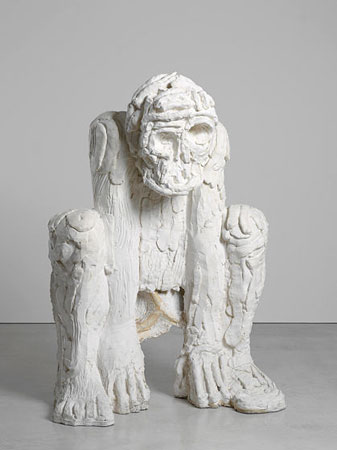
Thomas Houseago, East LA Figure (Crouching), 2009
iron rebar, plaster, hemp and wood 175x130x75cm / 68.9 x 51.2 x 29.5 in |
|||
|
||||
|
||||
|
THOMAS HOUSEAGO THERE IS A CRACK IN EVERYTHING THAT�S HOW THE LIGHT GETS IN 1 September - 6 October 2009 Contemporary Fine Arts freut sich, die erste Einzelausstellung von Thomas Houseago in Deutschland bekannt geben zu d�rfen. There is a crack in everything � That�s how the light gets in vereint neue Skulpturen, Masken, Gipspanele und Papierarbeiten des 1972 in Leeds geborenen K�nstlers. Seine monumentalen figurativen Skulpturen inszeniert Houseago in kraftvollen Posen. Ihre �bermenschlich gro�en Leiber stehen dem Betrachter konfrontativ gegen�ber, sie erscheinen wie grobschl�chtige, lauernde und animalische Heroen. Der bearbeitete Gips und die impulsiven Zeichnungen auf den Gipsplatten, die die Konturen der Leiber hervorheben, machen Houseagos dynamische Arbeitsweise deutlich. Die Skelette aus Eisenstangen, die der K�nstler deutlich unter dem Gips hervorstechen l�sst, �ffnen die K�rper und heben ihre Konstruktion hervor. Eine Umrundung der Plastiken verdeutlicht, dass Houseago bewusst Fl�chigkeit und Dreidimensionalit�t der einzelnen K�rperteile gleichzeitig erfasst und ausarbeitet. Rein formal macht der K�nstler folgendes: Er formt aus Eisenstreben Tr�gerwerke, die � dem menschlichen Skelett nachempfunden � den K�rpern inneren Halt geben. Weitere Werkmittel sind Holz, Gipsplatten und Hanf. Um bzw. auf dieses Moniereisenwerk werden mit Gips K�rperteile geformt. Dort, wo der Gips nicht zum Zuge kommt, wann bzw. wo immer sich also der K�nstler entscheidet, zwei- statt dreidimensional zu arbeiten, werden Holz- oder Gipsplatten eingesetzt. Die 3,60 Meter hohe Skulptur Monumental Figure beispielsweise, die in unserer Ausstellung ihren ersten Auftritt hat, ist von den F��en bis zur H�fte dreidimensional realistisch aus Gips geformt. Der Oberk�rper wiederum besteht aus einer Gipsplatte, aus der schablonenartig Schultern, Bauch und in die H�ften gestemmte Arme herausgeschnitten sind. Skizzenartig sind Muskeln auf den Oberk�rper gedruckt. Hinter der den Oberk�rper darstellenden Platte wird das Bewehrungseisen sichtbar, welches Beine und Kopf miteinander verbindet und st�tzt. Der Kopf wiederum ist aus Gips. Houseago spielt also mit der Welt der Zeichen, der Repr�sentation - und das auf verschiedenen Ebenen. Teile der Werke sind fast realistisch abbildend gearbeitet. Andere deuten K�rperteile nur an, verweisen zeichenhaft auf das, was der Figur fehlt, um eine vollst�ndig dreidimensional mimetisch den menschlichen K�rper darstellende Skulptur zu sein. So changieren die Skulpturen oft zwischen diesen verschiedenen Ebenen der Repr�sentation. Skulpturenensembles auf klassischen oder barocken Bauten haben oft eine Schauseite und eine f�r den Betrachter nicht sichtbare Seite. Von unten hat der Betrachter den Eindruck, es mit vollfigurigen Skulpturen zu tun zu haben. Hat man jedoch die M�glichkeit, solche Werke von nahem zu betrachten, so erkennt man ihren Fassadencharakter. Sie sind nur nach vorne gearbeitet, von innen hohl und dar�ber hinaus von Eisentr�gern gest�tzt. Auch hier ist man, mit der R�ckseite konfrontiert, �ber die Fragilit�t und das Fragmentarische erstaunt. Houseago verbindet Schau- und R�ckseite in einem und macht sich den verwirrenden Effekt dieses Changier-Spieles zu Nutzen. There is a crack in everything � That�s how the light gets in ist die erste Einzelpr�sentation von Thomas Houseago bei Contemporary Fine Arts. Thomas Houseago lebt und arbeitet in Los Angeles. THOMAS HOUSEAGO THERE IS A CRACK IN EVERYTHING THAT�S HOW THE LIGHT GETS IN 1 September - 6 October 2009 Contemporary Fine Arts is pleased to announce the first solo exhibition by Thomas Houseago in Germany. �There is a crack in everything � That�s how the light gets in� brings together new sculptures, masks, plaster panels, and works on paper by the artist, who was born in 1972 in Leeds. Houseago creates monumental figurative sculptures in powerful poses. Their larger-than-life bodies confront the beholder aggressively; they seem like rather coarse, lurking, and animalistic heroes. The sculpted plaster and the impulsive drawings on the plaster panels that underline the bodies� contours make Houseago�s dynamic working method clear. The skeletons of iron bars that remain clearly visible underneath the plaster open up the bodies and reveal how they are constructed. When we walk around the sculptures, we see how Houseago consciously grasps and develops the flatness as well as the three-dimensionality of individual body parts. Formally, the artist proceeds as follows: he builds support structures (modelled on the human skeleton) that give the bodies inner support. Additional materials include wood, plaster panels, and hemp. Around and on top of this structure, body parts are formed with plaster. Wherever plaster is not used, or wherever the artist decides to work two-dimensionally instead of three-dimensionally, wooden or plaster panels are being used. The sculpture Monumental Figure, measuring 3.6 metres, for example, which is making its first appearance in this exhibition, is modelled realistically in three dimensions from the feet to the hip. The upper body, on the other hand, consists of a plaster panel, from which the shoulders, stomach and the arms (akimbo) are cut out like stencils. The way the muscles are printed onto the upper body is reminiscent of a sketch. Behind the panel representing the upper body, the reinforcement steel connecting and supporting the head and the legs is visible. The head is once again made of plaster. Houseago thus plays with the world of signs, of representation � on several levels. Parts of the works are modelled almost realistically, while other parts merely allude to body parts, symbolically pointing towards what keeps the figure from being a completely three dimensional sculpture mimetically representing the human body. In this way, the sculptures oscillate between these various levels of representation. Sculpture ensembles on classical or baroque buildings often have a show-side and a side that is not visible to the beholder. From below, the beholder gets the impression that he is looking at fully modelled figures. However, given the opportunity to look at these sculptures closely, their fa�ade-character reveals itself. They are only modelled in the front, hollow inside, and also have iron supports. Here, looking at the back, we are surprised by their fragility and their fragmentary character. Houseago combines the show and back sides and takes advantage of the confusing effect of this interplay. �There is a crack in everything � That�s how the light gets in� is Thomas Houseago�s first solo exhibition at Contemporary Fine Arts. Thomas Houseago lives and works in Los Angeles |
||||
re-title.com
International contemporary art
SIGN UP FOR NEWSLETTERS

 SIGN UP for ARTIST MEMBERSHIP
SIGN UP for GALLERY MEMBERSHIP
SIGN UP for ARTIST MEMBERSHIP
SIGN UP for GALLERY MEMBERSHIP
Click on the map to search the directory