|
CUE Art Foundation: Mores McWreath: Curated by Andrea Zittel David Dunlap: Curated by Scott & Tyson Reeder - 12 Nov 2009 to 9 Jan 2010 Current Exhibition |
||||
|
Mores McWreath: Curated by Andrea Zittel
|
|||
|
||||
|
||||
|
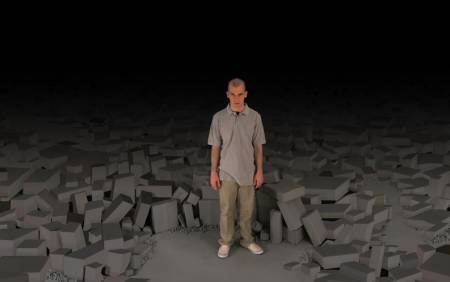
November 12, 2009 - January 9, 2010 Opening Reception Thursday, November 12, 6:00-8:00pm Mores McWreath: Curated by Andrea Zittel Monitors generously loaned by: Art in General David Dunlap: Curated by Scott & Tyson Reeder Mores McWreath Curated by Andrea Zittel Artist's Statement My art interrogates and restages the fragmented nature of human subjectivity using video, photography, sculpture, and drawing. These artworks actively oppose the dominant cultural assumption of a unified subject. This investigation often leads to a deconstructive self-analysis. It is not a need to �know� one�s true self because that seems an impossible task, but it is rather a need to make public the theater of perceptions that form individual subjectivities. The goal is to take the vaudevillian theater of the mind and project it out for others to access for the sake of identification. The Nietzschean concept of Perspectivism posits: �In so far as the word �knowledge� has any meaning, the world is knowable; but it is interpretable otherwise, it has no meaning behind it, but countless meanings.� My body and the bodies of others appear in my work as stacks of pieces and parts. These piles of rubble are composed of clips, segments, and quotations from private and public, real and imagined histories. They perform on camera in short bursts of dialogue, action or sculpture. These vignettes allow me to quickly access a broad range of genres, styles, and sources. The Internet has created access routes to a flood of media that I channel through various screens and filter into my work as references, homage, transformations and appropriations. The juxtaposition of fragmentary elements culled from the world of images creates a visual and textual metaphor for the nature of human existence in the face of overwhelming information. Curator's Statement by Andrea Zittel About a year ago I was walking down 23rd street between 7th and 8th. It had rained earlier in the day and the street lined with piles of damp black plastic trash bags waiting for pickup, and near one of the piles of bags was a semi-wet piece of paper with clumsy scrawled crayon writing that said: �think with your head.� Learning to think with our heads, or to think critically, is the benchmark for becoming an engaged adult participant in the discourse of contemporary art. But before critical perspective enters the door we think with our stomachs, relying on intuitive barometers like gut reaction. Often when I look at Mores McWreath�s work I feel like I�ve exhumed my teenage gut, enmeshed with pre-critical sensory confusion. Without knowing any of the particulars about McWreath�s upbringing, I instinctively believe that he grew up in a suburb just like I did, and that even though he was generally content, he simultaneously experienced that same latent sense of foreboding that something was �off� in the world. Most of the dialog in McWreath�s videos is found (or pillaged) rather than his own, and it is clear that he objectively �gets� the emptiness of living in a culture that oppresses its citizens via the empty rhetoric of freedom. But it is also clear in his work that he is a fully �indoctrinated� participant in this same consumer culture. Without giving up on the big questions (Why are we here? What is life for? What is our purpose?), McWreath points to a world in which meaningful relationships to labor, other people or self-empowerment can easily be relinquished, in exchange for the ever evasive fulfillment promised by a continual consumption of commodities. Similar to consumer culture that offers us variety without granting choice, McWreath�s videos are generally comprised of clips that fit together in a seeming interchangeable order. Rather than discrete works, each episode is in a sense a cellular segment that can be reconfigured into the evolving recombination that creates the larger whole. The repetitive order of his work also brings to mind the dictate of the earlier generation of minimalists who used the stance of �One thing after another� as a means to eschew subjective composition in favor of a more rote sequence that was the earmark of capitalist modes of production. McWreath�s work is repetitive, smart, juvenile, considered and foolish. The videos have a handmade feel � as if they were crafted in the corner of a bedroom and aren�t sure how to be public. And when they do go public it can be through many various channels of distribution including Bittorrent, YouTube and Vimeo. Or then again they may just as easily be projected supersize on the walls of the white cube. The image and content privilege neither the artworld nor the realm of internet techies, and the medium doesn't dominate the message. Or in the words of McWreath when talking about his decision to post his videos on line -�I don�t see the point of hiding it from anyone.� Artist's Bio Mores McWreath was born in Washington, PA in 1980 and grew up in ten different cities scattered throughout the South and Midwest. He received a BFA from The Cooper Union for the Advancement of Science and Art in New York and an MFA from the University of Southern California Roski School of Fine Arts in Los Angeles. He attended the Whitney Museum of American Art Independent Study Program in 2008-2009. Recent group exhibitions include: Theoretical Practice at the International Studio and Curatorial Program, New York, 2009; Worlds Away: New Suburban Landscapes at the Walker Art Center, Minneapolis, 2008; End-Times at the Lasso Gallery at the Butcher Shop, Chicago, 2007; Ghosts of Presence: International Emerging Artists' Video at the Art Gallery of York University, Toronto, 2007; and Flex Your Textiles at John Connelly Presents, New York, 2006. His work has been screened in film festivals both nationally and internationally, including the Athens International Film and Video Festival and the Jakarta International Video Festival. He currently teaches at the Cooper Union. McWreath's exhibition at CUE Art Foundation marks his first solo show in New York. Mores McWreath was born in Washington, PA in 1980 and grew up in ten different cities scattered throughout the South and Midwest. He received a BFA from The Cooper Union for the Advancement of Science and Art in New York and an MFA from the University of Southern California Roski School of Fine Arts in Los Angeles. He attended the Whitney Museum of American Art Independent Study Program in 2008-2009. Recent group exhibitions include: Theoretical Practice at the International Studio and Curatorial Program, New York, 2009; Worlds Away: New Suburban Landscapes at the Walker Art Center, Minneapolis, 2008; End-Times at the Lasso Gallery at the Butcher Shop, Chicago, 2007; Ghosts of Presence: International Emerging Artists' Video at the Art Gallery of York University, Toronto, 2007; and Flex Your Textiles at John Connelly Presents, New York, 2006. His work has been screened in film festivals both nationally and internationally, including the Athens International Film and Video Festival and the Jakarta International Video Festival. He currently teaches at the Cooper Union. McWreath's exhibition at CUE Art Foundation marks his first solo show in New York. David Dunlap Curated by Scott and Tyson Reeder Artist's Statement T h e C o u r a g e t o M i s s p e l l In Truth and Reconciliation Reparations That summer the first thing we did was to make a Device for Measuring the PRESENCE of Martin Luther King Jr. Then Gelsy and I began to draw. We sat across from one another and drew back and forth, and in this exchange we spoke of those things we do for keeps, love and war. We were mindful of the saying "all's fair in love and war." We also spoke of the memory we hold deep in our bodies, of being eaten. We marveled at how we had learned to become a herd and in this knowledge were no longer eaten (alive). Drawing back and forth we spoke of love. We spoke of the love that Martin Luther King Jr. described in his dream, the love we experience when we are part of a whole. Then we spoke of love when it is just us. In either case we realized love enters as a song. We remembered Martin singing his dream, then, thinking of love when it is just us, we listened to Ray Charles sing "I don't need no doctor." SUDDENLY the Device for Measuring the PRESENCE of Martin Luther King Jr. began to move and we both exclaimed, "Let's write our artists statement about this!" Let's make our artists statement about how to conduct our selves when playing for keeps. FIRST thing: NO zombies, NO water boarding, NO extraordinary rendition. We began to tell one another our experience with Zombies (Gelsy was Haitian-Canadian, often used "zombies," " royalty" in her work). We realized that zombies were the opposite of Martin Luther King Jr. They seemed to be present, but were not. They cast no shadows. When they apologized they always cried. Then we reflected on the times we had been zombies. Whenever we reflected we would read from our textbooks, children's geography books from the time of Darwin. We would read the description of a lake: "A lake is a pool of still water." Tears would well up in our eyes at this. Then in the same voice we would read "The black race is a degraded race." It was then that we realized that broccoli was sentient, had a soul and that we were cannibals. We realized that evil is evil because you cannot always see it, because it does not always goose-step. Tears would well up in us at this. Gelsy had an "I am a Man" project. She and those of us within her project would draw Martin Luther King Jr., as he would appear today. She, we took great liberties with his appearance (sometimes he looked like James Brown, sometimes he looked like Elizabeth Stanton). He was a living, breathing thing, not fixed. He was not what you expected (Gelsy sometimes called herself "The Unexpected Haitian"). I did not mean to, but I have a project, projects ("Ana Mendieta Foster Child of Iowa," "Kangying Guo, Brave and Resourceful," "The Swastika Drawing and Sewing Club," "The Burning Cross of Barack Obama"). I do not know what any of these projects mean or why I am involved with them. I can only trust there is something for me to learn. Out of the blue Gelsy died (age 39) leaving behind her daughter Clara (named after Gelsy's mother). Now it is harder to pursue my projects. Now I have to say that recently I have been diagnosed with a rare form of Tourette's syndrome in which I am compelled to draw swastikas and Barack Obama Burning Crosses. Gelsy Verna, NO water boarding David Dunlap, NO extraordinary rendition Curator's Statement by Scott and Tyson Reeder This is Always Finished David Dunlap is an artist, walnut farmer, and teacher living in Iowa City, Iowa. Since 1974, he has maintained a practice of keeping daily notebooks filled with drawings, words, lists, photos, dreams and sketches. The hundreds of numbered books are the building blocks for David's unique practice, a constantly evolving and mutating living document, both autobiographical and fiction, articulated through all media, including overflowing installations, hand-made suits covered with text, a 50-foot tower, pottery as clothes, and a Warhol-like obsession with capturing each fleeting moment with a camera or pen. Through these objects, Dunlap has created a universe of fellow artists, collaborators, friends and family who are all connected in some way to his story and practice. Although Dunlap organizes his installations using a chronological framework, there are no clear beginnings or ends to his projects. A drawing from 20 years ago can suddenly reappear next to a drawing from two days ago; and through this re-contextualization becomes something altogether new and different. In the same way, there are few fixed physical boundaries between Dunlap's individual works; conventional ideas about the autonomy and hierarchy of medium do not apply. A ballpoint pen drawing might eventually end up attached to a kinetic sculpture, or a large scale wall painting could be reborn as a smaller but more engaging 4"x 6" photograph. This rejection of familiar models of artistic production are part of what gives Dunlap's work it's strength, but it's his unique touch as a draftsman and inventive use of text and image that really animates his practice. Experiencing a room full of Dunlap's delicately rendered drawings and obsessively reworked passages of text is like following a well-worn path up an old wooden staircase. You feel at the same time comforted and humbled; many other people have gone this way before you. Artist's Bio In the spirit of friendship, passing this back and forth, I (David Dunlap) have collaborated with the following people, sometimes assuming a name: Rotomatic Corps, Phil Meyer, 1963-2009. Abracadabra, Susan Deming, Royce Dendler, 1967-90. The Living, Breathing Thing (FREE Art School), Jay Schmidt, 1966-2009, Wattle Daub, Michael Meyers, 1970-2009. Happy Cyclops Pottery, Michael Peed, 1975-2003 The Gitards, Melba Price ,Oakley Tapola, Bruce Tapola, 1980-2009, Grantana, Mel Andringa, Lloyd Dunn,1983-2009, Walnut Farms Inter-Species Artists Collective, Alva Gene Dexhimer, Emma Dunlap-Grube, Nelle Dunlap, Jane Gilmor, Victoria J. Grube, Andrea Loest, Philip Miller, Helen Neumann, Carrie Pollock, Alex Primm, Howard Rogovin, Bill Samualson, Irene Samualson, Scott Samualson, Ryan Standfest, DD Sunner, Britta Urness, Anthony Yoder, 1984-2009, The Story of the Rose, Hamlett Dobbins, 1991-2009. His River, Nathaniel Parsons, 1991-2009, The Teahouse of the White Flag of SURRENDER, Travis Freeman, 2000-09, Blue Hole Holler Dress + Honey Co, Maxine Payne, Clementine Ophelia Weeks, 2003-2008, T.I.S.H.A.M., Ed Bartlett, Sheridan Bartlett, Thomas Bartlett, Gabe Greenberg, 2004-09, The Mens Sewing Club, Pete Schulte, 2005-09, The Mens Fyloft Correspondence Club, Travis Head, Zach Stensen, 2006-09, ICCRPT, David Bendernagle, Maggie Booth, Jeremy Chen, Lydia Diemer, Josh Doster, Shawn Reed, 2006, Puppet Workshop, Mariah Dekkenga, Michael Perrone, 2006-09, The Obscenity Institute, Jill Baker, Jenn Myers, 2008, Paintallica, (Elders) Jesse Albrecht, Dan Attoe, Jamie Bolling, CeCe Cole, Bill Donovan, (Juniors) Posie Currin, Jeff Decker, Chris Miller, Jay Schmidt, Shelby S.C., Jeremy Tinder, 2008-09, The Gleaners, Caleb Engstrom, Andy Moeller, 2008-09 The Mens Cold Pork Drawing Club, Caleb Gentry, 2009. For additional information, please contact Ryan Thomas, Programs Coordinator, CUE Art Foundation, 212-206-3583, or |
||||
re-title.com
International contemporary art
SIGN UP FOR NEWSLETTERS

 SIGN UP for ARTIST MEMBERSHIP
SIGN UP for GALLERY MEMBERSHIP
SIGN UP for ARTIST MEMBERSHIP
SIGN UP for GALLERY MEMBERSHIP
Click on the map to search the directory