|
CUE Art Foundation: Mitchell Squire | Sarah Canright - 19 Nov 2011 to 14 Jan 2012 Current Exhibition |
||||
|
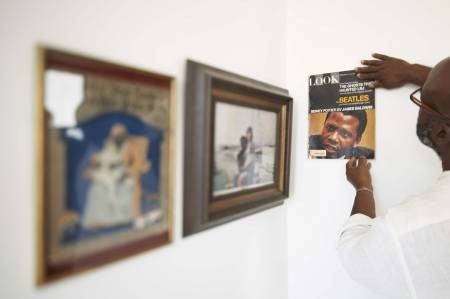
Mitchell Squire, One Year Later Same as Fifty Years Before (when all I want is a boat):
or, Tinsel Telos, 2010 Appropriated print media, colored pencil, colored tape, ink, 40" x 18" x 20" |
|||
|
||||
|
Mitchell Squire Curated by Theaster Gates November 19th, 2011 – January 14th, 2012 (Opening reception Saturday, November 19th, 6-8pm) “Mitchell moves comfortably through the world of story and makes harmonies from this country’s disparities. Mitchell is willing to engage Power in ways that allow us into a conversation about the value of histories, the right to speak and the way we are.” —Theaster Gates The work of Iowa-based artist, Mitchell Squire investigates the potent agency of material culture to allow us reflect upon society, race, and history – both shared and personal – by intertwining them within found, inherited, mass-produced and general everyday objects and materials. Narratives either inherent to, or constructed within them are very simply reorganized and manipulated by Squire to bring undercurrents in the American historical narrative to the surface, poetically underlining the moments of struggle and loss that accompany the various circumstances to which they loosely refer, and certainly that still influence the contemporary national dialogue. On view at CUE Art Foundation, Squire’s fist solo show in New York City, are ten of the artist’s most recent mixed-media works – two wall pieces, seven free-standing installations and one video. These works are a clear but certainly aligned evolution from past projects that were more archival and collection-based, moving to direct combination and thus more physical in their presence. Through the use of the objects – toys, baby shoes, rope, costume jewelry, and even materials like fur, feathers and human hair – the work is made universally accessible and functions as vessels for personal reflection through the viewer’s exploration of their own associations and assumptions. Much like the materials in these assemblages, the viewer is positioned to reevaluate their own reactions within a larger social context referred to in this selection of work. While interpretation is purposely left open-ended, an air of critique is palpable. The items and materials selected seem to reverberate with foreboding and precariousness as they appear to be just moments from falling, tipping or crushing. At the same time, many objects are tightly wrapped, gouged, torn, or simply weighed down. The implication conjured is of the unease felt when placed in the often dichotomous, complex position of reflecting upon cultural and historical instances and the constriction assigned when attempting to transcend instances of adversity while at the same time being called to acknowledge and reform them. Implication and is as far as these works travel – they do not support or further an authoritarian approach, nor do they provide absolution. Rather, they prepare use to move forward by supplying the means for looking back. Mitchell Squire is an installation artist, sculptor and performance artist based in Iowa. He is primarily known for his work that explores culture through collected artifacts. He historicizes the performative aspects of objects through strategies of association and the incorporation of provocative materials including human hair, candy, and athletic tape, in an attempt to tease out the presence of complex structures of desire. In 2010, Squire was the recipient of the Midwest Voices and Vision award, administered by the Alliance of Artists Communities and funded by The Joyce Foundation, and the Camille Hanks Cosby Fellowship to participate in the Skowhegan School of Painting and Sculpture. A nationally recognized educator in the field of architecture, his published works include the poetic treatise “Paris Done Burnt!” in White Papers, Black Marks: Architecture, Race and Culture (2000), and the object collection “cultureWARE: Implements of Desire; or EAT THIS!” in Eating Architecture (2004). He is currently an Associate Professor of Architecture and holds both Bachelor and Master of Architecture degrees from Iowa State University. Squire’s exhibition at CUE Art Foundation marks his first solo show in New York City. Sarah Canright Curated by Nic Nicosia November 19th, 2011 – January 14th, 2012 (Opening reception Saturday, November 19th, 6-8pm) “I imagine she works on a painting or a drawing every day because she has to, needs to, and because the idea will not go away until it’s realized and the working doesn’t stop until it’s “right”…The inherent beauty and the density of the emotions that her paintings emit makes them as memorable as anything I have seen.” —Nic Nicosia The work of Austin-based artist, Sarah Canright is an exercise in visual and conceptual fluidity. Occupying a space firmly rooted in painting and drawing, her work finds great pleasure in the stroke of the brush, and much use for the strong, clear lines of drawing. Canright began her career in abstraction, despite being loosely associated with the Chicago Imagists in the 70’s. However, her work has come to demonstrate a complex flexibility between the abstract and the figurative that allows her to create, as Canright states, “an inviting tactility, feeling out the surface, creating with paint the visual experience of physical presence.” Canright’s newest project, on view here at CUE Art Foundation for her first solo show in New York City in over twenty-five years, is a definite departure from her past work, yet continues to beautifully illustrate her skill at uniquely bridging both visual and emotional elements in highly engaging ways. Following the death of her greyhound, Canright began creating portraits of her dogs and cats. Placed in contorted, twisted poses, and often with mouths open and eyes closed, it is not immediately clear whether they are depictions of animals in deep states of relaxation, or instances of something more macabre. This uncertainty creates ample space for them to function as intimate reflections on mortality and vulnerability. At the same time, however, Canright’s controlled, highly specific brushstrokes pay a great deal of attention to these lithe animals’ writhing muscles, exposed teeth, and outstretched claws, suggesting an underlying power and dynamism within. The muted palette used by Canright hinders any differentiation between specific subjects in each piece, as well as within the whole series, leading the viewer to focus more on the repetition of lines, shapes and tones. The selective details, non-existent backgrounds and disoriented perspectives speak of her relation to abstraction, while at the same time underlining the figures’ sense of movement as the forms shift and twist from different points of view. Canright’s style is highly poetic: it invites long, studied viewing of the work, while at the same time providing ample flexibility in interpretation. These beautiful renderings, while initially highly specific to the artist, serve as eloquent metaphors for universal concerns such as love, attachment and the preciousness and frailty of life. Sarah Canright graduated from the School of the Art Institute of Chicago and began showing with the Chicago Imagists in the late 1960’s. In 1972, she moved to New York. In the 1980’s she began splitting her year between New York and Texas, and in the mid-1990’s, accepted a full-time teaching position at the University of Texas at Austin. Throughout her career, she has been awarded three National Endowment for the Arts Fellowship Grants and a New York State Council for the Arts Grant. During the 1970’s and 1980’s, she was represented by the Pam Adler Gallery in New York City and the Phyllis Kind Gallery in Chicago. She has exhibited her books at Franklin Furnace in New York City and was included in the 1975 Whitney Biennial. This exhibition marks Canright’s first solo show in New York City in over twenty-five years. For additional information, please contact Ryan Thomas, Programs Coordinator, CUE Art Foundation, 212-206-3583, or email [email protected] |
||||
|
||||
re-title.com
International contemporary art
SIGN UP FOR NEWSLETTERS

 SIGN UP for ARTIST MEMBERSHIP
SIGN UP for GALLERY MEMBERSHIP
SIGN UP for ARTIST MEMBERSHIP
SIGN UP for GALLERY MEMBERSHIP
Click on the map to search the directory