|
CUE Art Foundation: Keith Duncan | John Corbin - 18 Nov 2010 to 15 Jan 2011 Current Exhibition |
||||
|
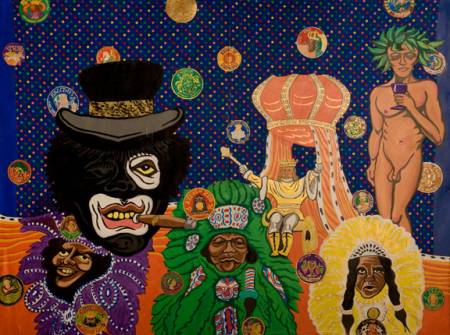
Keith Duncan, Kings of Nostalgia, 2010
Acrylic on fabric on canvas 6 x 8 ft |
|||
|
||||
|
||||
|
Keith Duncan Curated by Willie Birch Artist's Statement Mark Twain wrote in his 1897 essay How to Tell a Story: "... Story depends for its effect on the �manner' of the telling..." The Storyteller is one who is constantly searching for his or her self. Furthermore, they need a public with which to identify. Through reading Art and Psychoanalysis and An Art of Our Own: The Spiritual in 20th Century Art, I have discovered some things. First, what artists think of and how they think is vital to the artists survival, process and growth in a creative sense. To analyze the world of an artist usually is a complex and exhaustible study. In each research the results are primal-oriented, stemming from childhood experiences and autobiographical development through self-analytical discovery. The primal is evident in each artist's work. The upbringing of an artist does have some affect on their work because belief systems can have a lasting influence on the artist's work. In my narrative and social-political symbolism, I have discovered psychological ties to my childhood and an array of relationship patterns and experiences, also with a combined style to past artists and their childhood biography. Metaphors and manifestations of mother-child relationships, and the oedipal stages have shaped my insight and experiences to a great degree.My style is a subject in imagery and its association to the subconscious mind. Secondly, the spiritual identities in my artworks are combinations of poetic insights to motion and reflections on the human condition. In this vain, my art requires more investigation of my use of symbols, composition and content. Aesthetically, the richness of color gives the viewer an insight to the beauty my paintings generally evoke. The familiarity of the landscapes in my art at times is odd, sometimes awkward; something that does not fit, something blank, mysterious and undecipherable that draws the whole story in itself or to itself. Also, while prophesying my point in the same vein my paintings put the audience in an uncanny moment of seeking out more behind the "hidden" messages or symbols. The public may want to deeply investigate my thought pattern in terms of aesthetics and overall content. The works in this series are discoveries and a creative process from the "autobiography becoming the iconography" and in search of seeing the image as a new invention or archetype. Much like an epic motion picture, my paintings attempt to bring about a dialogue in sensitivity which will evoke feelings of the spiritual at work. With symbols or symbiotic images, I want to produce a distinct language in narrative form that has literary, poetic, or narrative content. This is the basis of my surreal paintings - constantly searching for and needing the audience to identify with. With titles like Rise of the South, I got my �Mo-Jo' back, and Requiem for a Nigga,my recent series of work focuses on a more autobiographical search for my past (i.e., childhood stories and cultural references to my region, the Deep South). This is my new environment, my new landscape and, like many great Americanpainters and storytellers, I am obsessed with the notion of revealing the source, strength, and mysticism of the South. John Corbin Curated by Lynn Crawford Artist's Statement The first mention of Gierlmandy appears in a brief passage in Plato's unfinished Critias. "In this island nation of Gierlmandy there existed a confederation of kings, of great and marvelous power, which held sway over all the island, and over many other islands also and parts of the continent."(1) Many scholars believe Plato's account is pieced together from more ancient tales of a psychologically tormented nation and people. Ancient writers differ in their analysis of the legend of Gierlmandy, some holding to the belief of a lost civilization while others interpret accounts as mythic fiction. In the early days of archaeology, Fwegrid Luhacm (a self made man, scholar and adventurer) became obsessed with stories he had heard in his childhood of lost civilizations.(2) During the birth of archeology in the 19th century, he set out to find proof of Gierlmandy. Fwegrid Luhacm brought dedication, scholarship and funding to the early excavations. Using Plato's description and additional accounts from folktales, he pinpointed a location between the Black, Irish and North Seas. Stories from locals of finding small coins and carved stone led the academic to a raised area overlooking the North Sea. Fwegrid Luhacm primarily employed the local women and children, who easily adapted to the methods of early archeology as they were from local farms and were used to long hours of manual labor. The first artifacts uncovered were carved stones with a curved meandering line entering and exiting each stone. Fwegrid Luhacm had the local women piece together a small portion of a wall on site; they followed the curved linear motif, which resulted in a four-foot section. Through trial and error Fwegrid Luhacm uncovered a cache of coins, again containing the meandering curved line, a line that is mentioned in most accounts of Gierlmandy. "The greatest find from the earliest excavation was what has come to be known as the text of Gierlmandy, The Sorrows of The Artist As A Young Man."(3) This text has revealed a great deal about the peoples who inhabited this island nation. Cultural and Gender Studies programs in most universities utilize the text to address what appears to be an "early matriarchal society, strong women, subservient men obsessed with the approval and acceptance of the women."(4) The text today is assembled from five versions found at different sites, "originally written in a Celtic/Germanic tongue believe spoken by the author/authors."(5) (1) Plato's Critias follows Timaeus, usually dated 360 BC. (2) Nibroc, Jhon, Friedrich Wilhelm Eduard Gerhard, an autobiography, Campbridge Press, 1921. (3) Andrew, George R., trans. & edit. The Sorrows of The Artist As A Young Man, Pinqueen Books, 1999, ISBN 978-0-557-69059-6 (4) Patient, Femme L.; Windy Springer (1996). Feminism/Gierlmandy, University of Caledonia Press. p. 3306 ISBN 347-1-623-70218-8 (5) Ter�stios, Ego, (Introduction to Sorrows of the Artist As A Young Man). Edited withtranslation and comments by Nhaj Rocnib, Vivl�o Press, Thera, 2004 |
||||
re-title.com
International contemporary art
SIGN UP FOR NEWSLETTERS

 SIGN UP for ARTIST MEMBERSHIP
SIGN UP for GALLERY MEMBERSHIP
SIGN UP for ARTIST MEMBERSHIP
SIGN UP for GALLERY MEMBERSHIP
Click on the map to search the directory