|
Belfast Exposed Photography: Border Country : Melanie Friend - 15 Nov 2007 to 11 Jan 2008 Current Exhibition |
||||
|
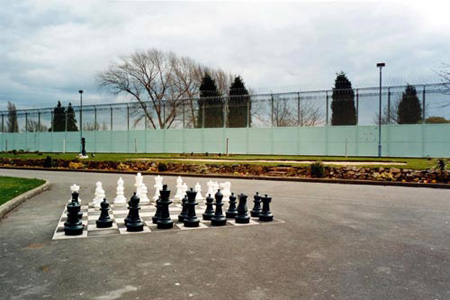
Detainees� recreation area, Lindholme Immigration Removal Centre, April 2006
� Melanie Friend |
|||
|
||||
|
||||
|
Border Country Melanie Friend Exhibition & book launch event: Thursday 15 November, 7 � 9pm 15 November to 11 January 2008 Belfast Exposed Photography is privileged to present Border Country by Melanie Friend, an exhibition of medium-format photographs, with a sound installation of voiced testimonies of asylum seekers and migrants in detention in the UK. A publication of the work, with essays by Mark Durden, Alex Hall and Melanie Friend will also be launched at the opening event. Melanie Friend began work on Border Country in 2003. Since then, more than 25,000 individuals per year have been held for some period in immigration detention in the UK. Immigration detainees in Northern Ireland had, until last year been held in Maghaberry and Hydebank Wood prisons. They are now automatically transferred to detention centres in Scotland and England. Melanie Friend has photographed the visits rooms in eight Immigration Removal Centres (IRCs): Dover, Colnbrook and Harmondsworth (near Heathrow), Lindholme (near Doncaster), Tinsley House (near Gatwick), Campsfield House (near Oxford), Yarl�s Wood (near Bedford) and Haslar (near Portsmouth). She also obtained permission to photograph some landscapes. As a visitor she met asylum seekers and migrants in several IRCs, and was given special access to record interviews with male detainees in Dover, and female detainees in Yarl�s Wood. The exhibition and publication include voice recordings that evoke complex identities and the physical and psychological experience of life in detention. The significance of a project like Border Country is that it literally �gives voice� to a socially excluded, almost invisible group of people. In his essay, Mark Durden states �In Border Country, Friend gives us the voices of people without any home or belonging, trapped within an inhumane system they cannot fully understand. The act of listening to those caught waiting, uncertain of their future� deportation or asylum� breaks the silence and invisibility surrounding these centres and those who are kept inside.� Alex Hall comments on how �immigration categorisations � distinctions between belonging and not belonging � constantly change and shift, and it is for this reason that detainees cannot be considered straightforwardly legal or illegal.� She proposes that: �These are people who may be subject to processes which aim to take away their everyday visibility, their political presence and their ability to define their own lives, but they refuse to disappear. We are challenged to listen, and in listening, we must confront the arbitrary classifications between national citizen and other, between belonging and not belonging; we confront the effect of drawing a border. In this confrontation, we must reassess who has the right to comment, who has the right to a political presence, who has the right to be seen and heard.� Artist�s biography Melanie Friend�s exhibition Homes and Gardens: Documenting the Invisible focused on repression in the �police state� of Kosovo preceding the war. It opened at Camerawork in 1996, toured the UK, and was exhibited at the Houston Center for Photography, Texas in 1998. Friend�s sound/image installation The Guide focused on the immediate aftermath of the Kosovo war and in summer 2001 was shown together with a newly curated version of Homes and Gardens at the Hasselblad Center, Sweden. In autumn 2001 her book No Place like Home: Echoes from Kosovo was published by Midnight Editions, USA and was widely reviewed in the USA, UK and in Kosovo itself. She is Senior Lecturer (Photography) in the Department of Media and Film, School of Humanities, University of Sussex. Writers' biographies Mark Durden is Professor of Photography at Newport School of Art, Media and Design (University of Wales) and is also part of the artists� group Common Culture. Alex Hall is a researcher at the Department of Geography, University of Durham. |
||||
re-title.com
International contemporary art
SIGN UP FOR NEWSLETTERS

 SIGN UP for ARTIST MEMBERSHIP
SIGN UP for GALLERY MEMBERSHIP
SIGN UP for ARTIST MEMBERSHIP
SIGN UP for GALLERY MEMBERSHIP
Click on the map to search the directory