|
Barbara Weiss: Andreas Siekmann : Verhandlungen unter Zeitdruck / Negotiations Under Time Pressure - 2 May 2008 to 7 June 2008 Current Exhibition |
||||
|
|
|||
|
||||
|
||||
|
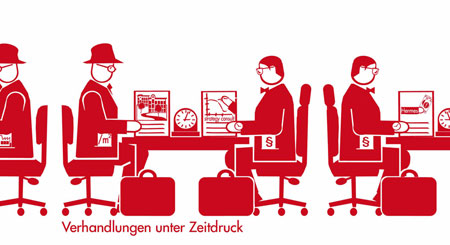
Andreas Siekmann Verhandlungen unter Zeitdruck Aus: Faustpfand, Treuhand und die unsichtbare Hand (2005-2008) Negotiations under time pressure From: Pawns, Trustees, and the Invisible Hand (2005-2008) May 2 � June 7, 2008 Opening: Friday May 2, 2008, 6�9 pm Gallery hours: Tuesday � Saturday, 11 am�6 pm Gallery Weekend: May 3 and May 4, 10 am�7 pm Galerie Barbara Weiss is delighted to announce the opening of its new spaces on the ground floor of Zimmerstra�e 88-89 on the occasion of the Gallery Weekend with the show "Verhandlungen unter Zeitdruck / Negotiations Under Time Pressure" by Andreas Siekmann, who recently participated in Documenta 11 and 12 as well as in Sculpture Projects Muenster 07. In his works, Andreas Siekmann - who attracted great attention at Documenta 12 with his roundabout of protagonists of exclusive power set up in front of the Fridericianum as well as during Sculpture Projects Muenster 07 with a large ball of shredded plastic city mascots at the Erbdrostenhof - is essentially dedicated to the analysis of the economic paradigm shift from social market economy to neoliberalism as well as to its impacts on society and urban space. Siekmann critically displays prevailing power relations and conceives utopian counter-models. His unique, narrative image worlds are based on references to art history and mass media as well as on observations drawn from the realm of realpolitik. In "Verhandlungen unter Zeitdruck / Negotiations Under Time Pressure", Andreas Siekmann addresses the parameters of economic restructuring in former East Germany after reunification. The central coordination agency of this privatization process was the Treuhandanstalt, seated in the building of the former Reich Air Ministry, today�s Ministry of Finance on Wilhelmstra�e. Its fa�ade is projected via an outdoor mirror into the gallery spaces. From March 1990 through December 1994, the Treuhandanstalt liquidated 13,800 East-German companies � 15 a day. The transformation from nationally-owned enterprises to incorporated firms, their valorisation, was considered to be the security of an economic consolidation, a precondition for the invisible hands of private economy to bring about a new economic miracle. The history of the Treuhandanstalt is therefore part of the transformation economy that first affected Eastern Europe and then spread across the globe. Its protagonists, e.g., the investment banks and consulting firms, today form an indispensable part of political decision-making processes geared to new forms of optional capitalism. The motto of the Treuhandanstalt�s work � "privatization before reconstruction" � produced, as a symptom, unquestionable methods that due to lacking alternatives demanded increasingly rapid liquidations, something which is still continued in today�s government techniques. Andreas Siekmann has recorded this history from 2005 on in 20 graphic sheets. In the process, he developed an anti-subjective pictogram language based on the political constructivism of the Cologne Progressives in the 1920s, with which he depicts the four-year work of the Treuhandanstalt both numerically and within a temporal frame of narration. Following stops at the Heidelberger Kunstverein and in the travelling show "Shrinking Cities", these sheets, which are held exclusively in red and black, were selected to create a "Treuhand-Space" together with prints, silhouettes and paintings. The centre of the show is a "Theatrum Mundi". Similar to the mechanical figure theatres that were built until the end of the 19th century by disabled or dismissed miners in the regions of Saxony and Thuringia, among other places, and that replicated natural disasters and world events, but also the miners� former workplaces, Siekmann�s Theatrum Mundi presents the "Stations of a Market Mechanism". Mounted to conveyor belts, Andreas Siekmann has the figures of liquidation and their negotiating parties ride past a backdrop of the institutions and buildings closely linked to the Treuhandanstalt, e.g., the seats of consulting firms or the former GDR Council of State Building, in which the private European School of Management and Technology now resides. Barbara Buchmaier We thank Fromut Zschekel for his mechanical expertise. Andreas Siekmann Verhandlungen unter Zeitdruck Aus: Faustpfand, Treuhand und die unsichtbare Hand (2005-2008) Negotiations under time pressure From: Pawns, Trustees, and the Invisible Hand (2005-2008) 2. Mai � 7. Juni 2008 Ausstellungser�ffnung: Freitag 2. Mai, 2008, 18�21 Uhr �ffnungszeiten Di-Sa, 11�18 Uhr Gallery Weekend: 3. und 4. Mai, 10�19 Uhr Die Galerie Barbara Weiss freut sich, mit der Ausstellung �Verhandlungen unter Zeitdruck� von Andreas Siekmann � zuletzt Teilnehmer der Documenta 11 und 12 sowie der Skulptur Projekte M�nster 07 � am Galeriewochenende ihre neuen R�ume im Erdgeschoss der Zimmerstra�e 88-89 zu er�ffnen. Das essentielle Thema der Arbeiten von Andreas Siekmann, der zuletzt w�hrend der Documenta 12 mit einem vor dem Fridericianum installierten Karussell der Protagonisten exklusiver Gewalt, sowie bei den Skulptur Projekten 07 im M�nsteraner Erbdrostenhof mit einer Kugel aus zerschredderten Kunststoff-Stadtwappenmaskottchen gro�e Aufmerksamkeit erregte, ist die Analyse des �konomischen Paradigmenwechsels von der sozialen Marktwirtschaft hin zum Neoliberalismus sowie dessen Auswirkungen auf Gesellschaft und Stadtraum. Siekmann stellt herrschende Machtverh�ltnisse kritisch zur Schau und entwirft utopische Gegenmodelle. Seine eigenwilligen, erz�hlerischen Bildwelten entwickelt er aus kunsthistorischen und massenmedialen Bildreferenzen sowie aus Beobachtungen, die er der Realpolitik entnimmt. In �Verhandlungen unter Zeitdruck� thematisiert Andreas Siekmann die Parameter der wirtschaftlichen Umstrukturierung Ostdeutschlands nach der Wiedervereinigung. Die zentrale Koordinationsstelle dieses Privatisierungsprozesses war die Treuhandanstalt, die ihren Sitz im Geb�ude des ehemaligen Reichsluftfahrtministerium, im jetzigen Finanzministerium in der Wilhelmstra�e hatte, dessen Fassade �ber einen Au�enspiegel in die R�ume der Galerie projiziert wird. Die Treuhandanstalt wickelte von M�rz 1990 bis Dezember 1994 13.800 ostdeutsche Betriebe ab, pro Tag 15 Firmen. Die Verwandlung von volkseigenen Betrieben in Kapitalgesellschaften, ihre Inwertsetzung, wurde als Faustpfand einer �konomischen Konsolidierung betrachtet, als eine Bedingung, daf�r, dass die unsichtbaren H�nde der Privatwirtschaft ein erneutes Wirtschaftswunder besorgen w�rden. Die Geschichte der Treuhandanstalt ist somit Teil der Transfomations�konomie, die zun�chst Osteuropa betraf und sich dann global ausbreitete. Ihre Protagonisten, beispielsweise die Investmentbanken und Beratungsgesellschaften, sind heute ein unentbehrlicher Bestandteil politischer Entscheidungsfindungsprozesse, der sich nach den neuen Formen des optionalen Kapitalismus ausrichtet. Das Motto der Arbeit der Treuhandanstalt � �Privatisierung vor Sanierung� � produzierte als Symptomatik unhinterfragbare Methoden, die durch ihre Alternativlosigkeit eine immer schnellere Abwicklung forderten, die sich bis in aktuelle Regierungstechniken fortsetzen. Seit 2005 hat Andreas Siekmann diese Geschichte in 20 grafischen Bl�ttern aufgezeichnet. Dabei entwickelte er eine dem politischen Konstruktivismus der K�lner Progressiven der zwanziger Jahre verpflichtete, antisubjektive Piktogrammsprache, mit der er die vierj�hrige Arbeit der Treuhandanstalt sowohl in numerischen Gr��en wie auch innerhalb eines zeitlichen Erz�hlrahmens darstellt. Nach Stationen im Heidelberger Kunstverein und in der Wanderausstellung �Shrinking Cities� wurde f�r �Verhandlungen unter Zeitdruck ein Teil dieser ausschlie�lich mit roter und schwarzer Farbe gestalteter Bl�tter ausgew�hlt, um mit Drucken, Scherenschnitten und Gem�lden einen �Treuhandraum� zu gestalten, dessen Zentrum ein Theatrum Mundi bildet. �hnlich wie in den mechanisierten Figurentheatern, die bis Ende des 19. Jahrhunderts unter anderem im s�chsisch-th�ringischen Raum von invaliden oder entlassenen Bergleuten gebaut wurden und neben Naturkatastrophen und Weltereignissen auch den eigenen ehemaligen Arbeitsplatz nachstellten, f�hrt Siekmanns Theatrum Mundi die �Stationen eines Marktmechanismus� vor. Auf Laufb�nder montiert, f�hrt Andreas Siekmann die Figuren der Abwicklung und ihre Verhandlungspartner an einer Kulisse der Institutionen und Geb�ude vorbei, die mit der Treuhand eng verkn�pft waren, so zum Beispiel die Quartiere der Beratungsfirmen oder das Staatsratsgeb�ude, das jetzt die private European School of Management and Technology beherbergt. Barbara Buchmaier F�r die mechanische Kompetenz danken wir Fromut Zschekel. |
||||
re-title.com
International contemporary art
SIGN UP FOR NEWSLETTERS

 SIGN UP for ARTIST MEMBERSHIP
SIGN UP for GALLERY MEMBERSHIP
SIGN UP for ARTIST MEMBERSHIP
SIGN UP for GALLERY MEMBERSHIP
Click on the map to search the directory