|
BALICE HERTLING: SAMUEL RICHARDOT - 29 Oct 2010 to 10 Dec 2010 Current Exhibition |
||||
|
|
|||
|
||||
|
||||
|
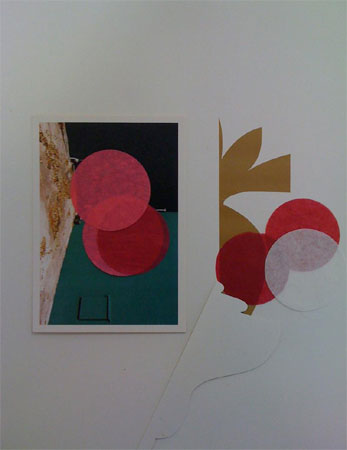
SAMUEL RICHARDOT OCTOBER 29 - DECEMBER 10 2010 Opening reception Thursday October 29, 6-9 PM Balice Hertling is pleased to present new works by Samuel Richardot. The exhibition consists of one large-format painting, a series of smaller paintings, and-new for the artist-a collage. What is not at issue in these paintings is the search for a land between figuration and abstraction. Granted, the motifs in Richardot's works are derived from various common objects: scissors, clouds, and so on. Sometimes one spots tromp-l'oeil traces, sly mocking ghosts of the object-that-was; at other times, the process of transformation tosses up new phantoms, a slideshow of flickering symbols, which, like the rabbit in the moon, or clowns in da Vinci's wall of smoke, may or may not really be there at all. The artist is interested in disguises of all kinds. More crucially, though, is the question of temporality. Or rather: disguise is a form of delay; it is a way of slowing down the viewer's perception, thus offering a much slower, more saturated experience of time, nearer to eternity and intuitive mystical comprehension. Richardot uses a very diluted, rather liquid paint, which does not only sit on the canvas but also soaks into it; the painted surface becomes (or rather the artist reminds us that it has been from the start) a living thing, changing slowly-like all living things-before one's eyes. It is by way of this slow-time, which verifies and refutes the first world of fake symbols, and which is of course open to and determined by chance, that these paintings offer themselves not merely as images but more exactly as painting. Text: David Lewis Balice Hertling est heureux de vous pr�senter les nouvelles oeuvres de Samuel Richardot. Cette exposition est compos�e d'une toile grand format, d'une s�rie de toiles plus petites, et, nouveau chez l'artiste, d'un collage. Ce dont il n'est certainement pas question au sein de ces toiles, c'est la recherche d'un paysage entre figuration et abstraction. Admettons que les motifs dans l'oeuvre de Richardot soient d�riv�s de diff�rents objets communs : des ciseaux, des nuages etc. On peut parfois alors remarquer des zones qui trompent l'�il, invitant les ombres narquoises de ces m�me objets, interpr�t�s ; parfois encore, le processus de transformation projette de nouvelles ombres, donnant naissance � un ensemble de symboles vacillants qui, comme la forme du lapin sur la lune d'apr�s la l�gende chinoise ou les nuages chez L�onard De Vinci avec sa technique du sfumato, seraient l�, devant nos yeux ou non. L'artiste s'int�resse aux d�guisements en tout genre. Le point focal de la r�flexion �tant la question de temporalit�. Ou plut�t, le d�guisement comme une sorte de retardement de la perception du temps par le spectateur, offrant ainsi une exp�rience plus lente et dense du temps. Celui-ci s'apparentant alors � l'exp�rience d'�ternit�, et sa compr�hension mystique et intuitive. Richardot utilise une peinture liquide, tr�s dilu�e, qui non seulement prend place dans la toile mais se glisse entre ses fibres. La surface peinte devient alors un objet vivant, organique (ou plut�t l'artiste nous rappelle qu'il en a �t� ainsi d�s le d�but), et la peinture au contact de la toile serait comme un �tre vivant, se mouvant devant nos yeux. C'est au travers de ce processus du temps ralenti, qui v�rifie et r�fute le monde originel de ces faux symboles, et qui est en outre d�termin� par le hasard, que ces toiles se pr�sentent � nous, peut-�tre plus en tant que peinture, au sens mati�re peinte, qu'en tant qu'images. Texte: David Lewis (traduit de l'anglais) |
||||
re-title.com
International contemporary art
SIGN UP FOR NEWSLETTERS

 SIGN UP for ARTIST MEMBERSHIP
SIGN UP for GALLERY MEMBERSHIP
SIGN UP for ARTIST MEMBERSHIP
SIGN UP for GALLERY MEMBERSHIP
Click on the map to search the directory