|
Terri Saul Page 1 | 2 | Biography |
||||
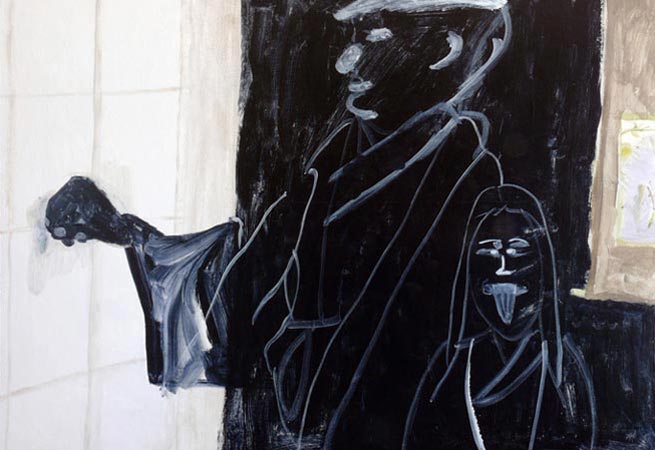
Hakone Visitors Variation 2 2009
|
||||
|
Most of my productions are efforts to reconcile tangible experience and nostalgia. Being a person of mixed-race decent, juxtapositions and hybridization have grown increasingly important. |
||||
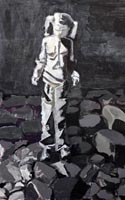
Northwest Stone Stepper 2009
Despite considering myself to be a narrative and figurative artist, none of my questions are as important as how a brush stroke has its own energy-strutting and certain, or meandering and curious; making arguments and counter arguments; landing sharply with a shortened approach on a crowded runway; or circling for hours, burning off fuel. I believe, in the end, formal concerns supersede content to create a world of meaningfulness. Katie Kurtz of the San Francisco Bay Guardian described my work as gestural, with a kind of Donnie Darko twist. |
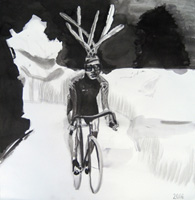
The bicycling series touches on familial influences, in particular the art of my grandfather, Chief Terry Saul, a Choctaw painter, illustrator, and peyotist, albeit in a free-form and unregimented fashion. For me these pieces are about two impossible childhood fantasies, both dreams of a kind of "manhood" that didn't yet seem off limits: being a fancy dancer on the Pow Wow circuit, and racing in the Tour de France. On a broader level, the series attempts to challenge conceptions of normality by juxtaposing two alien traditions that come together and even fuse at unexpected points of contact: the colorful regalia of the dancers, stoicism and feats of athleticism leading to transcendence, ritual movement within the context of the natural landscape, the individual's realization of a "dream" that becomes truth by way of communal performance. The characters' riding gear and dress don't belong to any one tradition or tribe in particular, or to one time period or sport (some references are to early Tour de France equipment). Fantasies are not altered by growing pains, distractions, accidents, gender roles, or historical truth, but rather follow a shaman's spirit. Hopefully and not least, these pieces also capture an aspect of tribal culture that is too often ignored in westernized conceptions of the "Indian": our rich and even phantasmagorical senses of humor.
Holds Loosely the Thunder Tired Award 2006 |
|||
|
||||
re-title.com
International contemporary art
SIGN UP FOR NEWSLETTERS

 SIGN UP for ARTIST MEMBERSHIP
SIGN UP for GALLERY MEMBERSHIP
SIGN UP for ARTIST MEMBERSHIP
SIGN UP for GALLERY MEMBERSHIP
Click on the map to search the directory