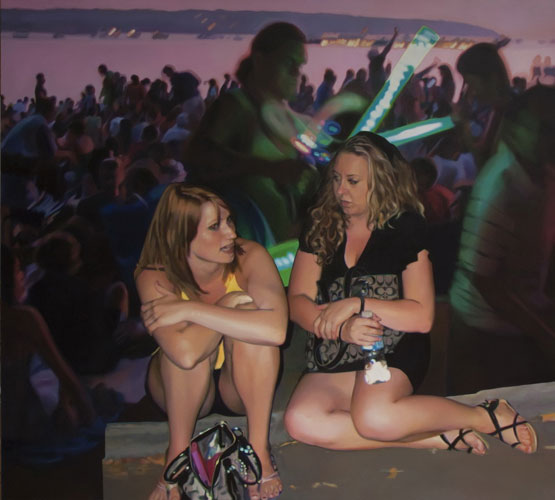
Kate Waters, Little Miss Spentyouth - Oblivia and Promiscuity Downtown Oil on canvas / 2010 / 200 x 220 cm Image � Kate Waters, courtesy Galerie Voss, D�sseldorf
Most intriguing are her works which show people in museums, like her painting of Asian visitors in the Louvre in Paris, with "The Death of Sardanapalus" by Delacroix in the background. Not only that the museum has had its rebirth as a subject in contemporary art, it is, as the general subject "people plus art", a traditional motif. Only few masterpieces, however, have been produced which embrace this subject. One of them, albeit slightly different by subject, is Watteau's "Gersaint" store sign (SMPK Berlin), the most recent one by Kate Waters. Kate Waters has turned Watteau inside out: In Watteau's painting the people in the picture turn themselves to the new art offered by the dealer Gersaint (while the old stuff is being packed away) and turn their back to the viewer. Kate Waters' museum visitors turn their back to Delacroix and face the viewer, however without looking at him. But still they look at art, being in the Louvre. The colour scheme is breathtaking: The warm colours are all in the Delacroix in the background, the visitors are in cool blue hues. Oh yes, we see, art is concerned with life, and that on all levels. Could it be that this is a comment on museum visitors? It could. Could it be that it is a comment on the greatness of art and the inherent lifelessness of modern absolute tourism? It could. We do not need answers. In our time, we are happy if we come to intelligent questions. In her 200x220 cm large, monumental painting "Babes in the Wood" we look at a contemporary garden party. Does Ruth Rendell's novel play a part, or the subject of innocence and guilt? Are we modern people "Babes in the Wood" or not innocent at all? What does it really mean when we inhabitants of large cities try to regain a little of living in nature, of course with all modern amenities, represented by the innocently white plastic garden chair? And the heavily tattooed man in the foreground? Is this a "cross-culture"-subject, or the by-passing glimpse of such phenomena? Phenomena like displacing exotic customs like tattooing - which are deeply rooted in cultural and social traditions in their places of origin - into contexts where they do not have that context but stand out like modish quirks, although they already represent a document of the history of social changes? Tattooing was "imported" by sailors (low on the social scale), was taken up by nobility (especially in France), sank back into the realm of low-class people and petty criminals and whores, only to re-emerge as an element of "beauty"-enhancement with the middle classes and pop stars? You might well ask. It is one of the intriguing qualities of Kate Waters' work that it raises questions instead of coming up with answers. But her work as such gives an answer to the questions "Why paint?" and "Why paint in such a way?". If we look at Kate Waters' nightly street scenes, often in rainy weather, with all these wonderful reflections of light (like "Via Bergamo, 60x70 cms, 2002, or "The West End", 180x160 cms, 2002, or her monumental "The Underworld", 170x240 cms, 2003) we can only come to one conclusion: The everyday experiences activated in our memory lead to the always new experience of painting. But there is still more than that. Her scenes of everyday life, at the bowling alley, in a Spanish restaurant, in a street caf�, they all show us that this world is a stream of images. Arresting this stream if but for a moment, we gain insight into life, just as we did when we read the "stream of consciousness"-type of literature like "Ulysses" or "Finnegans Wale" by James Joyce. But again, Kate Waters has turned such experiences inside out: In "Ulysses" we look into the brain of Mr. Leopold Bloom, and we can, more or less, relate to him. In Kate Waters's images we see what is inside ourselves. And we should relate to that, so help us, well, whoever. Kate Waters, surely.
Turning Insides Out Further Notes on the Work of Kate Waters By Gerhard Charles Rump